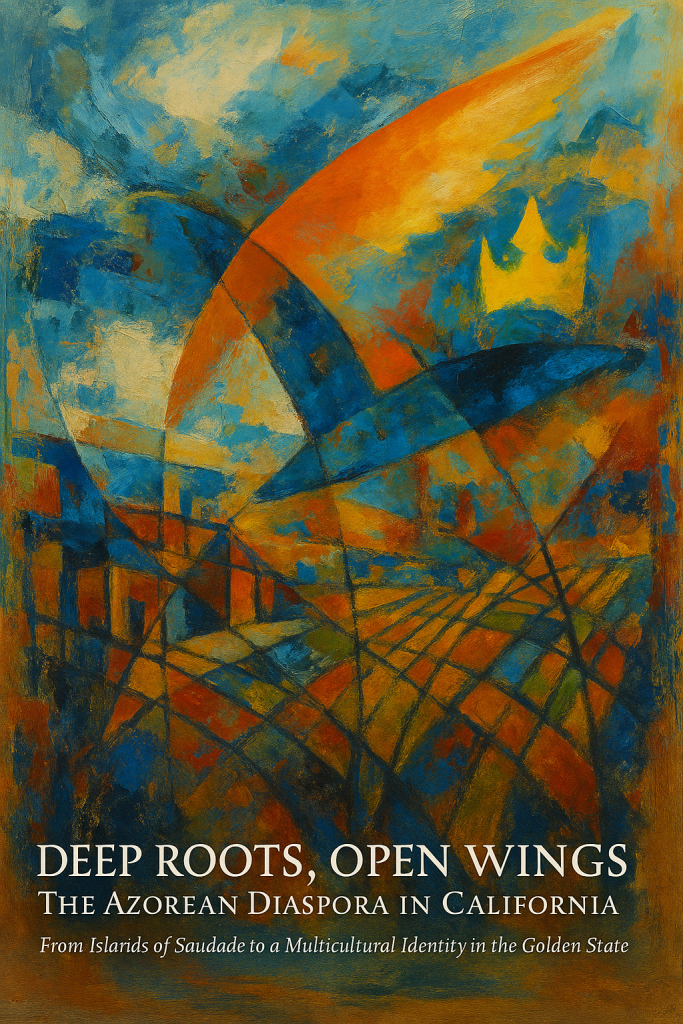
From Islands of Saudade to a Multicultural Identity in the Golden State

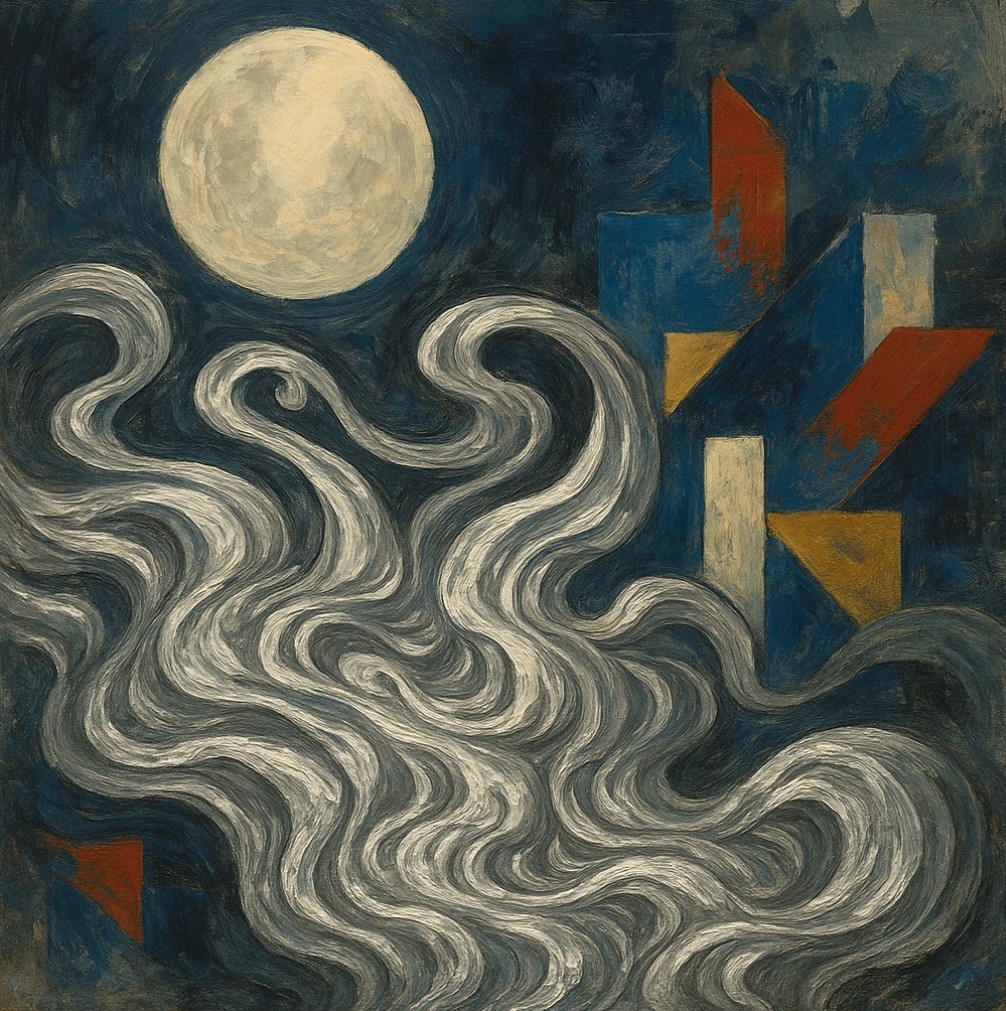
Moon Boiling in Silver by Diniz Borges
Literary Translation and Azorean Identity in North America
“Without translation, we would be living in provinces that border on silence.”
— George Steiner
The sea has always been our first translator. Long before ink, it carried voices between islands, echoing them in the shells of distant shores. Each wave was a syllable, each tide a sentence, turning basalt cliffs into libraries and horizons into bridges. To be Azorean is to live with this grammar of water, to belong to a language that was never content to remain only at home. Translation, then, is not foreign to us—it is our oldest inheritance.
The impossible art—that is how an essay in Columbia University Magazine once named the practice of literary translation. It is an art that dares the impossible: to carry the breath of one language into the lungs of another, to give words new wings without clipping their flight. Recently, The New York Times Book Review devoted an entire issue to this ancient alchemy, dwelling on its paradoxes—how it both betrays and redeems, distorts and yet clarifies.
For Azorean literature—among the most vital tributaries of the Portuguese tongue—translation is not simply a bridge. It is a lifeline. In English, the words of our poets and storytellers can enter the homes of the nearly one million emigrants and descendants in North America. They can be read at kitchen tables where grandparents’ voices once told tales, where the smell of sopas do Espírito Santo still lingers, where family names bear the trace of volcanic soil. Translation allows the islands to breathe in other latitudes. It is, in the phrase of Vitorino Nemésio, a way of carrying açorianidade—that delicate consciousness of belonging to nine scattered islands—across the ocean’s distances.
Nemésio once wrote: “Ser açoriano é uma maneira de estar no mundo, uma consciência da distância e do mar, um diálogo constante entre a saudade e a esperança.” (To be Azorean is a way of being in the world, an awareness of distance and the sea, a constant dialogue between longing and hope.) Translation ensures that this dialogue is not lost to silence, but heard anew in English, resonating for the children and grandchildren who may no longer speak Portuguese, yet still feel the tides in their veins.
It is not merely important—it is urgent—that Azorean literature reach the tables of the next generation. Alongside music, painting, and performance, literature in translation is the keystone that ensures Azorean creativity is not confined to memory or nostalgia, but becomes part of a living identity.
Although half of North Americans read no book in a given year, the generation now between thirty and forty-five is reading more than previous generations. They are building families, crafting identities, seeking stories that weave tradition and transformation. This is the audience Azorean literature must embrace—descendants who no longer speak the ancestral tongue, yet whose imaginations are still open to it in English. We must abandon the illusion that great-grandchildren will suddenly acquire fluency in Portuguese. To cling to this fantasy is to lose time and readers. Translation is our vessel. As Sabina Musthafa affirms in her luminous essay, Translation: A Bridge to Cultural Hybridity in a Globalized Literary World: “Just as globalization has familiarized us with products from around the world, translation has brought various cultures into our reading room.” In those rooms, Azorean literature deserves a place—not only for the descendants of the archipelago, but also for their neighbors and friends who make up the mosaic of multicultural North America.
The Azorean presence must go beyond folklore frozen in amber. Festa queens and sopas matter, but they are not enough. What we need is to seed our literature in schools, universities, and libraries—spaces where identity is cultivated and memory reshaped. Courses in world literature already thrive on translation. Why should they not include Nemésio’s Mau Tempo no Canal, Natália Correia’s fierce poetry, or Emanuel Félix’s modernist explorations of exile and belonging, among others? Natália Correia, with her luminous humanism, once declared: “A liberdade é a pátria da alma.” (Freedom is the homeland of the soul.) For the diaspora, literary translation is precisely that homeland—a place where they may enter the freedom of their ancestors’ imagination without the barrier of language. Translation transforms nostalgia into continuity, turning the memory of grandparents into a living cultural inheritance.
Our tradition is immense. From Nemésio’s meditations on insularity to the surrealist vigor of Roberto de Mesquita, from the social critiques of Dias de Melo to the contemporary lyricism of younger poets, Azorean literature is a constellation too bright to remain hidden. We must not fear to take it higher, especially when the Azorean diaspora in North America numbers four times the population of the islands themselves.
Onésimo Almeida once performed a quiet miracle when he founded Gávea-Brown at Brown University in the early 1980s, introducing Azorean voices into the American academy. Later came Frank Sousa with Tagus Press, Portuguese Heritage Publications of California, and others. Each initiative stretched meager resources to amplify voices from the mid-Atlantic. Their courage must inspire us to do more. We certainly are trying at Bruma Publications.
Yet, as translator Samantha Schnee has lamented, funding for translation remains limited, and Portugal, as we know, invests little in cultural export. The Azores, despite limited means, could chart a new course through partnerships that prioritize translation. Tourism may draw visitors for a summer, but literature sustains a sense of belonging for a lifetime. To place our books in diaspora libraries, to gift them to public leaders, to present them at American and Canadian book fairs—this is how identity endures.
Nemésio captured this very paradox of exile and belonging when he observed that the Azorean lives in “um perpétuo trânsito, entre a ilha e o mundo” (a perpetual transit, between the island and the world). Translation is the vessel for that transit today, carrying our stories from Pico’s lava fields to the plains of California, from the fajãs of São Jorge to the streets of Toronto and New Bedford.
The diaspora is not merely a Mercado da Saudade—a “market of longing.” It is a living organism—multicultural, multigenerational, thirsty for meaning. We cannot allow another generation to drift without discovering its literary heritage. Cultural investment is not a luxury but the foundation of identity itself. Ezra Pound once said: “A great age of literature is always a great age of translations.” For the Azores, the age of translation is now. To translate is to keep the islands alive in distant hearts. To publish in English is to let the diaspora see the moon boiling in silver over Atlantic waters—even when they stand in the dust of California’s valleys or the snow of Canadian winters.
Natália Correia reminds us: “A poesia é a mais alta forma de solidariedade humana.” (Poetry is the highest form of human solidarity.) Through literary translation, Azorean poetry and prose can continue to perform this solidarity—across oceans, across languages, across generations.
And so let us listen: to the moon boiling in silver over Atlantic waters, to words reborn on unfamiliar tongues, to stories that refuse to vanish. Literature is the vessel, translation the sail. With them, the Azores will not remain an isolated horizon, but a constellation that shines in many skies—still insular, still Atlantic, yet now, universal and eternal.
Diniz Borges
A bit about this new segment here in Filamentos
The Azorean presence in California is written in tides and valleys, in salt carried across oceans and dust lifted from orchards and dairies. It is a story of crowns lifted to the Holy Spirit and hands bent to the soil, of sopas shared in parish halls and poems whispered in new tongues. Yet these writings are not only chronicles of what has been, or what is unfolding still; they are also questions placed before us. What do we wish to carry forward, and what must we renew? How can saudade become more than longing—how can it become participation, creation, and belonging in the great mosaic of California’s cultures? As the old island saying reminds us, “Deus dá o frio conforme a roupa”—God gives the cold according to the clothing—our community has always found the strength to endure and adapt. Here, memory is not a monument but a living river: one that asks us to reflect, to critique, and to imagine how this diaspora might continue to take root and open its wings for generations to come.
Our vision and mission:
Vision
To illuminate the Azorean journey in California as both history and horizon—honoring the courage of those who left, the resilience of those who stayed, and the creativity of their descendants—while cultivating a critical space for reflection so that the diaspora may continue to grow as a vital part of California’s multicultural identity.
Mission
- To document the history, traditions, and voices of the Azorean diaspora with honesty and depth.
- To apply a critical lens to our cultural practices, institutions, and expressions—celebrating their vitality while questioning where renewal is needed.
- To create a platform for dialogue that links past and future, islands and valleys, memory and reinvention.
- To encourage the Azorean-Californian community to see itself not only as a keeper of heritage, but as an active participant in shaping California’s multicultural present and future.
Remembering, Reflecting, and Reimagining the Azorean Presence in California.
You can check out Bruma Publications and our translations.
 Filamentos (artes e letras)