
ANTÓNIO M. S. AVELAR, VENCEDOR DO PRÉMIO VITORINO NEMÉSIO

Vitorino Nemésio Literary Award, for his novel “Irma.” What does this distinction mean to you, in a competition that had more than 400 entries?
My last text with literary intentions was written while I was a student at the then Liceu Nacional de Angra do Heroísmo, at the suggestion of Dr. Alice Borba, about fifty years ago. I therefore have no strong convictions about my literary competence. So, more than the distinction, what pleases me is the technical recognition by an authoritative jury. Then there is the patron (Nemésio), the excellence of the jury, the sponsorship of the Regional Assembly, and, of course, the number of candidates, all factors that contribute to my satisfaction. What is the story of this novel, which you will now have the opportunity to publish?
Without telling the story, which even in summary is intricate, I can say that it is a narrative about the birth of Angra as a city, centered on anonymous (fictional) characters who lived at that time and who were at the origin of the settlement of the entire territory between what are now São Mateus da Calheta and Santa Bárbara. This story, as it should, intersects with the primordial conflicts of land distribution (which humanity has yet to resolve) and with the representation of the Holy Spirit on earth (which we Azoreans have addressed in a particular way).
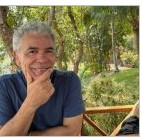
Although you have lived in Lisbon for many years, you are originally from Agualva, on the island of Terceira. What influences from the Azores can be found in this novel?
The Azores are not only the subject of all fiction, but also the author’s emotional link to writing.
You have dedicated your entire life to teaching at the Faculty of Letters of the University of Lisbon, where you graduated in Romance Philology and obtained a PhD in Applied Linguistics. How did you start writing fiction?
In a way that was as natural as it was unexpected: two friends of my generation, in Monte Brasil, “maliciously” told my son Adriano about episodes from my youth. He was indignant that I had “hidden things from my family.” I tried to sidestep the issue, but as I am not good at talking about myself (even to an adult child, you can’t tell everything…), I promised him I would write… one day. When I started, I was once again awkward about talking about myself, and the result was the nearly 400 pages of Irma.
Could this award be an incentive to devote more time to writing? Do you have other works ready for publication?
Yes, I kept my promise to my son… without, once again, talking about myself, but it resulted in a novel set in my student days in Angra, which I want to dedicate to my colleagues and my generation. There is another work, almost finished, about emigration; a novel set between Brazil and Peru, involving Azorean emigrants from the island of Flores and a colony, also emigrants, from Tyrol, Austria. So as not to lose the momentum gained with “Irma,” I am writing short stories at random, already numbering six, which constitute a reasonable volume for publication. But first, I need to know if people like my “Irma.”
In your opinion, how important is this literary prize launched by the Legislative Assembly of the Autonomous Region of the Azores, in honor of Vitorino Nemésio?
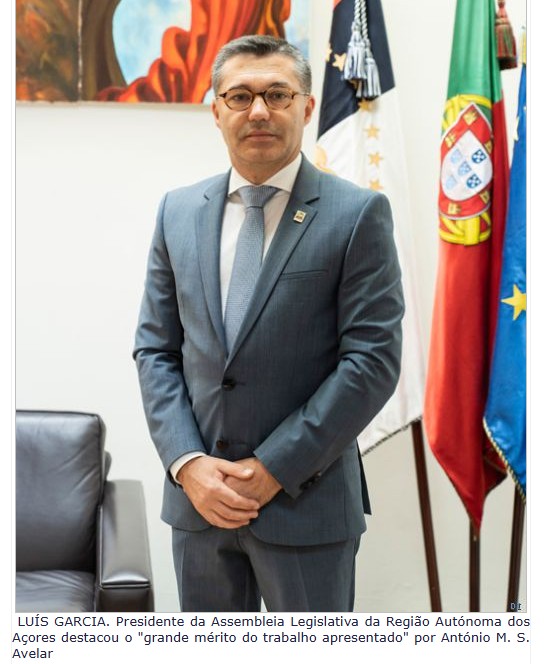
Very important, as I gather from the previous answers. Nemésio is an internationally recognized author, which explains the high number of competitors. The launch of the literary prize by ALRAA can only enhance the institution’s reputation.
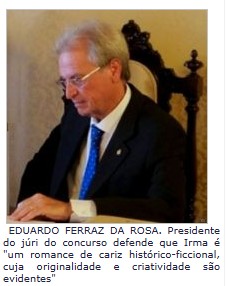
“Irma”
“It is a narrative about the birth of Angra as a city, centered on anonymous (fictional) characters who lived at that time and were at the origin of the settlement of the entire territory between what are now São Mateus da Calheta and Santa Bárbara. This story, as it should be, intersects with the primordial conflicts of land distribution (which humanity has not yet managed to resolve) and with the representation of the Holy Spirit on earth (which we Azoreans have resolved in a particular way).”
in Diário Insular-José Lourenço, director
We thank the Luso-American Education Foundation for its support of PBBI at Fresno State.
 Filamentos (artes e letras)