
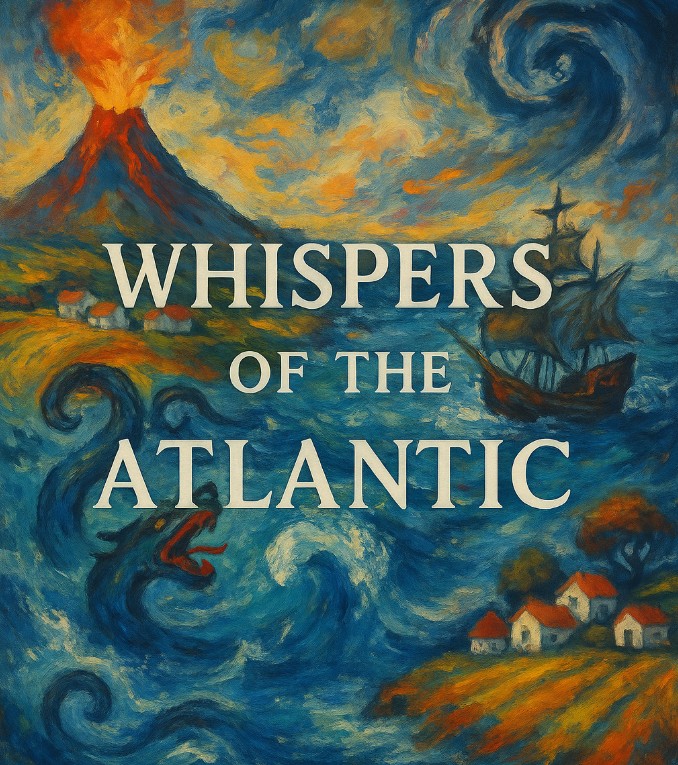
Where islands dream, and stories cross oceans.
From the volcanic heart of the Atlantic rise tales that have traveled through centuries—stories whispered around hearths, sung in work songs, carried in the wind across nine islands. Whispers of the Atlantic: Legends from the Azores gathers these timeless narratives and brings them into English, offering readers a journey through the enchanted archipelago where myth and memory intertwine. Giants, saints, sailors, and dreamers live side by side with the sea, the volcano, and the hydrangea. These are not only legends of the past; they are living echoes of a people who have always dwelled between fire and water, exile and belonging, homeland and diaspora.
A legend from the smallest island, Corvo
It was the 16th century, and the island of Corvo, although almost surrounded by high cliffs like a castle, was isolated and sparsely populated, leaving it completely at the mercy of pirates who frequently crossed the seas of the Azores at that time. The village and the chapel stood on a rocky outcrop by the sea, close to a pebble beach called Porto da Casa, one of the most accessible locations for pirates.
Once, while the men tended the sheep and the land, and the women spun and did the housework, a large group of pirates approached the port. The people of Corvo, taken by surprise, thought their end was near, as they were few and had no weapons to defend themselves. Many shots began to ring out from the sea, and the pirates threatened to invade the island, steal, and destroy everything if the Corvinos did not respond with force.
Seeing themselves powerless, while they fought from the top of the rock against the Moors, throwing as many stones as they could, they called on Our Lady of the Rosary for help. The vicar had carried to the place of battle a small image that he had found years ago on the shore, among the rocks of Porto da Casa, and which had an altar in the little chapel there on Alto da Rocha. The fight was fierce, but the people of Corvo routed the pirates, defeated them, took many of their weapons, and suffered no harm to the island’s people, even managing to capture a Moor. This victory was due to Our Lady of the Rosary, patron saint of the people of Corvo, who, fighting at their side, deflected all the shots fired by the pirates and returned them, multiplied, to the Moors’ boats, managing to scatter them. The pirates fled in fear and for a long time did not return to attack the smallest island in the Azores, saying among themselves:
Let’s not go to Corvo, there’s a “Margarida” there who deflects bullets. We fire one shot, and she sends seven back on board, killing seven at once!
That “Margarida” was Our Lady of the Rosary, who, for having performed this and many other miracles, came to be called Our Lady of Miracles and became the most beloved saint of all the Corvinos. Today, the small image is no longer in the little chapel on the rock, but in a beautiful church, situated in a low-lying area, in the center of the small houses on a narrow street in the small village of Corvo.
Vision Statement
To preserve, translate, and reimagine the legendary heritage of the Azores as a cultural bridge across oceans—connecting generations, honoring the voices of the ancestors, and ensuring that these stories remain vibrant for the future of the diaspora and the world.
Mission Statement
Through the Whispers of the Atlantic series, Bruma Publications and Filamentos are committed to:
- Collecting and translating Azorean folktales, myths, and legends with literary fidelity and poetic resonance.
- Sharing these stories with English-speaking readers in North America and beyond fosters cultural pride and cross-cultural dialogue.
- Preserving centuries-old oral traditions as living cultural treasures, not museum relics.
- Inspiring new generations of writers, artists, and dreamers to draw from Azorean heritage in building bridges across languages, cultures, and oceans.
 Filamentos (artes e letras)