
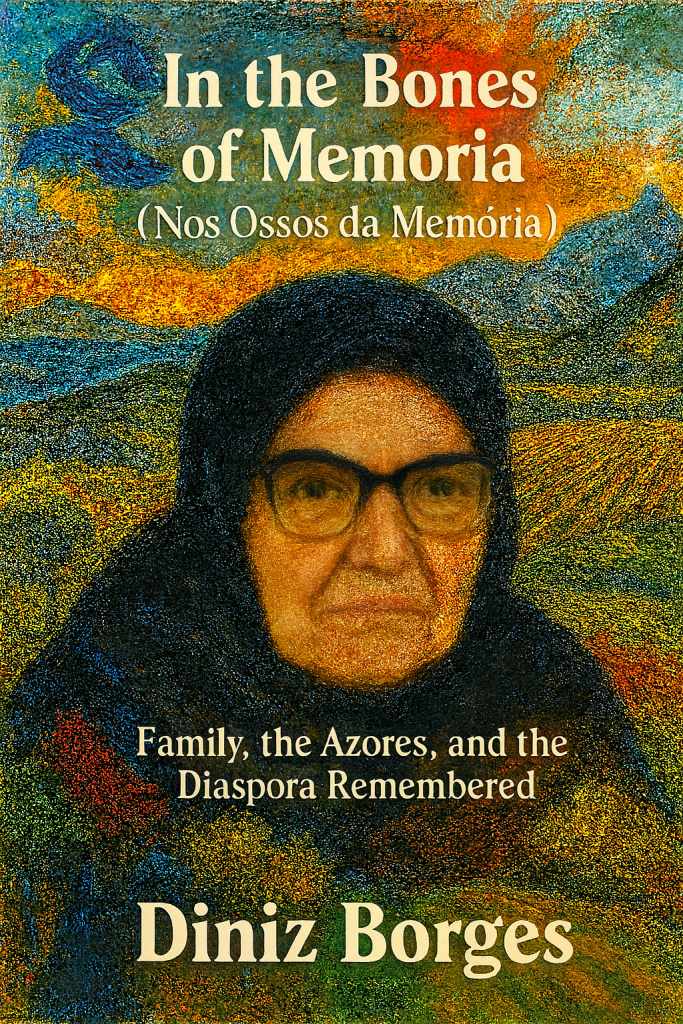
In the bones of memory, the ocean still murmurs. Its voice is not one of distance but of nearness — a rhythm within the blood, a tide that ebbs and flows even when one is far from the shore. I hear it when silence falls over California’s Central Valley, when dusk settles across fields of alfalfa and corn, of orchards and almond groves, and the air carries the faint scent of milk and dust. In those quiet hours, the ocean returns, whispering the language of basalt cliffs and hydrangea hedges, of black stone streets slick with rain, of a people who have always lived between fire and water.
I was ten years old when I crossed the ocean with my parents, leaving behind the green ridges of Terceira for the vast horizons of California. Yet in many ways, the journey had already been made before me. My maternal grandparents, Manuel and Angélica, had crossed the Atlantic decades earlier — still in their teens, alone, driven by necessity and the hope of a better future. They lived eighteen years in America, working, saving, and dreaming, before returning to the island they never stopped calling home. And then, nearly forty years after their return, my parents, my brother, and I made the same crossing once more, completing a cycle of departure and return that was deeply ingrained in our family’s marrow.
Not all my grandparents emigrated. Leonor and Antonico, my paternal grandparents, never left the island. Yet their wisdom was no less expansive than that of those who had traveled oceans. My avó Leonor, especially, remains one of my guiding lights — as universal as any traveler, though she never stepped beyond the Azorean horizon. Her understanding of life, her compassion, and her ability to see the world in its fullness were born not from departure, but from presence: the steadfastness of tending land, family, and faith. In her, I learned that universality is not measured by the distance traveled, but by the breadth of the spirit.
Between these two lineages — those who emigrated and those who stayed — lies the truth of the Azorean diaspora: that exile and rootedness are not opposites, but companions. From Manuel and Angélica, I inherited the courage of departure, the willingness to risk, and the dream of return. From Leonor and Antonico, I inherited the strength of staying, the faith in continuity, the certainty that wisdom can be as boundless as the sea, even when lived on an island. All four of them remain present in me, their voices and gestures part of the archive I carry in my bones.
The diaspora begins with such transmissions: in a grandfather’s hand rough from the land, in a grandmother’s eyes that remembered every neighbor, every chapel bell, every funeral procession that wound its way down narrow streets. They taught me that memory is not a museum, but a living thing —a pulse in the marrow, as essential as breath. To forget would be to unlearn who I was; to remember is to claim a place in a lineage larger than my own life.
I grew up among two landscapes that seemed, at first, impossibly distant: the volcanic ridges of Terceira and the endless flat fields of California’s Central Valley. Yet in me, as in so many Azorean-Americans, the two were not contradictions but convergences. The sea was the bridge. It taught me that exile is never absolute, and that return is more than a physical act — it is the reclaiming of what lives in your bones.
These writings are born of that awareness. It is a weaving of memory and imagination, of the Azores and America, of family and diaspora. It is not only my story but a fragment of the larger story of a people who crossed oceans in search of survival, dignity, and a future. It is, above all, a testimony to the way memory endures, not in monuments or grand declarations, but in the quiet blessings of grandparents, in the work of hands, in the poetry of saudade.
I write because the ocean insists on being remembered. I write because in the marrow of my bones lives an island, and around it, the tides of generations who came before me. This is my return — not to a single shore, but to the constellation of shores that form the Azorean-American soul.
And so, I invite you to walk with me through these passages. To hear the murmurs of the sea that carried our people across the world. To feel the pulse of memory that refuses to die. To honor the grandparents whose wisdom shapes us still. And to discover, perhaps in your own bones, that exile and return are not opposites but companions, forever entwined in the rhythm of the waves.
For memory is not only what anchors us to the past, it is also the compass that points us toward tomorrow. The memory of the individual nourishes the memory of the family; the memory of the family nourishes the memory of the community; and the collective memory of a people nourishes the soul of a nation. Without these threads, we are adrift. With them, we weave belonging, we sustain dignity, we carry forward the fire that others lit before us.
Some of my favorite writers said it best. Pablo Neruda once wrote: “If nothing saves us from death, at least love should save us from life.” And what is memory, if not a form of love — the most enduring act of fidelity to those who came before, and the most luminous gift we offer to those who will come after. Fernando Pessoa reminds us: “Tudo vale a pena se a alma não é pequena” (“Everything is worthwhile if the soul is not small”). Memory enlarges the soul, binding exile and belonging, past and tomorrow, into a single horizon of hope. Walt Whitman once declared: “I am large, I contain multitudes.” Memory, too, contains multitudes — not only of the self but of the family, the community, the nation. It is through memory that we learn to embrace the vastness of our inheritance and to live forward with generosity. And Sophia de Mello Breyner Andresen once wrote: “A memória é uma casa de onde nunca saímos” (“Memory is a house we never leave”). Within that house lives the song of our ancestors, the courage of our journeys, and the promise of all that is yet to come.
For memory is not a solitary voice, but a polyphony — a chorus of the living and the dead, of past and future, of island and continent. It is the echo that turns silence into song, the thread that binds absence into presence. In its harmonies, we find not only the story of who we were, but the meaning of who we are, and the promise of who we might yet become. Memory is the music of existence itself, the rhythm that gives life its depth and its dignity.
Diniz Borges
 Filamentos (artes e letras)