
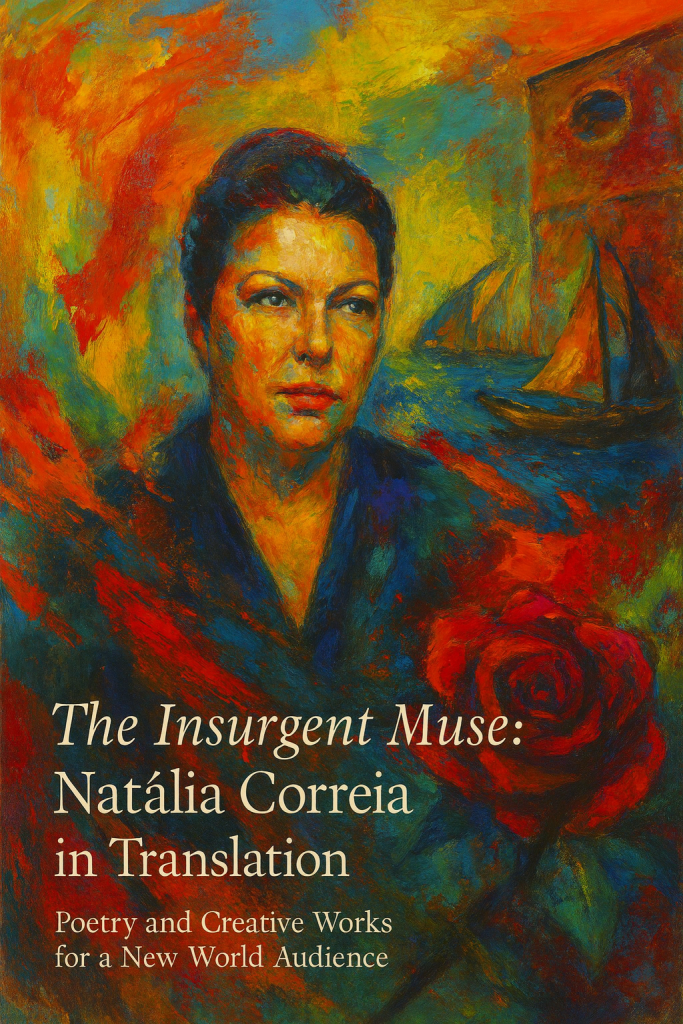
Natália Correia (1968). “The poet and the world”, “Adynata”.
When we look at irony in the emotional field of poetic language, at the load of destruction it bears, we recognize a basic affective impulse. Irony appears to us as a weapon that the will of love uses to disarm the obstacle that frustrates its realization. Love employs a strategy to demonstrate the inferiority of the object it attacks by highlighting its laughable qualities. This is in line with the irony in the poetry most passionately committed to transforming the world, which has love as its discipline because it is an act of faith in man’s perfectionist powers. Such is the case with Surrealism, in which irony appears subjectively conditioned by the faith in removing the causes of boredom and hopelessness. The surrealist revolution thus focuses on a general change in relationships using the inversion technique. In an inverse combination, the parts exchange positions to show the other whole hidden in the concealed whole, as revealed by logic.
For surrealist themes, things, as reason places them in the world, absurdly describe reality. It is, therefore, vital to denounce them as abusive aspects of a reality that is unveiled when everything in man that is not afraid of madness – imagination, dreams, fantasy, and love – recognizes in the exercise of its freedom the signs of the actual being of this distorted reality. Here, surrealist irony intervenes to unmask the false appearances of reality, reducing them to their absurdity, which is maintained by the truths revealed in automatism, dreams, or the imagination invested with full powers. What was lawful becomes unlawful, or, as Mário Cesarinny says, “or let me tell you / that I see everything the opposite / of what was lawful to see.” Inversion restores reality.
This poetic strategy of irony, whose formal principle is the process of inversion, is nothing new in the history of the spirit. Despite Surrealism’s anti-rhetorical criteria, the enumeration of impossibilities has a long history in rhetoric, dating back to the Virgilian adunata that persist in Western literature. However, the situation of this topic in Surrealism does not derive directly from the rhetorical tradition but from the human content it gives to culture. The fact is that the avatars of the ancient adynaton always appear framed within a characteristic historical-literary circumstance. That is, in an agitated era when the crisis of consciences takes on expression in the polemics between the moderns and the ancients. Following the path indicated to us by E.R. Curtius (Literatura Europea y Edad Media Latina), there is a connection between the critical inversion of the world’s facts and a spirit of modernity that wants to subvert the order of facts. This is the case of the poets of the time of ???, who, through the mouths of Horace and Ovid, emphasize the value of novelty and the modern??? From the 12th century, a period that mainly makes use of the enumeration of impossibilities of the present time that testify to the decadence of institutions, whether we turn to Latin literature or look at poetry in the vulgar language that transmits the topic of the world upside down to Galician-Portuguese medieval satire. The seventeenth-century exasperation of Baroque, whose new sentence structure reflects a restructuring orientation of the world, also adopted the adynaton to highlight the chiaroscuro of being tormented by the spiritual disproportion of present time when confronted with inner time. From this rich arsenal of imagery, we see poems that are strikingly part of surrealist irony emerge.
In the topic of O mundo às avessas (the world upside down), in the core of its ironic pulp, we must discern the pained proclamation of the error of the things of the world, a protest authorized by the love of the world. And this manifests itself on two levels: the social and the human. In the first case, the enumeration of impossibilities is colored by a critical realism rooted in the coherence of the social cosmos broken by the error of structures. With this character, the technique of inversion is applied in the Carmina Burana and in Galician-Portuguese satire. In the second case, the adynata becomes the individual expression of humanity outraged by the failure of love. The unhappy outcome of passion is an effect of the imbalance in the world, whose natural order is upset by the anomaly of failed love. Since Virgil, poetry has explored the consequences of this animosity for the deceptive appearances of a world that cannot be true as long as it does not authenticate the truth of love. Only amorous passion is the bearer of the world, which changes when it is not respected. This more subjective and creative application of the adynaton that appears in modern amatory poetry, whose foundations were worked on by the surrealist removal, acquires a conscious formal expression in a poem by David Mourão-Ferreira, which (see the title itself: Adynata) is among us, the most decisive testimony as to making transparent the causes of the enumeration of impossibilities in today’s lyricism.
Adynata is a panting staircase of the rhythms of things hammered out by the loneliness of a lover deprived of the light of the loved one, whose absence obscures the world, laying bare the meaninglessness of things which, dislocated from the law of love that reconciles them, are abandoned to the violent madness of their non-purpose. Through the steps of the unpredictable effects of the warring causes (the irons of torture instead of these balconies or the razors of the wind serving as pavilions), the poet leads us to the evidence of the impossibility of peace being made between the parts as long as a flaw (the still temporary failure of the lovers) affects the coherence of the whole that is maintained by love. In this way, an erotic pantheism is revealed in the background of this poetry, which works toward social peace.
Translated by Diniz Borges
Natália Correia (1968). «O poeta e o mundo», «Adynata». Diário de Notícias, 19 de Dezembro, pp. 17-18.
The series envisions Natália Correia as a world writer, a voice whose work transcends geography and language. Through translation, it will establish her as a central figure not only of Portuguese literature but of universal literature, accessible to readers of all backgrounds. Rooted in the Cátedra Natália Correia at the Portuguese Beyond Borders Institute, California State University, Fresno, this project is guided by the belief that literature is both cultural memory and social capital — a bridge between Portugal, the diaspora, and the global community of readers.
- Translate and publish Natália Correia’s poetry, prose, and creative writings systematically into English, creating the first sustained body of her work in translation.
- Connect diaspora communities in North America to one of their greatest literary and feminist figures, strengthening cultural pride and identity.
- Introduce American and Canadian readers to a bold, universal author whose themes — freedom, feminism, justice, creativity, and human dignity — speak urgently to our own age.
- Preserve, amplify, and institutionalize Natália’s legacy as poet, essayist, novelist, and cultural icon through the Cátedra Natália Correia at the Portuguese Beyond Borders Institute, Fresno State, ensuring that her work reaches both academic and community audiences.
- Foster dialogue between Portugal and its diaspora by using literature as a shared space of memory, imagination, and critical thought.
Natália Correia (1923–1993) was one of Portugal’s most incandescent voices — poet, novelist, playwright, essayist, and fearless advocate for freedom and women’s rights. Her words shook dictatorships, inspired generations, and continue to burn with relevance today.
The Insurgent Muse: Natália Correia in Translation is the first sustained project to bring her creative universe into English. Conceived under the auspices of the Cátedra Natália Correia at the Portuguese Beyond Borders Institute (PBBI), California State University, Fresno, this series brings together her lyrical poetry, her essays of resistance, her daring erotic writings, and her visionary humanism.
This project is more than translation — it is cultural bridge-building. It offers the Portuguese diaspora in North America a luminous return to one of their greatest voices, while introducing American and Canadian readers to a writer whose work belongs among the greats of world literature. In her lines, we find not only the soul of Portugal but also the universal call of a writer who believed that poetry was a force for liberty, equality, and imagination.
This project is sponsored by the Luso-American Education Foundation.

 Filamentos (artes e letras)