

“MY FLORIPA and THE ARK OF MY YESTERDAY
Saturday, March 23, autumn, bright sunshine, blue skies, and sea illuminated the birthday girl, while I reflected on the delightful way our Floripa nestles and embraces us. It is truly the passion of the islanders and of all those who, like me, have chosen to live here. It is impossible not to resort to the verses of the late writer and great master Júlio de Queiroz to translate this delightful feeling of being at peace with life and loving “my” city, which welcomed me fifty-three years ago:
A reckless angel knocked down the blue that was meant for the sky,
also upon the sea of Florianópolis. In paradise, even silliness becomes beauty.
Florianópolis was born 350 years ago. It was emancipated from Laguna 297 years ago, being elevated to the category of Vila Nossa Senhora do Desterro, by an act instituted on March 23, 1726. In this stroll
through fond memories, I would like to briefly reflect on the name of the city that spreads across the entire island of Santa Catarina and a small part of the mainland. Florianópolis added to its spelling the youthfulness of “Floripa” (a term coined by columnist Cacau de Menezes in the 1970s) and the delicacy of the doguarapuvu flower. Floripa has become the hallmark of our city. Perhaps it is a reverent way of feeling the “name change” when the town ceased to be Desterro and became Florianópolis in 1894, in honor of Floriano Peixoto, the second president of the Republic.
An island city that, in the past, served as a safe haven for 16th-century expeditions that crossed the South Atlantic towards the Rio de la Plata or the Strait of Magellan, it welcomedwelcoming six thousand Azorean islanders in the 18th century, received more than two dozen foreign travelers who ventured through the waters of southern Brazil between the 18th and 19th centuries, leaving their impressions in irrefutable documentary records in pictorial art, colorful iconography, and admirable foreign literature. This remarkable encounter of peoples made Floripa an example of sociological and cultural diversity that identifies it and has the Azoreans’ contribution as its cultural reference. It is always worth noting that, from 1748 to 1756, Azoreans from the islands of São Jorge (24%), Graciosa (11.5%), Pico (9%), Terceira (4.5%), Faial (2.75%), and São Miguel (0.73%) settled on the island of Santa Catarina and along the Atlantic coast. Faial (2.75%), and São Miguel (0.73%). We are bearers of an “Azorean identity,” framed by a long cultural process of assimilation and transformation that has survived, in new forms, even after 275 years.
Floripa is the New World of our Azorean islanders from the distant 18th century and of their descendants today, who are moving forward into the 21st century with renewed hope, thinking about the future without mortgaging their social and cultural history. A contemporary Floripa based on pillars responsible for social, technological, and sustainable development, for the promotion of innovative projects in all fields of knowledge, and, in particular, for urban planning associated with environmental preservation, built historical heritage, the territory of a city built for people, where the quality of life of its residents is the essence of the city that fascinates all who visit us and those who have chosen it as their adopted home—the new migrants from other states of the federation and other countries and continents.
Past and present intertwine…
I open the chest of my yesterday to bring to light the fond memories of “my” Floripa, this charming girl celebrating 350 years. Since yesterday, voices and images have been arriving. Memories so vivid that I want to reach them, bring them close to my heart, retain just a little bit, and kill the longing. On Conselheiro Mafra Street, which still has some preserved houses, lived my godmother, Josefina Salém, in a two-story house next to Alexandre’s fabric store and Mrs. Salma Salum’s, and next door to Fiambreria Koe-rich. Further ahead was the Customs building; on the right, the Public Market. Arm in arm with my godmother, I went from door to door, chatting endlessly and laughing loudly. It was from her that I first heard the story of the golden flute player, Patápio Silva, who died in late April 1907 of pneumonia after a concert at the Clube Doze de Agosto. My godmother was a photographer and would make a fuss if the customer didn’t like the portrait. She would come to the foot of the stairs (with the steps covered in advertisements), with her hand on her waist and her finger pointed, saying that she couldn’t do any better, because she didn’t perform miracles. As the daughter of a photographer, I liked to accompany my godmother to the lab, “the dark room.” That was where the magic happened, in the richness of movement, in the incidence of light, seeing the revelation emerge on the white Ilford or Kodak paper, the image photographed in black and white and often bathed in a sepia tone. I am moved just by describing those unique moments that time cannot erase.
In the left corner of Conselheira Mafra, facing Fernando Machado Square, was the Hotel La Porta, with lace makers at the entrance offering their lace and sieves. Further down, the Miramar—a bar and restaurant, meeting place for the island’s society—completed the elegant ensemble in an eclectic style with neoclassical lines. In the middle of it all, the XV de Novembro square and the old fig tree, which contemplates me and I bow before its majesty. A few days ago, I decided to return to that quadrangle formed by Conselheiro Mafra, Trajano, Felipe Schmidt, and Deodoro streets, and I speculated on every nook and cranny, highs and lows, starting with the century-old Casa Kotzias, renowned for its fine fabrics, a reference in local commerce for 114 years. Further on, the trendy Chiquinho pastry shop (and its famous empadinhas) and the short-lived Cine Central movie theater. I even managed to catch a glimpse of some fragments of my yesterday, from the 1950s and 1960s.
I walked slowly and entered Trajano Street, revealed by Altino Flores. I loved finding characters similar to those described with irreverence and mischief by Chico Perereca, the chronicler of the Sertão do Rio Tavares, who published in the newspaper Época in the 1910s. I looked for Galeria das Sedas at number 9 on Trajano Street, with its shelves full of velvet, lace, linen, organza, tulle, muslin, brocade, and silk, and the friendly smiles of Dona Bentinha and Jorge Barbato. Real and meaningful stories that reveal memories of the past that are still present today.
In conclusion, I want to bring the past to the present, following in the footsteps of generations, voices from near and far that have immortalized the beauty of “my” Floripa in poetry, song, art, and warm, vibrant colors. The first is the declaration of love by the Swiss-German navigator Carl Friedrich Gustav Seidler, who, between 1823 and 1827, landed twenty-four times in Desterro, aboard the ship Caroline. In Zehn Jahre in Brasilien, published in 1836 in Germany, he enthusiastically expresses his passion for the island he calls beautiful:
“I had been particularly impressed by the cordiality and kindness of the inhabitants, the beauty and sociability of the ladies, the cheapness of the food, and the romantic nature of the excursions; so much so that today I wish the dawn would come a few hours earlier so that, the sooner the better, this fabulous paradise of the new world would open up to me. I could no longer sleep; impatient as a lover full of longing or a feverish patient, I waited on deck for daybreak. (ALESC, 1979, p. 299).
The second is an excerpt from the poem Florianópolis, eu te amo! (Florianópolis, I love you!), by Leatrice Moellmann, born on the island, with the temperament of German immigrants – “Traske, Moellmann, and Moritz” – and Azorean sailors – “Costa.” A voice of great sensitivity that sang of Florianópolis, the island of Santa Catarina, the south wind, the sea, the culture, island life, and stories from her life, such as the vacations spent at her grandfather Eduardo Moellmann’s farm in Esteves Júnior and swimming in the sea at Praia de Fora. Florianópolis was his passion and inspiration until his death in the fall of 2019, at the age of 94:
I’ll put in my car The fanfare of my love, I want to spread this joy Everywhere I go.
Atavistic love, ancient, Ancestral, trans-secular, Immense, so great that, when I leave, I want to return, when I am there, I want to stay. (…)
Florianópolis, I love you! Your beauty dazzles me, your aura intoxicates me. Days of sunshine or gloom, Happy times, sad times, I will sing of you forever. You are a part of me, or I am a part of you,
One day I will rest, welcomed into your embrace.
The third and final verse is from the beautiful song Florianópolis by the singer and composer Luiz Henrique Rosa, who passed away thirty-nine years ago. He is also part of “my” Floripa and my fond memories:
There in Florianópolis
Where does this singer come from? There is also so much joy
There is a lot of samba, yes sir Carnival, such beauty So much laughter, so much color My Saudade beach
Where my love lives. (…)
From my window, I gaze at the island and Floripa, its cosmic magic enveloping me in a game of eternal seduction. Floripa 350 years, the city that belongs to all of us is our greatest gift.
Floripa, March 23, 2023
(THE POEMS, SINCE THE TRANSLATION DOESN’T RHYME, THE TRANSLATOR KEPT THEM IN PROSE/POETRY.)
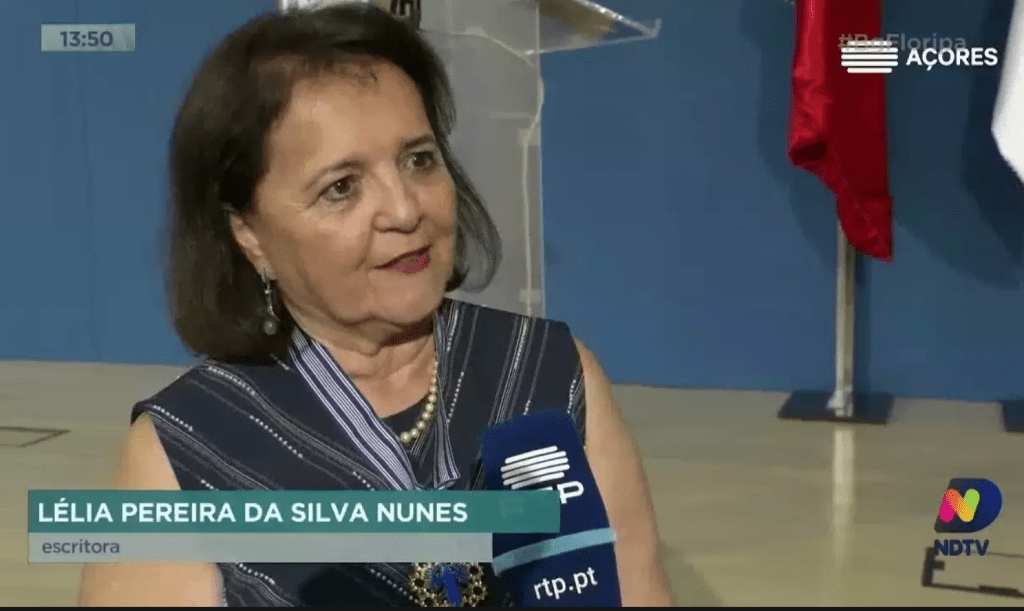
Filamentos is pleased to translate and publish a chapter from Lélia Pereira Nunes’ new book, Casa do Tempo, every few weeks. We are delighted to publish these translations as part of our vision/mission statement: to be a voice for the Global Azorean Diaspora. Brazil has, for many centuries, been an important aspect of the Azorean Diaspora. It is time that we all know each other, regardless of where we live. We thank Lélia Pereira Nunes for the opportunity to translate her important work.
 Filamentos (artes e letras)