
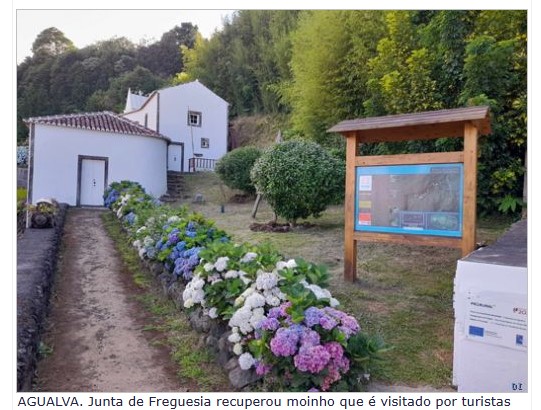
The “Memórias dos Moinhos da Ribeira da Agualva” (Memories of the Mills of Ribeira da Agualva) have been recorded in a book, the result of more than two years of work by the Terceira Island Historical Institute (IHIT), in partnership with the Agualva Parish Council.
The project, which was supported by the Regional Directorate for Culture and later by the Praia da Vitória Municipal Council, aimed to “establish an interpretive trail in Ribeira dos Moinhos da Agualva, based on research and existing documentation, available historiography, and with a particular focus on the oral and material memory of the milling industry, through interviews about life stories,” according to the book “Memórias dos Moinhos da Ribeira da Agualva” (Memories of the Mills of Ribeira da Agualva), which will be launched next Saturday at 8 pm at the Agualva Parish Council headquarters.
“The Terceira Island Historical Institute is aware of the importance of the eco-heritage niche that Agualva and its mills (in many cases in ruins) represented for the whole of Terceira Island, if it could counteract the trend towards the devaluation of local heritage, also aiming, restoring the self-esteem of local populations as far as possible, raising awareness of the importance of defending and valuing what ultimately identifies them, with their own distinct identity,” said the project coordinator and president of IHIT, José Olívio Rocha, in the conclusions of the work now published.
Located on the banks of a permanent freshwater stream with a large flow from several springs in the Pico Alto massif, Agualva was one of the most prosperous parishes on the island due to its role in cereal production.
From the 16th century until the first half of the 20th century, the parish of Agualva was one of the most prosperous rural areas on the island, not only due to the fertility of its land and the abundant production of cereals and fruits it provided, but also due to the existence of numerous watermills, which reached a number of 50 along the course of the river and with a natural extension into the territory of Vila Nova,” reveals José Olívio Rocha in the book.
For the president of the Agualva Parish Council, Hélio Rocha, this project is of great importance because it portrays the role of the parish in the island’s economy as an “industrial capital” until the mid-20th century.
“It is a revival of the memory of that whole economy. We still have some memories that can be brought to light thanks to historical testimonies. This project comes at the right time to keep this memory alive,” he told DI.
Today, the mills of Agualva no longer grind grain, but Hélio Rocha believes they can attract tourists to the parish.
The council has restored a mill, which, although it no longer grinds grain, is in working order and can be visited.
In the summer, it is the young people attending the OTLJ program who open the doors to tourists, and many are delighted to see the watermill in operation.
“We are in the summer with hundreds of people every day walking the Ribeira da Agualva trail, which starts at the mills. We have the mills open, and tourists love it,” said the mayor.
The mill, located next to Ribeira da Agualva, on Rua do Saco, was donated to the parish council after the floods of 2009.
The local authorities now intend to restore a second mill in ruins in the Frechas area, at the end of the trail.
In Diário Insular, José Lourenço-director
 Filamentos (artes e letras)