
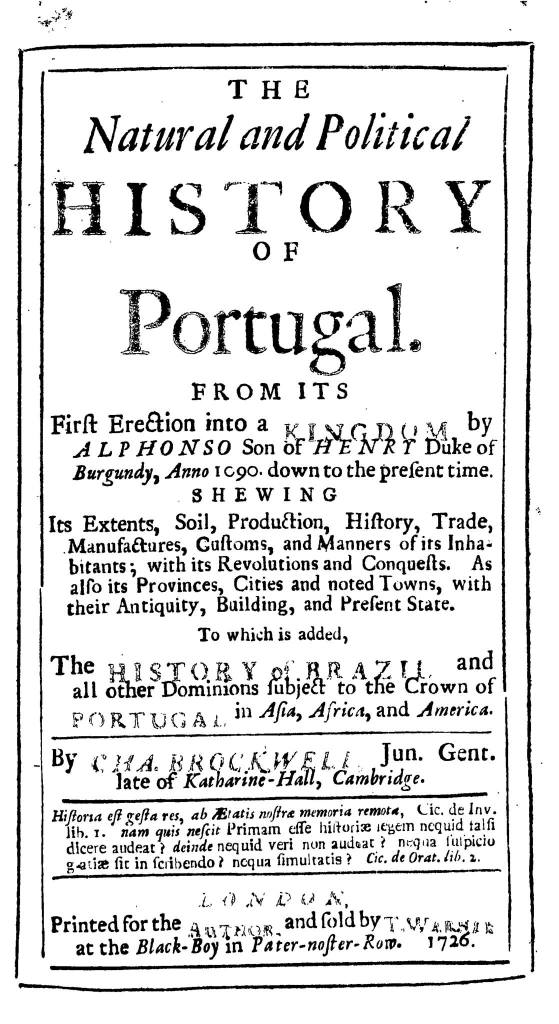
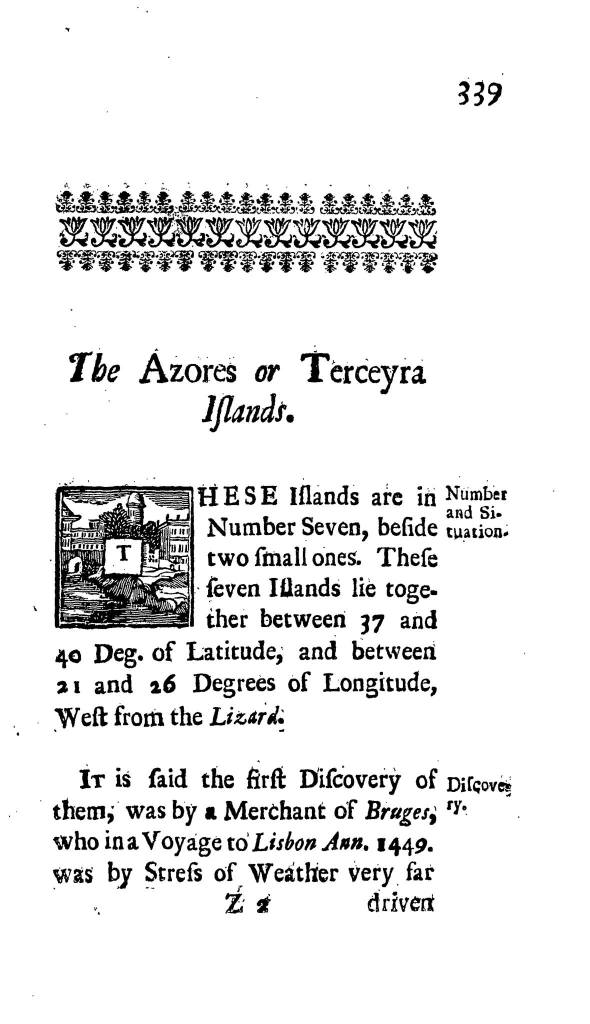
This magnificent piece of writing is from a book published in 1726. Here is the explanation by Professor Emeritus Manuel Menezes de Sequeira, retired on the island of Flores: “This is an author’s edition, by prior subscription from a number of promising buyers. The author is the Reverend Charles Brockwell (1696-1755), master of St Catharine’s College, Cambridge, chaplain to His Majesty in Boston, New England. I have been unable to find any further information about him, other than that he published at least one sermon and translated a history of Sweden. The book was published in 1726 and is entitled “The Natural and Political History of Portugal. From its first erection into a kingdom [etc.]”. In the second part, with descriptions of Brazil, etc., there is a chapter on the Azores or Terceyra Islands, pages 339-344. Here it is…” It is worth reading. The Portuguese translation by Professor Sequeira is at the bottom. We thank him for the amount of research he has done about the Azores. We thank him for allowing us to share with students and the community at large.

{Number and Situation.} These Islands are in Number Seven, beside two small ones. These seven Islands lie together between 37 and 40 Deg. of Latitude, and between 21 and 26 Degrees of Longitude, West from the Lizard [Lizard Point, na Cornualha].
{Discovery.} It is said the first Discovery of them, was by a Merchant of Bruges, who in a Voyage to Lisbon Ann. 1449. was by Stress of Weather very far driven to the West, and at last made these Islands, which he found destitute of Inhabitants, and named them the Flemmish Isles. He finally got to Lisbon, where by boasting of this Discovery, he gave the Portuguese such Hints of their Situation, that they immediately set sail, and took Possession of them; nay Anthony Gonzalo [António Galvão (c. 1490–1557)] in his Treatise of the Discovery of the World [Tratado dos Descobrimentos], affirms, that Prince Henry went with them.
We are also informed, that upon the Account this Merchant gave his Countrymen at his Return to Bruges, they set upon an Expedition thither, and planted a Colony, whose Posterity do still remain in Fayal, which was the Island they occupied.
{S. Michæl.} SANTO MICHÆL, is the most Easterly in its Situation, 20 Leagues in Circumference, and yields plenty of Wheat.
{S. Maria} SANTA MARIA, is very small but abounds in Provisions of most Kinds, and Potters Earth.
{Terceyra} TERCEYRA, lies twenty eight Leagues more to the West, and has its Name from being the third of these Islands in Situation; but it is the first in Dignity, and therefore communicates its Name in general to them all. It is by Mistake reckoned the largest of them, but in reality is not; being only fifteen Leagues over. The Soil is fertile, and the very Rocks producing Vines, of which good Wine is made, though not comparable to the Madera, or Canary Wines. The Land yields plenty of Wheat, Oranges, Limons, and all Sorts of Fruit. The Pastures feeds large Oxen; and the Country neither wants Necessaries or Delicacies, excepting Oil and Salt.
{Angra.} The Metropolis is called Angra, where the Governor resides, it is seated on the South Coast, well built, and defended by a good Castle, wherein Alphonso [Afonso VI] was by his unnatural Brother Peter [D. Pedro II] confined An. 1668. This City is the See of a Bishop, Suffragan to the Archbishop of Lisbon. Here is a commodious Harbour for Shipping, whence the Town is called Angra (i. e.) a Station for Ships, and moreover this is the only safe Habour in all these Islands, it is enclosed like a Crescent with two Mountains, seen fourteen or fifteen Leagues at Sea. It is not however very safe in all Winds; it is chiefly for the sake of this Port, that the Portuguese have been so careful of the other Islands, and are shy of letting Foreigners approach them, because their Situation, is very convenient to refresh their Ships, in the Brazil, and other long Voyages.
{Graciosa.} GRACIOSA, is so called from its Pleasantness, and lies the most North.
{S. George.} S.GEORGE, is mountainous and yields much Cedar.
{Pico.} PICO, is so named from an high Mountain in it, by some thought to be equal with Teneriffe; the Soil of this Island is exceeding fertile.
{Fayal.} FAYAL, is more West, and is so named from its Beech-trees; yields Provision and Fish in abundance, and is inhabited by the Posterity of the Flemmings.
{Flores.} FLORES, so named from the Flowers growing on it.
{Corvo.} CORVO, so called from abounding with Crows; this Island and Flores are seventy Leagues West from the rest of the Islands, and kept by the Portuguese to prevent any Incursions of the Enemy.
{Air.} THE Air of these Islands is generally clear and wholesome, but so sharp as to corrode Iron, and consume Stone, wherefore the Inhabitants build of the finest Flint [sic].
{An odd Notion.} It was of Old the Opinion of the Seamen, that as soon as they had passed the Azores, in sailing from Europe, all the Fleas, Lice, and other nauseous Vermine died. Now we come to the Portuguese Dominions in Africa.

Os Açores ou Ilhas Terceiras
{Número e Situação.} Estas ilhas são em número de sete, além de duas de menor dimensão. As sete ilhas encontram-se situadas entre os 37 e 40 graus de latitude e entre os 21 e 26 graus de longitude, a oeste do Lizard [Ponta do Lizard, na Cornualha].
{Descoberta.} Diz-se que a primeira descoberta destas ilhas foi feita por um mercador de Bruges que, numa viagem para Lisboa no ano de 1449, foi arrastado por ventos adversos muito para oeste, acabando por alcançar estas ilhas, que encontrou desabitadas, e às quais deu o nome de Ilhas Flamengas. Chegou finalmente a Lisboa, onde, ao vangloriar-se desta descoberta, forneceu aos portugueses indicações tão precisas sobre a sua localização que estes imediatamente zarparam e tomaram posse delas; aliás, António Galvão, no seu Tratado dos Descobrimentos, afirma que o Infante D. Henrique os acompanhou. Sabe-se também que, com base no relato que este mercador fez aos seus conterrâneos ao regressar a Bruges, estes organizaram uma expedição para lá e estabeleceram uma colónia, cujos descendentes ainda hoje permanecem no Faial, a ilha que ocuparam.
{São Miguel.} SÃO MIGUEL é a mais oriental na sua localização, com 20 léguas de circunferência, e produz trigo em abundância.
{Santa Maria.} SANTA MARIA é muito pequena, mas abunda em provisões de várias espécies e em argila para oleiros.
{Terceira.} A TERCEIRA encontra-se vinte e oito léguas mais a oeste e deve o seu nome ao facto de ser a terceira ilha em posição; no entanto, é a primeira em dignidade, pelo que dá o seu nome a todas as demais. Por engano, é considerada a maior delas, mas na realidade não o é, tendo apenas quinze léguas de extensão. O solo é fértil, e até as rochas produzem videiras, das quais se faz um bom vinho, embora não comparável aos vinhos da Madeira ou das Canárias. A terra produz trigo em abundância, laranjas, limões e toda a sorte de frutos. As pastagens alimentam bois de grande porte; e o território não carece de bens essenciais nem de iguarias, excepto azeite e sal.
{Angra.} A capital chama-se Angra, onde reside o governador; está situada na costa sul, bem construída e protegida por um bom castelo, onde Afonso VI foi confinado pelo seu desnaturado irmão D. Pedro II no ano de 1668. Esta cidade é a sede de um bispado, subordinado ao Arcebispo de Lisboa. Possui um porto cómodo para a navegação, pelo que a cidade se chama Angra (ou seja, um ancoradouro para navios), sendo este o único porto seguro em todas estas ilhas; está rodeado, como uma lua crescente, por duas montanhas, visíveis a catorze ou quinze léguas no mar. Contudo, não é totalmente seguro em todos os ventos. É principalmente por causa deste porto que os portugueses têm sido tão cuidadosos com as restantes ilhas e relutantes em permitir a aproximação de estrangeiros, pois a sua localização é muito conveniente para reabastecer os navios nas viagens para o Brasil e outras longas travessias.
{Graciosa.} A GRACIOSA, assim chamada pela sua graciosidade, é a mais setentrional.
{São Jorge.} SÃO JORGE é montanhosa e produz muito cedro.
{Pico.} O PICO deve o seu nome a uma alta montanha que nela se encontra, por alguns considerada equiparável ao Teide, no Tenerife; o solo desta ilha é extremamente fértil.
{Faial.} O FAIAL, mais a oeste, tem o seu nome devido às suas faias; produz provisões e peixe em abundância e é habitada pelos descendentes dos flamengos.
{Flores.} FLORES, assim chamada pelas flores que nela crescem.
{Corvo.} CORVO, assim designada por abundar em corvos; esta ilha e a das Flores estão setenta léguas a oeste das restantes e são mantidas pelos portugueses para evitar incursões inimigas.
{Ar.} O ar destas ilhas é geralmente puro e saudável, mas tão cortante que corrói o ferro e consome a pedra, motivo pelo qual os habitantes constroem com o mais fino sílex [sic].
{Uma Noção Curiosa.} Antigamente, os marinheiros acreditavam que, ao passarem pelos Açores, em navegação a partir da Europa, todos os piolhos, pulgas e outros vermes nauseabundos morriam. Passamos agora aos domínios portugueses em África.
—
 Filamentos (artes e letras)