
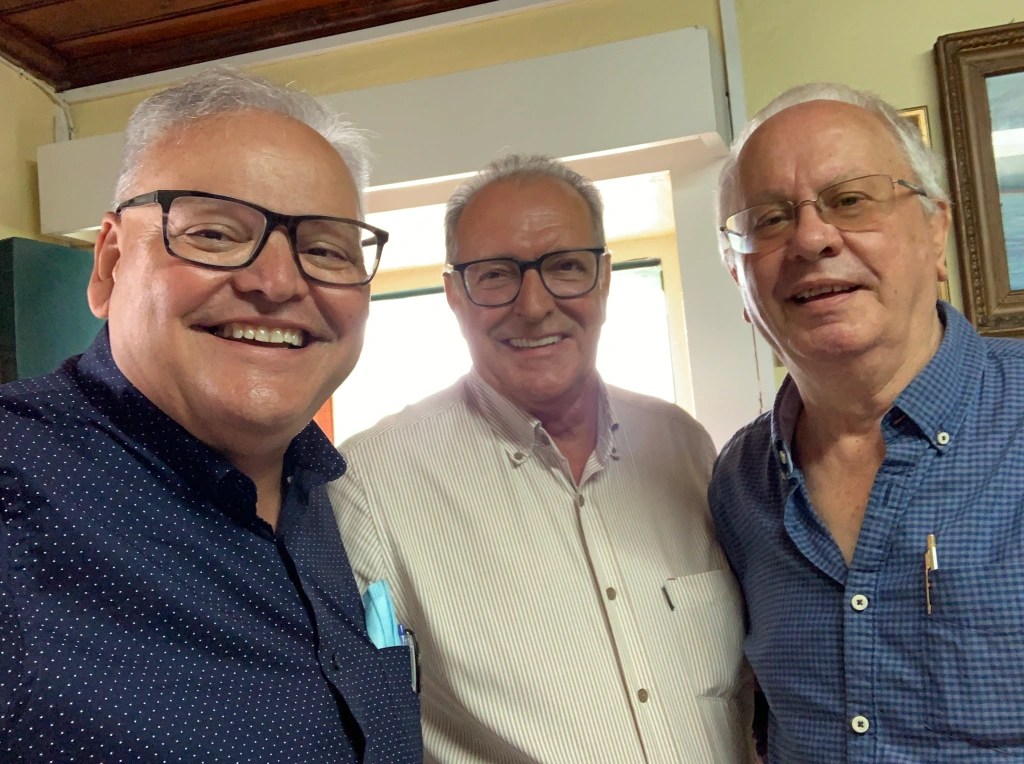
Each day, a page. Each page, a moon. Each moon, Álamo.
Álamo Oliveira and His Writing by Vamberto Freitas
The cursed time inside me like a marble snake nibbling at my belly.
Álamo Oliveira in Verses Of All Moons
The epigraph comes from one of Álamo Oliveira’s poems included in his recently published poetry collection in the Azores. During the last couple of years, we have seen magnificent renditions of his poetry, prose, essays, and theater. And what an impressive collection this is. It is impossible to synthesize the totality of his writing, as he is one of the most prolific and profound Azorean contemporary writers. So, in this brief preface to the poems selected and translated by Diniz Borges, let’s say the essentials. Álamo Oliveira’s writing is as much a part of our collective Azorean memory as it is extended to the rest of the world, where our immigration to the Americas is equally and vigorously present. His prolific work is well-known and respected throughout the Portuguese-speaking world. As João Medina, professor at the University of Lisbon, once told me, among many of his works, Álamo wrote the best “Portuguese book on the Colonial Wars in Africa,” which transfigures his experience as a soldier in Guinea-Bissau: Até Hoje: Memórias de Cão.
Reading Álamo Oliveira is reading myself. With a difference: he knows how to create literary art, and indeed art in various forms, from painting to music, and I just know how to appreciate it, sometimes euphorically, sometimes with the nostalgia, but always with a sense of joy and very grateful for all that he has given us, in novels, short stories, essays, plays and poetry, as this collection demonstrates. Here, in my home in Ponta Delgada, I have prominently displayed in my living room a painting that pays homage to his Raminho and, by inference, to our shared past as children of parents with a meager life in a rural parish in Terceira Island, Azores.
Álamo’s writing isn’t only about his person in personal exile; it is, above all, a constant dialogue with his most significant peers in a daily experience that intertwines the literary and the historical. Even his dedications to some of his colleagues throughout his work constitute this dialogue he shares because of his good fortunes, challenges, and dilemmas. Álamo Oliveira writes about his limited space as an islander and of the world through an array of countries, including those in North and South America, where our Azorean Diaspora is ever present, remembering all those whom he encountered, in a constant discovery, in a never-ending search for the other within ourselves. In Álamo Oliveira’s poetry, one finds elements of everything that brings meaning to his life, his historicity, and the lives and history of a people who are often forgotten in the islands and the Azorean Diaspora.
The essayist, and translator of this book Diniz Borges, who has been a resident of California since childhood, writes on the back cover of Álamo Oliveira’s poetry collection: “In poetry, theater, f iction, narrative, and even in the essay, our poet presents us with a world where Humanity is clothed with dignity and justice. Each text is composed of a lyricism that elevates the human spirit. In each of his texts, a deep cry penetrates the most hidden labyrinths of our existence. Among the themes the author has explored, emigration and the deep imprints on Azorean society and idiosyncrasy have had a special prominence.
Álamo Oliveira continues to be a writer of his people and his place and, therefore, a writer of all peoples and all places.” I know very well what Diniz Borges refers to concerning a specific part of Álamo Oliveira’s work – emigration and diaspora experiences. Besides everything else in his writing that makes direct reference to the existentialism of our communities, especially in California, it was Álamo who wrote the novel Já Não Gosto de Chocolates (I No Longer Like Chocolates). Just like the war novel already mentioned, he is our only author who hasn’t been fearful – a frightened writer isn’t worth much as a writer – of behaviors that until recently were taboo among us, both here in the archipelago and there in the Azorean Diaspora.
I No Longer Like Chocolates is not a controversial novel among its more intelligent readers. It is a novel in which the whole “normalized” experience, considered by the ignorant to be something “deviant, “ is artistically portrayed. Much like in his prose, Álamo takes risks in his poetry, with themes and styles, always mindful of the role of art in the human experience. “I have been traveling through known lands to get lost. The lost are always found at the edge of the border map, badly drawn by the erratic and the undressed.” This is just a stanza from one of his poems. With such precise and elegant words, this poem, like all the great works of Álamo Oliveira, tells all that we want to and don’t want to know. In this translated collection, we see many aspects of how lucky or unlucky we are to be who we are.
All great literature should be what writes us, what makes us go into the deepest part of our existence. We laugh, or we cry, or we do both simultaneously. That is the essence of art, whatever form it takes. These poems will undoubtedly move the reader.
Vamberto Freitas-the preface to the book Through the Walls of Solitude

 Filamentos (artes e letras)