
Each day, a page. Each page, a moon. Each moon, Álamo.
“Álamo Oliveira should be taught in schools in the Azores.”
Victor Rui Dores, interviewed by Armando Mendes ~ Diário Insular, July 8, 2025
Translated by Katharine F. Baker
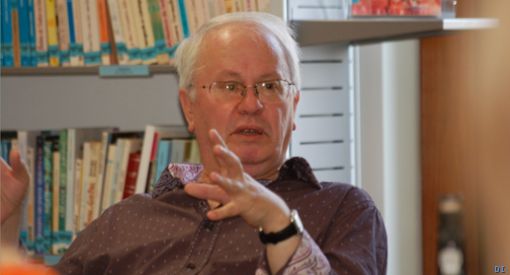
Victor Rui Dores has read many of the roughly forty books by Álamo Oliveira (1945-2025). He contends that the work of this just-deceased author, considered by many a genius, should be included in schools via the regional curriculum and promoted urbi et orbi by a regional distribution policy. And he laments that Álamo Oliveira, a civil servant, was not freed from his job duties in order to create, as happened for others.
Diário Insular: Where does Álamo Oliveira (1945-2025) belong in Portugal’s national pantheon of culture, and especially the Azorean one that extends to our communities in the diaspora?
Victor Rui Dores: I had a longstanding friendship, literary camaraderie and additional associations with Álamo Oliveira. I have read the majority of his work, and appreciated his inexhaustible creative capacity — and the fact that we are discussing one of the most iconic names in Azorean literature. A writer of the highest quality who unfortunately did not find a publisher to promote him nationwide, he is represented in more than a dozen anthologies of poetry and narrative fiction in Portugal and abroad, with some of his works even translated into English, Italian, Spanish, Croatian, Slovenian and Japanese.
DI: Álamo Oliveira cultivated several types of writing — novels, theater, poetry — and was a master of other arts and crafts. Was he some type of Renaissance man? In which genres was he most notable?
VRD: A cultural Renaissance man, he was a knight errant for love of literature. He shone above all in poetry and narrative fiction. And, at 80 years of age (with 65 years of published writings), he had stopped “escreviver” [living to write]. The man is gone, but a vast and versatile body of his work remains — 43 books published in various forms and diverse literary genres: poetry, theater, novels, short stories, chronicles and essays (in the areas of literature, sociology and cultural anthropology). And all of this in the most heartfelt recording of some very personal and deeply human writing.
This Terceira native from Raminho was also a theater and visual arts critic, painter, cultural organizer, designer, lyricist, marcha rehearsal captain, songwriter, and conductor of the Grupo Coral do Raminho. I caught him decorating the church in that parish on several occasions. Jokingly, I used to say the only thing Álamo did not know how to do was drive a car.
DI: With composer Carlos Alberto Moniz, he wrote many lyrics for the Sanjoaninas marchas.
VRD: The song-writing team of Álamo Oliveira and Carlos Alberto Moniz created over a half-century a new model and distinct style for marchas, which have nothing to do with the traditional Lisbon marcha. In this regard, these two Terceira natives managed to be innovative.
DI: In general, how would you characterize Álamo Oliveira’s body of work?
VRD: For Álamo Oliveira, life and writing are inseparable. Living on Terceira, his microcosm of reference, he knew very well the nature of the island’s people in all their contradictions and contrasts, vileness and greatness.
With creative imagination, penetrating wit and poetic expression, he describes the island and the Azorean diaspora in all its telluric and human dimensions, since literature is nothing but a search for the meaning of life and the questioning of mankind. Indeed, tellurism and social contention are two fundamental themes — in poetry (Pão verde, 1971), narrative fiction (Já não gosto de chocolates, 1999, and Marta de Jesus: a verdadeira, 2014) and drama (Manuel, seis vezes pensei em ti, 1977, and Missa terra lavrada, 1984) — by our author.
From out of Raminho, Álamo wrote to the world, looking at some of the events that marked our history and experiences in the past seventy years, addressing fundamental questions of the human condition. For example: in the novels Burra preta com uma lágrima (1982) and Pátio d’alfândega: meia-noite (1992), where he uses irony (sometimes caustic) as a critical instrument to target well-defined elements in social strata.
DI: The novel Até hoje (memórias de cão) is considered by many to be possibly the finest work of fiction about the Portuguese colonial war in Africa. Do you agree?
VRD: To me, the best novels that have been written about the Colonial War to date came from the pens of three Azorean writers: José Martins Garcia, with Lugar de massacre (1975); João de Melo, with Autópsia de um mar de ruínas (1984); and Álamo Oliveira, with Até hoje (memórias de cão), 1988.
Very early on, Álamo learned André Gide’s lesson. “Good literature is not written with good feelings.” That is why his writing is almost always transgressive and transgressing. Consider how openly the author deals with the theme of homosexuality in Até hoje (memórias de cão), which relates the story of a romantic relationship between men; and also in Murmúrios com vinho e missa (2013), with the same thematic domain and fictional approach, where the characters live in rupture and open conflict with societal norms (which reject and repress those who are different) and with the paradigms accepted (and exalted) by the community. These are characters who in a bold and audacious way say no to prohibitions, false moralisms, hypocrisy… Besides, such amorous boldness was already contained in the homoerotic poetry of this author: Cantar o corpo (1979), for example.
DI: Over the decades Álamo Oliveira vigorously promoted culture, helping for example to create several theater groups and making them flourish. Alpendre’s founding is perhaps his greatest achievement in this realm. Under the Regional Government’s aegis he also established the Gaivota collection, which discovered the writings of dozens of authors. How might it be possible to commemorate these achievements of his in perpetuity?
VRD: Having studied at the Angra Seminary, which provided him a tremendous background in the Humanities, Álamo Oliveira was a founding member of the Alpendre theater group (1976), for which he wrote signature plays, served as artistic director and stage director, and was also an actor, costume designer, scenery and prop manager… he did it all.
He afforded the Gaivota collection an unparalleled dynamic back when there was still a specific cultural policy. In my opinion, a great service would be rendered to the Region if some of those works were republished and their authors rediscovered.

DI: Álamo Oliveira was never able to earn enough from writing to support himself, which meant he had to work at a job until retirement. Should he have been given different treatment, like for example being released from work in order to create (as happened for others)?
VRD: As a civil servant, he should have been assigned to create and conduct research on subjects of relevant cultural interest to the Region, as happened for Dias de Melo. This was impossible, but he never stopped putting into practice what he thought should be done. On the job and off duty.
I have stated publicly several times — once even in the presence of a Regional Director of Culture for the Azores — that Álamo Oliveira by himself was more valuable than the entire Santa Clara soccer team. Of course I realize he was honored many times, receiving an Insígnia Autonómica de Reconhecimento and even the Comendador da Ordem do Mérito. But these did nothing to promote his work.
DI: In your opinion, how should the Azores pay tribute to Álamo Oliveira and his vast body of work?
VRD: It is essential that his work reach schools and be included in the Currículo Regional, especially his poetry. And that there be a cultural policy that promotes, urbi et orbi, this Terceira native’s books. And let us be clear about this: Álamo Oliveira will only die the day we stop reading him. Until then, he is alive and well.
 Filamentos (artes e letras)