
Cada dia, uma página. Cada página, uma lua. Cada lua, o Álamo.
Each day, a page. Each page, a moon. Each moon, Álamo.
”The departure of Álamo Oliveira has left us poorer.”
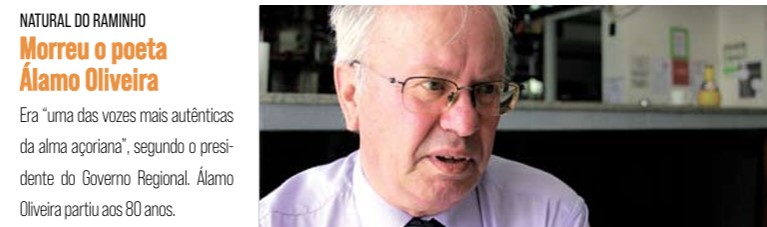
The Terceira-born writer Álamo Oliveira died on Sunday at the age of 80. The president of the Regional Government described him as “one of the most authentic voices of the Azorean soul.”
“It was with deep sadness that I received the news of the passing of Álamo Oliveira, a man whose life was dedicated to literary creation, the defense of Azorean culture, and the appreciation of our people’s identity. The news of Álamo Oliveira’s departure has left us poorer,” said José Manuel Bolieiro in a statement of condolence.
A native of Raminho, Álamo Oliveira published around 40 books, including poetry, novels, short stories, plays, and essays. His works have been translated into English, French, Spanish, Italian, Slovenian, Croatian, and Japanese.
He studied philosophy at the Angra Seminary and did his military service in Guinea-Bissau (1967-69).
He was a founding member of the Alpendre theater group (1976), where he was artistic director and stage director.
In 1985, he received the Maré Viva prize from the Seixal City Council for his novel “Até Hoje Memórias de Cão” and, in 1999, the Almeida Garrett/Teatro prize for his play “A Solidão da Casa do Regalo.”
He also stood out in the visual arts, with exhibitions in the Azores and abroad, and created over a hundred book covers.
He wrote countless lyrics for Carnival dances and shared the authorship of São João marches with Carlos Alberto Moniz for over 50 years.
He was the first Portuguese to teach his own work to Portuguese language students at the University of California, Berkeley, for a semester in 2002.
In 2010, he was awarded the Autonomous Region of the Azores’ Insignia of Recognition and the title of Commander of the Order of Merit of the Presidency of the Republic.
He chose to live by the word
For the president of the Regional Government, Álamo was not just a writer, poet, and playwright.
“He was, above all, a man who chose to live through the word. He wrote as someone who listens, as someone who seeks to give meaning to who we are. And he did so with rare dedication, truth, rigor, and a sensitivity that touched deeply,” he said.
“Emigration, longing, the feeling of belonging, the struggle for justice, faith in others, all of this runs through his writing like a thread of hope. And that hope is perhaps his greatest legacy. A hope that is not naive, but made of resistance and tenderness. Because he genuinely believed that literature could change something in the world,” he added.
The president of the Legislative Assembly, Luís Garcia, also remembered Álamo Oliveira as “one of the leading figures of contemporary Azorean literature.”
“His life and work had a profound impact on Azorean culture, leaving a literary legacy of great importance for the identity of the archipelago,” he said in a press release.
Municipal mourning
The Angra do Heroísmo City Council declared a day of municipal mourning (yesterday) for the death of Álamo Oliveira, whom it described as “a distinguished poet, writer, and major figure in Angra and Azorean culture.”
“An unavoidable figure in literature, Álamo Oliveira leaves a legacy of inestimable artistic and human value, which marked generations and enriched the cultural identity of Angra do Heroísmo in a unique way,” said the municipality in a post on social media.
The municipality of Praia da Vitória also mourned the passing of an “undeniable figure in Terceira culture.”
“The poet, novelist, playwright, short story writer, chronicler, lyricist, and essayist brightened the literary event ‘Outono Vivo’ on several occasions, enriching the culture of this city on many occasions,” it said in a post on social media.
One of the greatest writers
Luiz Fagundes Duarte, philologist and essayist, argues that Álamo Oliveira “knew how to listen to and capture the feelings of the population and articulate them with the values and interests of the more erudite classes.”
“This is very evident in his poetry, an area in which he successfully combined the simplicity and authenticity characteristic of popular poetic tradition, mimicking its forms, rhythms, and concepts, with more erudite and reflective poetry,” he pointed out in an interview with DI.
For literary critic Vamberto Freitas, “Álamo was and is one of our greatest Portuguese writers.”
“His artistic greatness, in these very particular senses, has no equal among us, at least for now. Once again, he is one of the greatest Portuguese writers who has ever written about his life experience in the Azores. He taught us, like no one else, the true university of our literature,” he emphasized in an interview with DI.
Diniz Borges, a university professor in California, considers Álamo to be “the greatest poet of Atlantic Portugal, the craftsman of an Azorean identity that stretches across the sea and is rediscovered in the veins of the diaspora.”
“His voice was not an echo: it was the source. He sang to us like no one else, with the fierce tenderness of someone who knows the lava and salt of identity. For him, the diaspora was not a parenthesis, but the beating heart of the archipelago scattered around the world,” he emphasized in an interview with DI.
These three interviews about Álamo Oliveira will be published in full in upcoming editions. We will also publish them here on Filamentos.
In Diário Insular-José Lourenço, director.
Álamo Oliveira foi mais do que um poeta — foi a consciência de um arquipélago, a voz dos que partiram e dos que ficaram. Durante trinta dias, convidamo-lo a caminhar connosco pelas suas palavras, a sua memória, e a sua luz. Todos os dias partilharemos homenagens, versos escolhidos, notícas, depoimentos, reflexões e mensagens de escritores, leitores e amigos de todo o mundo.
 Filamentos (artes e letras)