
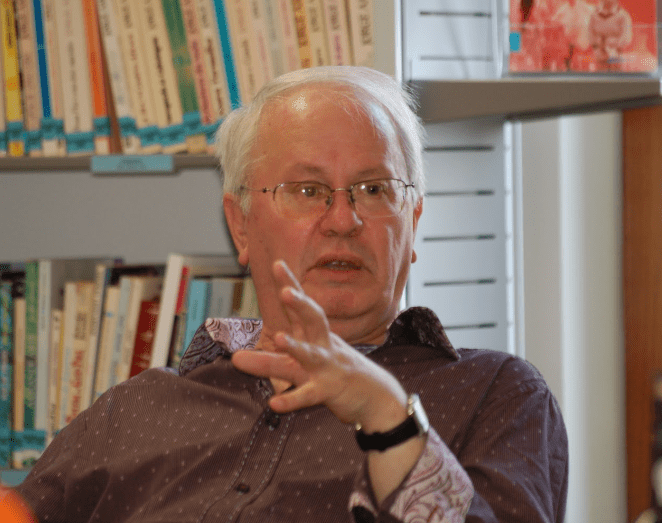
“my name is written on the soles of everyone’s shoes”
— Álamo Oliveira, Versos de Todas as Luas
Some losses are not measured by silence, but by echo. When a poet departs, it is not only a person who disappears — a lighthouse goes dark, a full moon is extinguished, one that lights the inner geography of our archipelago, of our world. José Henrique Álamo Oliveira has died — the poet from Raminho, the man who turned words into a hoe, a mirror, a compass, and a flower of resistance. His voice belonged to the people and the stones, to the body and the spirit, to the island and the exile. Today, the island of Terceira mourns him as one grieves a most lucid and untamable child. And the entire Azores bows to the greatness of one of the supreme poets in our Portuguese-language literature.
Álamo Oliveira’s body of work is itself an archipelago. He published more than forty titles spanning poetry, novels, drama, essays, and short stories — a dense, coherent, and profoundly humanistic literary production. In poetry, we must highlight books such as Pão Verde, Poemas de(s)amor, Fábulas, Itinerário das Gaivotas, Nem mais amor que fogo, Textos Inocentes, Missa Terra Lavrada, and, more recently, the magnificent anthology he had promised to prepare — Versos de Todas as Luas, where verses of farewell, belonging, and transcendence echo. In each of his books, the language is raw and delicate, simultaneously provocative and lyrical — reflecting the true poet who wrote with his heart in the earth and his gaze upon humanity.
His fictional work is equally significant, with novels such as Burra Preta com uma Lágrima, Triste Vida Leva a Garça, Até Hoje (Memórias de Cão), Pátio d’Alfândega Meia-Noite, Murmúrios com Vinho de Missa, Marta de Jesus (a verdadeira), and Já Não Gosto de Chocolates — the most emblematic narrative about Azorean emigration to the U.S., translated into English by me and Katharine F. Baker (I No Longer Like Chocolates), and also translated to Japanese — among many other titles. Álamo’s fiction carries a rare human and literary density. His novels do not merely tell stories; they are sensory and existential experiences that compel us to look inward and reflect on the collective scars of our people. Emigration, uprootedness, family silence, the tension between tradition and modernity, repressed sexuality, inner exile — all these themes appear not as background, but as living, pulsating substance. In “I No Longer Like Chocolates,” for instance, the everyday life of the diaspora in the United States is portrayed with starkness, compassion, and a prose where every sentence seems to carry the weight of salt and dust. His writing has many layers — it is simultaneously poetic prose, social critique, insular memory, and cultural psychoanalysis. There is no paternalism, no idealization; there is clarity, and a deep love for human contradiction. To read Álamo Oliveira is to enter a geography where the archipelago opens itself to the world — and the world, in turn, returns to the island with all its sorrows and promises.
In theater, he was a pioneer. Founder of the group Alpendre, he directed and wrote several remarkable plays: Manuel, Seis Vezes Pensei em Ti, A Solidão da Casa do Regalo, Enquanto a Roupa Seca, Judite – Nome de Guerra, among many others. His dramaturgy is a confrontation between the poetic and the political, between the everyday and the symbolic. His plays have been performed on several islands, on the mainland, and abroad. A Solidão da Casa do Regalo received the Almeida Garrett Prize in 1999.
He was also an essayist and editor of literary supplements, and maintained long-standing collaborations with schools, libraries, and cultural institutions in the Azores and the diaspora. He is an indispensable reference in the artistic and literary thought of the Azores.
To me, one of the most moving aspects of his public and literary life was his dedication to the diaspora. My friend Álamo traveled countless times to the United States and Canada, participated in conferences and congresses, published and promoted books about emigration, and most importantly, treated Azorean emigrants — and their descendants — as inseparable parts of the Azorean cultural community. In Já Não Gosto de Chocolates, as well as in Contos D’América and other books, he masterfully portrayed the cultural shock, the trauma of lost identity, the harshness of emigrant life, and the unexpected beauty of those who, far from home, persist. In 2002, he was invited by the University of California, Berkeley, to teach his work — the first Portuguese author to be so honored. In that gesture, his literature crossed the Atlantic as naturally as he would cross the streets of Angra or the trails and roads of Raminho. He was one of the main promoters of the symposium Filamentos da Herança Atlântica.
The brilliance of his writing lies in his singular ability to unite the sensorial and the ethical, the island and the world, struggle and tenderness. In his most recent poems, a farewell tone echoes like a murmuring Atlantic. At the end, he writes:
“I go with what I have:
a name among the syllables
of my children
a verse that never came out right
and hope in whatever comes next.”
In his final moon:
“this is the last moon
I did not see it rise
but I gave it a name
and for that, it belongs to me.”
And in gratitude:
“thank you, words.
you were better than I was.”
That humility, interwoven with such truly poetic language, is the mark of a true master of the word.
I met Álamo forty years ago. Since then, we shared tables, books, travels, drinks, conversations, and dreams. He was my brother, my comrade in struggles, my guide through the labyrinth of language, my mentor, and my total friend. We never needed masks. He taught me the value of authenticity, the courage to stand in a world that often dismisses what it cannot understand. We traveled together to the heart of the diaspora, to the soul of the Azores, to the essence of literature. From him, I learned that to be in the realm of letters (though I never was — and never will be — a true craftsman of the world) is to carry an ethical and aesthetic responsibility toward the world.
Álamo’s friendship was greater than books. It was made of presence, of drinking wine while having long talks, where I learned a great deal about life. Without trying to teach, he taught me a great deal. He had genuine affection for my family, as well as visible tenderness for Nivéria, my wife, whom he had great respect and fondness for. He watched our sons, Steven and Michael, grow from children to men, following their steps with silent pride, never hiding his admiration for the generous and upright adults they became. He always inquired about them and always held them in memory. He possessed that rare gift of truly being present for his friends: caring, knowing, and always having a word, a smile, or a hug to offer. That’s who he was — a human to the bone. A Poet to the end. A Brother for eternity.
Today, it is impossible not to feel a profound sense of emptiness. And perhaps that is why the pain runs so deep, so thick, like the fog that covers the island’s interior at dawn. The absence of my friend Álamo Oliveira is not just the passing of a man — it is the abrupt silence of a voice that named us from within, that gave shape to our memories, that spoke the island like no one else. We are all in mourning: family, friends, readers, islanders near and far, the entire diaspora. There is a sense of grief that crosses oceans and settles in the chest like cold lava. One feels the vacuum, the break as if a part of the Azorean soul had been torn from time. What remains is the truth: our Álamo endures. He lives on every page where the island becomes the world. In every verse where the stone thinks. In every reader who will discover him tomorrow and be moved by genuine writing, where love, justice, and beauty intertwine. Because a poet like Álamo does not die — he becomes echo, ground, lighthouse. And because, as he once wrote:
“I have enormous hopein the redemption of the island.”
That redemption begins in us, in love with which we will continue to read him, celebrate him, translate him, and share the light of all his moons.
Farewell, Álamo. Or perhaps not.
Because you, poet, are “on the soles of everyone’s shoes.”
And in all the moons, still waiting to rise.
Diniz Borges
 Filamentos (artes e letras)