

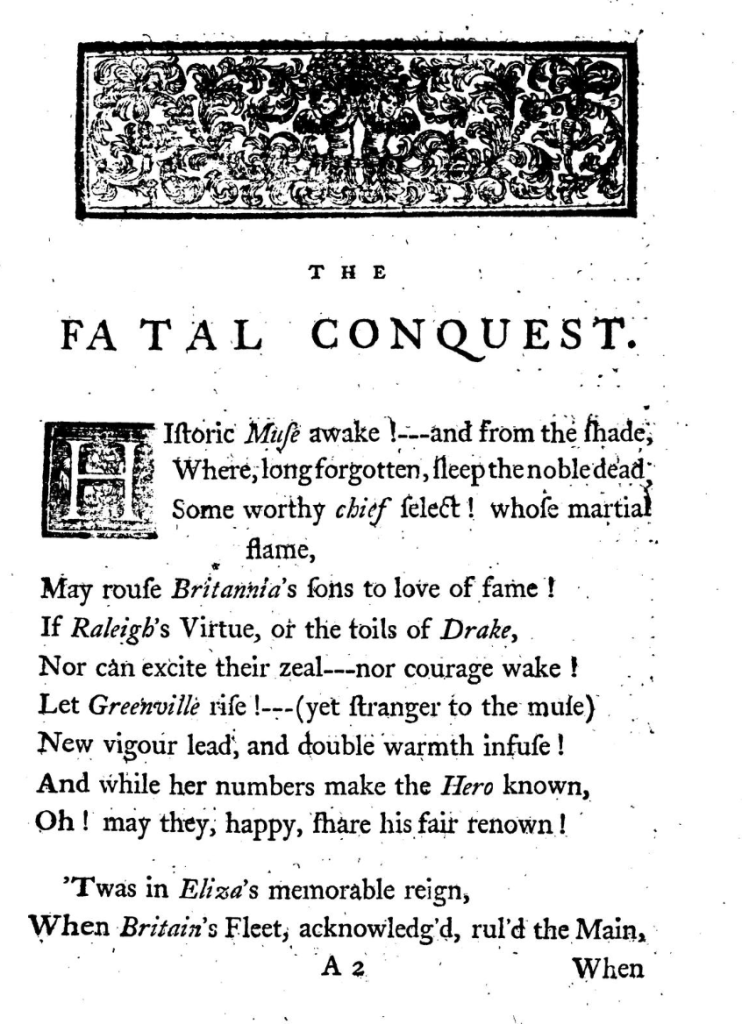
THE FATAL CONQUEST.
Historic Muse awake !—and from the shade,
Where, long forgotten, sleep the noble dead;
Some worthy chief select! whose martial flame,
May rouse Britannia’s sons to love of fame !
If Raleigh’s Virtue, or the toils of Drake,
Nor can excite their zeal—nor courage wake !
Let Greenville rise !—(yet stranger to the muse)
New vigour lead, and double warmth infuse!
And while her numbers make the Hero known,
Oh! may they, happy, share his fair renown!
‘Twas in Eliza’s memorable reign,
When Britain’s Fleet, acknowledg’d, rul’d the Main,
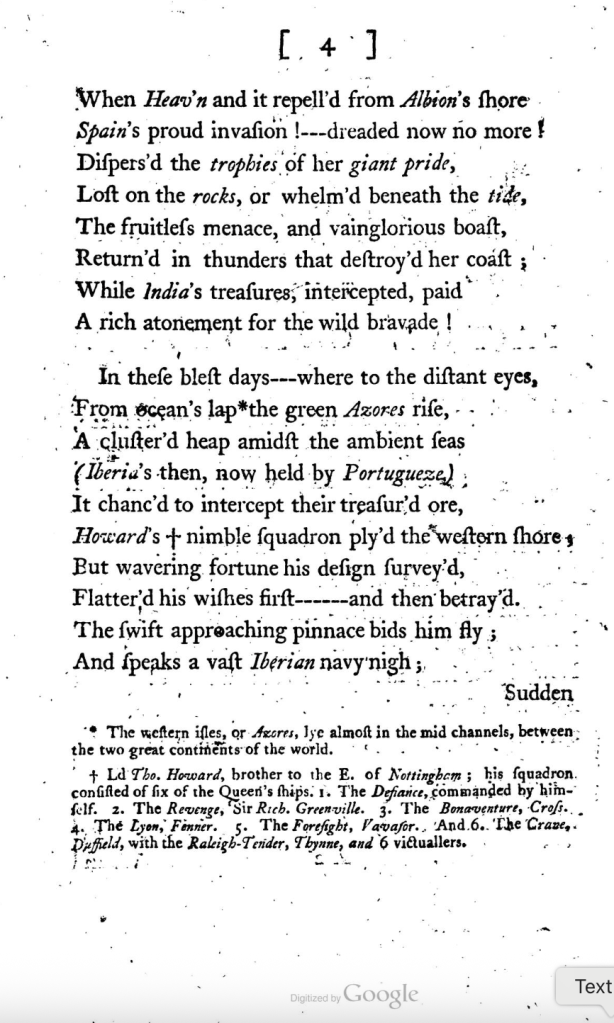
When Heav’n and it repell’d from Albion’s shore
Spain’s proud invasion !—dreaded now no more !
Dispers’d the trophies of her giant pride,
Lost on the rocks, or whelm’d beneath the tide,
The fruitless menace, and vainglorious boast,
Return’d in thunders that destroy’d her coast;
While India’s treasures, intercepted, paid
A rich atonement for the wild bravade !
In these blest days—where to the distant eyes,
From ocean’s lap (1) the green Azores rise,
A cluster’d heap amidst the ambient seas
(Iberia’s then, now held by Portugueze)
It chanc’d to intercept their treasur’d ore,
Howard’s (2) nimble squadron ply’d the western shore,
But wavering fortune his design survey’d,
Flatter’d his wishes first—and then betray’d.
The swift approaching, pinnace bids him fly;
And speaks a vast Iberian navy’nigh;
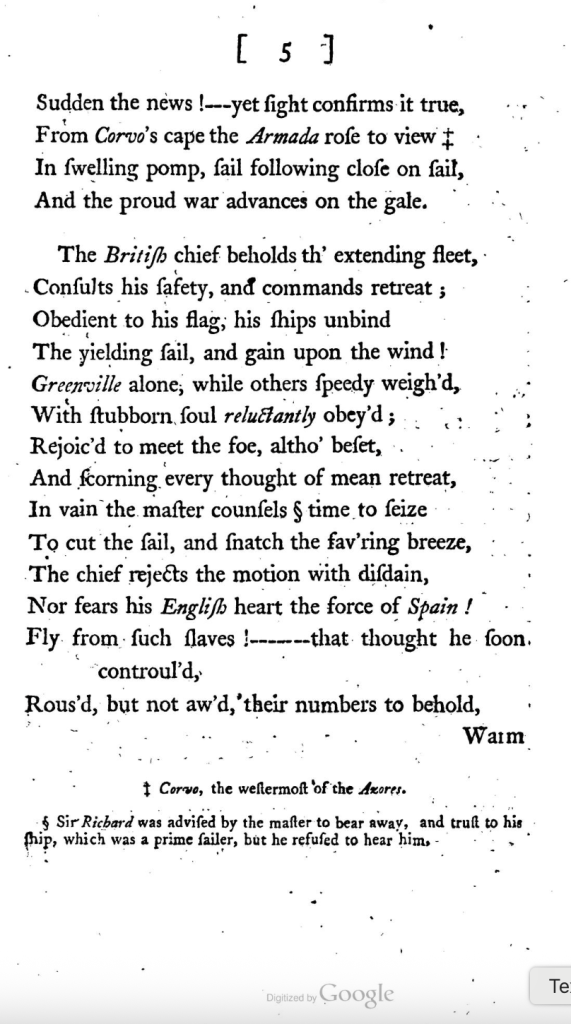
Sudden the news !—yet sight confirms it true,
From Corvo’s cape the Armada rose to view (3)
In swelling pomp, sail following close on fail,
And the proud war advances on the gale.
The British chief beholds th’ extending fleet,
Consults his safety, and commands retreat ;
Obedient to his flag, his ships unbind
The yielding sail, and gain upon the wind!
Greenville alone, while others speedy weigh’d,
With stubborn soul reluctantly obey’d ;
Rejoic’d to meet the foe, altho’ beset,
And scorning every thought of mean retreat,
In vain the master counsels (4) time to seize
To cut the sail, and snatch the fav’ring breeze,
The chief rejects the motion with disdain,
Nor fears his English heart the force of Spain !
Fly from such slaves !—that thought he soon controul’d,
Rous’d, but not aw’d, ‘their numbers to behold,
Warm glows his cheek, he knits his steady brow,
And keeps his course, regardless of the foe.
[…]
(1) The western isles, or Azores, lye almost in the mid channels, between the two great continents of the world.
(2) Ld Tho. Howard, brother to the E. of Nottingham ; his squadron consisted of six of the Queen’s ships. 1. The Defiance, commanded by himself. 2. The Revenge, Sir Rich. Greenville. 3. The Bonaventure, Cross. 4. The Lyon, Fenner. 5. The Forefight, Vavafor. And 6. The Crane, Duffield, with the Raleigh-Tender, Thynne, and 6 victuallers.
(3) Corvo, the westermost of the Azores.
(4) Sir Richard was advised by the master to bear away, and trust to his ship, which was a prime sailer, but he refused to hear him.
In Portuguese…
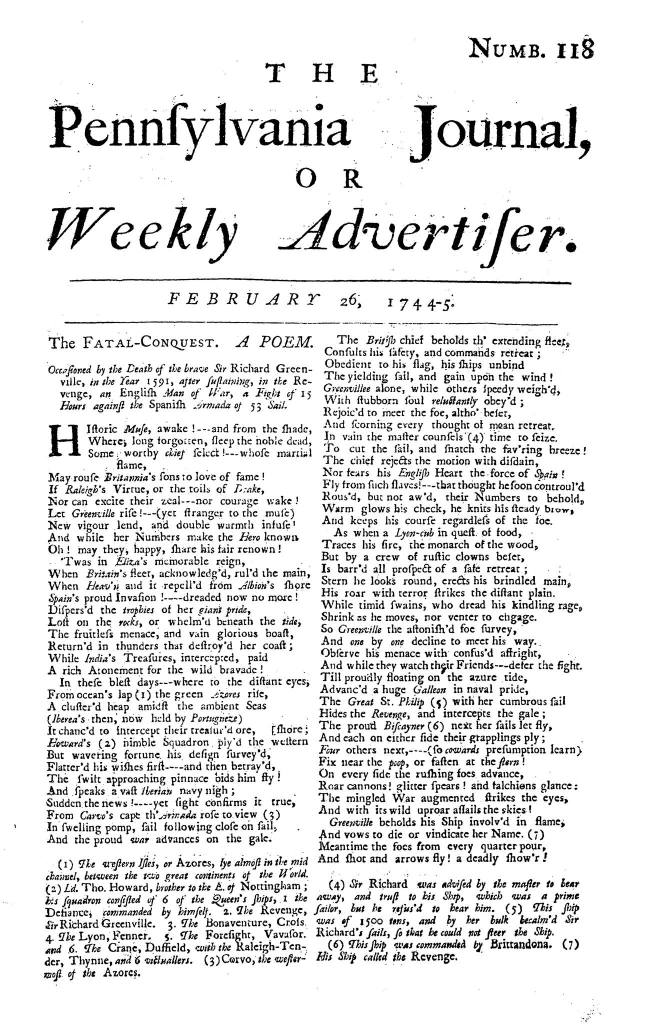
Não foi só Tennyson que escreveu sobre a batalha das Flores. Um poema épico anónimo foi publicado em duas partes nos números 118 e 119 do «The Pennsylvania Journal, or Weekly Advertiser» (de Filadélfia, Pensilvânia) saídos nas sextas-feiras de 26 de Fevereiro e 5 de Março de 1745 (páginas 1 e 2, em ambos os casos). Mais tarde, em 1772, o poema saiu em livro, impresso por John Dunn, de Whitehaven, Reino Unido. Aqui vai um troço inicial (as notas acompanham o poema: não são minhas):
— Tradução automática com pequenos retoques:
A CONQUISTA FATAL.
Musa histórica, desperta! — e da sombra,
Onde, há muito esquecidos, jazem os nobres mortos,
Escolhe um chefe digno! cujo ardor marcial
Inspire os filhos da Britânia ao amor da glória!
Se a virtude de Raleigh, ou os labores de Drake,
Não logram excitar seu zelo — nem coragem despertar!
Que Greenville se erga! — (ainda estranho à musa)
Com novo vigor lidere, e duplo ardor infunda!
E enquanto seus versos tornam o Herói conhecido,
Oh! que, felizes, partilhem sua justa fama!
Foi no reinado memorável de Isabel,
Quando a frota da Britânia, soberana, dominava o mar,
Quando o Céu e ela rechaçaram da costa de Albion
A orgulhosa invasão de Espanha! — já não temida!
Dispersos os troféus do seu gigante orgulho,
Perdidos nas rochas, ou submersos sob a maré,
A ameaça vã e o vanglorioso alarde,
Regressaram em trovões que devastaram sua costa;
Enquanto os tesouros da Índia, interceptados, pagaram
Uma rica expiação pelo audaz desafio!
Nestes dias abençoados — onde aos olhos distantes,
Do seio do oceano (1) surgem os verdes Açores,
Um aglomerado de ilhas entre os mares circundantes
(De Ibéria outrora, agora em portuguesas mãos),
Aconteceu interceptar seu ouro cobiçado,
O esquadrão ágil de Howard (2) que patrulhava a costa ocidental,
Mas a fortuna volúvel espreitou seu intento,
Primeiro seus desejos lisonjeou — e depois traiu-os.
A lancha que se aproxima veloz ordena-lhe fugir;
E anuncia uma vasta armada ibérica, perto;
Súbita a notícia! — mas verdadeira a confirma a vista,
Do cabo do Corvo a Armada surgiu visível (3)
Em pompa crescente, vela após vela bem cerrada,
E a guerra altiva avança com a brisa.
O chefe britânico contempla a frota que se estende,
Pondera a sua segurança, e ordena a retirada;
Obedientes à sua bandeira, suas naus desfraldam
As velas complacentes, e ganham com o vento!
Apenas Greenville, enquanto outros depressa se aprestavam,
Com alma obstinada a contragosto obedeceu;
Alegrou-se ao enfrentar o inimigo, embora cercado,
E desprezando todo pensamento de vil retirada,
Em vão o mestre aconselha (4) aproveitar o momento
Para cortar a vela, e capturar a favorável brisa,
O chefe com desdém a proposta rejeita,
Nem teme o seu coração inglês a força de Espanha!
Fugir de tais escravos! — esse pensamento logo dominou,
Excitado, mas não intimidado, ao ver seus números,
Arde-lhe a face, franze a fronte resoluta,
E mantém o seu rumo, ao inimigo indiferente.
[…]
(1) As ilhas ocidentais, ou Açores, situam-se quase no meio dos canais, entre os dois grandes continentes do mundo.
(2) Lorde Thomas Howard, irmão do Conde de Nottingham; o seu esquadrão era composto por seis navios da Rainha: 1. O Defiance, comandado por ele próprio. 2. O Revenge, de Sir Richard Greenville. 3. O Bonaventure, de Cross. 4. O Lyon, de Fenner. 5. O Foresight, de Vavafor. E 6. O Crane, de Duffield, com o Raleigh-Tender, de Thynne, e 6 navios de abastecimento.
(3) Corvo, a mais ocidental das ilhas dos Açores.
(4) Sir Richard foi aconselhado pelo mestre a retirar-se e confiar no seu navio, que era exímio no velejar, mas recusou ouvi-lo.
 Filamentos (artes e letras)