

The publication of the collection Contos Populares Portugueses da Califórnia (Portuguese Folk Tales from California), collected and transcribed by Manuel da Costa Fontes and classified by Isabel Cardigos and Paulo Correia, is a significant editorial and cultural achievement for the Portuguese-American community. It is the result of decades of work and is not only a literary repository but also a powerful tool for reconstructing the cultural identity of the Azorean diaspora. In this essay, we will analyze the importance of rescuing and archiving oral tales, focusing on some stories from the collection, as well as the author’s introductory notes on the Portuguese presence in California and the value of English introductions for readers from the diaspora. We will also show how this type of publication allows new generations to access their ancestry without the pressures of folklorism.
The introduction written by Professor Manuel Costa Fontes sheds light on the historical journey of the Portuguese in California, especially those from the Azores. From the first whalers recruited in Horta to the powerful dairy farmers of the San Joaquin Valley, the author’s narrative is rich in detail. It reveals the significant role of the Azorean community in shaping the California economy. The phrase “land, the more the better” expresses the spirit of perseverance that marked the trajectory of Azorean immigrants in agriculture and the dairy industry.
This context helps us understand why the collected stories are so diverse and fascinating: they reflect a people who navigated between worlds, who preserved traditions even in distant lands, and who used oral tradition as a form of resistance and survival.
The collection consists of 86 stories divided into categories such as animal tales, fairy tales, religious tales, humorous tales, and formulaic tales. This organization is not merely technical, but mirrors the very diversity of the Azorean cultural experience, which has always known how to integrate the sacred and the profane, the magical and the everyday, laughter and moral lessons.
An emblematic example is the story “A Rosa e o Urso” (The Rose and the Bear), a typical fairy tale in which the enchanted bear serves as a magical helper. The young protagonist is kidnapped and taken to the forest, where a bear protects and guides her, revealing himself to be a prince charming in the end. It is a tale of transformation and female maturation, filled with symbolic images, such as the forest—a space of the unknown and initiation—and the bear. This ambiguous figure represents both threat and salvation.
Another story of great interest is “O João da Vaquinha” (João da Vaquinha), belonging to the tradition of “cunning fools.” João, a seemingly naive boy, ends up deceiving a series of characters through the logic of absurdity and repetition. Humor here is a weapon against authority and the established order—a typical feature of popular culture that pokes fun at power, subverts norms, and favors the underdog.
In the more daring vein of the collection, we find tales such as “A Rapariga que Tinha Comichão nos Peitos” (The Girl Who Had Itchy Breasts) and “O Conto do Cagalhão” (The Tale of the Big Poop), which reveal an uninhibited, corporeal popular imagination deeply connected to the oral tradition of the people. Despite their scatological humor, these tales reveal a creative freedom that resists moralism and modern puritanism.
Also noteworthy are the religious stories, such as “O Sapateiro Pobre” (The Poor Shoemaker), where the protagonist, aided by Saint Joseph in disguise, is rewarded for his faith and kindness. The moral lesson is clear: virtue is rewarded, even if the path of life seems unfair.
One of the great innovations of the work is the presence, before each story, of an introduction in English. These notes serve as a guide for readers who are less familiar with the Portuguese language or traditional narrative conventions.
This editorial gesture represents an opening to the community, a recognition that the mother tongue can be an obstacle, but that it does not have to be a barrier.
Unlike traditional folklore, which is often centered on public exhibitionism and spectacle, reading allows for an intimate and internalized experience. For young people in the diaspora, this means being able to learn about and reinterpret their roots without the pressures of being “on display,” wearing traditional costumes, or participating in celebrations with which they do not always identify.
The work Contos Populares Portugueses da Califórnia (Portuguese Folk Tales from California) is, above all, a celebration of Azorean oral culture and its survival within the Californian diaspora. By collecting, transcribing, classifying, and presenting these tales, Manuel da Costa Fontes and his team have rendered an invaluable service to the collective memory of the Portuguese in the United States.
Diniz Borges is a Portuguese Language Instructor at California State University, Fresno, and the Director of the Portuguese Beyond Borders Institute (PBBI) at Fresno State.
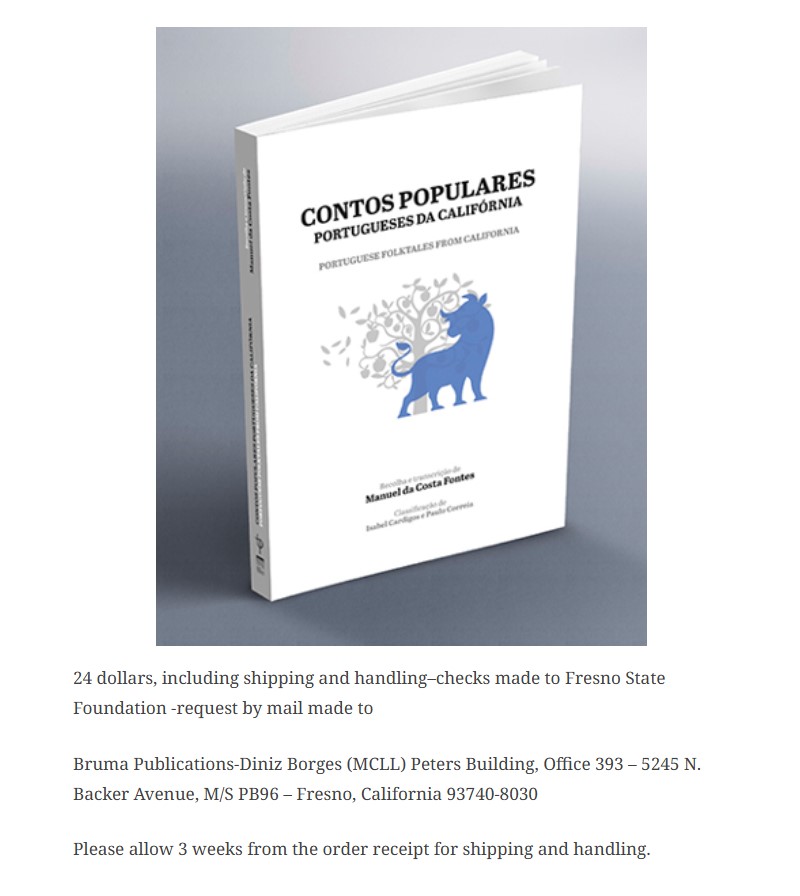
Contos Populares Portugueses da Califórnia, Manuel Costa Fontes, Bruma Publications and Letras Lavadas, Ponta Delgada and Fresno -2022 (cover by Rui Melo)
You can get the book here in the USA and Canada directory from Bruma Publications. In the Azores, all of Portugal, and any European Union country, you can obtain it from Letras Lavadas, as listed below.
https://www.letraslavadas.pt/contos-populares-portugueses-da-california
 Filamentos (artes e letras)