

AZOREANS IN ONTARIO
Portuguese emigration to Canada is a relatively recent phenomenon, starting in the early 1950s. In 2023, the Portuguese-Canadian community celebrated the 70th anniversary of the arrival in Canada of the first group of (eighty-five) Portuguese immigrants, who disembarked from the Saturnia on May 13, 1953, in Halifax.
During this decade, the number of Portuguese people arriving in Canada totaled 17,114. Subsequently, immigration through family reunification contributed to the intensification of flows: 59,677 Portuguese immigrants in the 1960s and 79,891 in the 1970s. However, these numbers began to fall considerably from the 1980s onwards – 38,187 in the 1980s, 19,325 in the 1990s, and 2,894 between 2000 and 2007.
Most of the Portuguese who emigrated to Canada are, or were, originally from the Azores. It is estimated that between 60% and 70% of all Portuguese people currently living in Canada come from the Azores (first generation of emigration) or are descended from Azoreans (second, third, and fourth generations). In absolute terms, this corresponds to around 350,000 to 400,000 Azoreans or their descendants, for a total resident Portuguese community of 500,000 to 600,000 people (unofficial figures). A good percentage (65-75%) comes from the islands of São Miguel and Terceira.
In the province of Ontario, in the early years of establishing themselves as a group, the Portuguese built an “institutionally complete” community in the central core of Toronto, known as “Little Portugal”. This is an ethnic neighbourhood (and economic enclave) with a strong and visible identity, whose high degree of “institutional completeness” is amply demonstrated by the considerable number of Portuguese businesses, associations, and religious organizations concentrated in this area.

The presence of the Portuguese, and Azoreans in particular, in this area of Toronto is also reflected in their spatial and social isolation from the host society. The visual landscape of this part of the city demonstrates, in a fascinating way, the cultural traits of Azorean life, as evidenced by the urban gardens maintained by its residents or the exuberant decoration of their houses, in areas that were previously run-down. It’s no coincidence that this neighborhood is considered part of the “Tenth Island of the Azores”.
In the 1960s and 1970s, southern Europeans were among the largest groups to arrive in Toronto. The arrival of entire families as part of the chain migration flows led to the emergence of residential areas with their own characteristics, characterized by the presence of religious spaces and ethnic commercial establishments. Examples of this include Kensington Market in the 1950s and 1960s and “Little Portugal” in the 1970s and 1980s.
In the case of Kensington, the Portuguese legacy can still be seen today in the Portuguese-owned stores and businesses, as well as in the brightly painted homes that remain as vestiges of this chapter in the neighborhood’s extraordinary history. In 2003, José Carlos Teixeira presented a proposal to include the Kensington neighborhood on Canada’s list of historic sites and monuments. This proposal was officially approved by Environment Canada in November 2006.
However, over the last few decades, a large number of Portuguese, many of them from the Azores, have moved from downtown Toronto to the suburbs (e.g., Mississauga) in search of their “dream home.” In this respect, the Portuguese, along with Italians and immigrants from Hong Kong, have one of the highest rates of home ownership, with more than two-thirds owning the home they live in.
These are excerpts from the text “Toronto: the tenth island of the Azores,” written by Carlos Teixeira, a Professor at the University of British Columbia, which help characterize the Portuguese communities in Canada, who are especially Azorean and are mostly based in the province of Ontario.

It was to better represent these emigrant communities and their islands of origin that a group of Azoreans, led by Eovaldo Moniz from Graciosa, founded the Casa dos Açores de Toronto in 1985. The organization was renamed Casa dos Açores do Ontário in 2005. Its successive presidents have been Leo Rosa (1987), Emanuel Soares (1993), Miguel Correia (1994), Manuel Ferreira Moniz (1995), Fernando Pereira (1996), José Ilídio Ferreira (1997), Fernando Faria (2000), Tony Arruda (2004), Carlos Alberto Botelho (2005), Lucília Simas (2010) and, since 2014, Suzanne da Cunha.
_____
José Andrade is the Regional Director for Communities of the Government of the Autonomous Region of the Azores. This essay is based on an earlier essay from his book Açores no Mundo (2017)
Translated by Diniz Borges
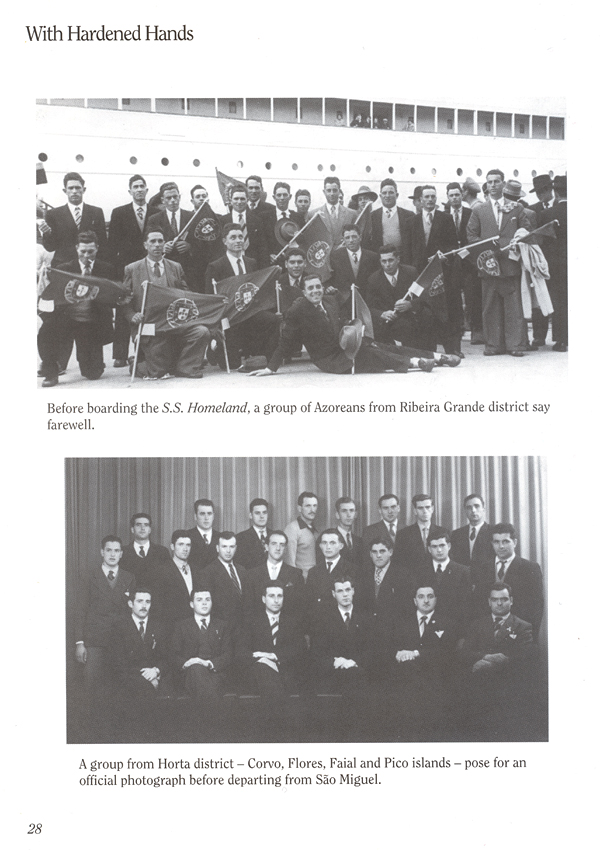
Historical Pictures of Azorean Immigration to Canada


 Filamentos (artes e letras)