
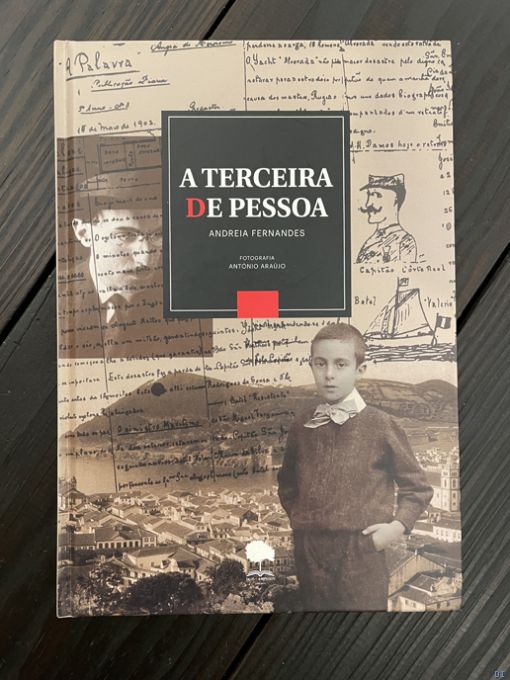
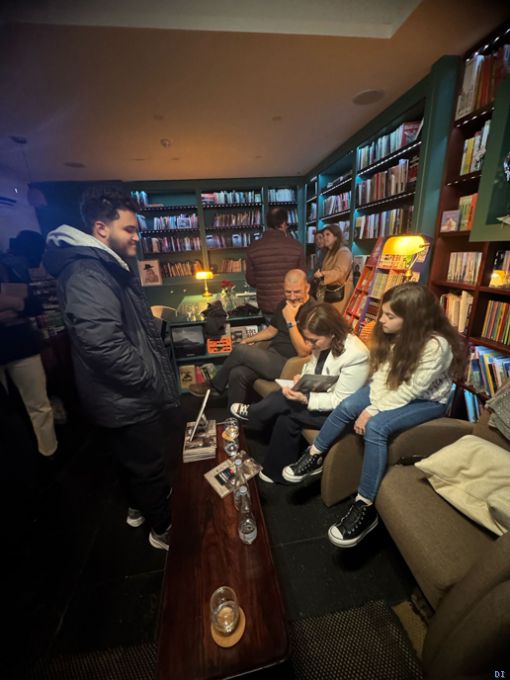
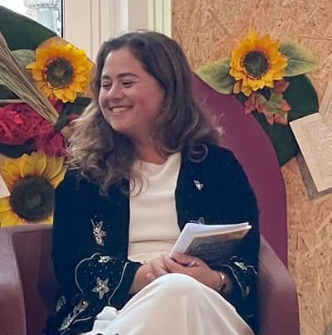
Andreia Fernandes, journalist and writer, recently launched “A Terceira de Pessoa” at the Lar Doce Livro bookstore. The book, published by Dois Caminhos, features photographs by António Araújo.
This book was based on a research article on Fernando Pessoa. How did the opportunity to share it in book form come about?
This book was born from an initial text I wrote about Fernando Pessoa’s time in Angra do Heroísmo and his family relationship with Terceira, where his mother was from. It led to an article co-authored with Ana Salgueiro and published in the Pessoa Plural magazine at Brown University (Department of Portuguese and Brazilian Studies), directed by Jerónimo Pizarro. Joel Neto later invited me to publish this story in book form, with photographs by António Araújo, in the publishing house I would create with Marta Cruz. I adapted the text for a wider audience, with some context about Pessoa and what Angra would have been like in the Azores in 1920, when the poet, still a teenager, visited Terceira. The work has just been released as the first edition by Dois Caminhos Editores, in a team that includes graphic design by Rui Leitão (with proofreading and editing by Marta and coordination by Joel), which I’m very proud of. In addition to the relevance of the content, the book is beautiful.
Is Fernando Pessoa’s connection to the island of Terceira still little known? Do you hope this book will help publicize it?
I really hope so. That this part of our history reaches more and more people. I’d like it to reach schools, students, teachers, parents, the curious, and visitors. And that it can continue to be told. This book results from journalistic and publicity research and opens the way to other historical, genealogical, and architectural studies. The centerpiece of our work is the house where Fernando Pessoa stayed in Angra in May 1902, the home of his aunt Ana, Anica, as they called her, his mother’s sister. But there are other houses to look for, where they were born and raised. Their parents’… Fernando Pessoa’s maternal family is from Terceira, and that’s the subject of much discussion. His mother, Maria Madalena, is a unique character in her own right. An unusually cultured woman for the time, she knew languages and the pain, and she wrote poetry. She stood out in the social circles of her father, Luís António Nogueira, who held high government positions in Angra, Porto, and Lisbon.
Are there any traces of this connection to the island in Fernando Pessoa’s poetry?
Pessoa wrote a poem in Angra when he was 13 years old, which we know today under the title “Quando ela passa” (When she passes), one of the first in Portuguese and signed by Dr. Pancrácio, in a handwritten journal that he wrote with his cousin during his time in the city. And two others published in Lisbon shortly after his trip to the Azores, “Estátuas” and “Enigma”, identified as having been written in Terceira, signed by Eduardo Lança, who can be called the first heteronym. Thus, Fernando Pessoa’s heteronymy was born on the island. The year-long vacation in Portugal, which included a visit to the Azores (and to Tavira, where he visited his late father’s family), was decisive in Pessoa’s return to his Portuguese roots and his resumption of contact with his mother tongue, since elementary school and the first part of secondary school were taught in English, the language in which he would already write verses (in Durban, South Africa, where he lived while his stepfather was consul). Some authors argue that the blood and myth of the islands live on in Pessoa. What is certain is that the sea occupies an important place in his work. And within it, the islands. We see them in Mensagem. Maritime and island metaphors are frequent in Fernando Pessoa: the semi-heteronymous Bernardo Soares writes in the Book of Disquiet, “We are, as the poet said, islands in the sea of life; the sea that defines and separates us runs between us”. These metaphors can be found especially in Álvaro de Campos, the poet of Ode Marítima (“Spread me on the seas, leave me / On the eager beaches of the islands”).

Could this connection between Pessoa and other renowned Portuguese writers and Terceira Island be a tourist attraction for those who like literature? For example, could an itinerary be created?
It’s an argument to affirm Angra and Terceira as a literary city/island of culture. A route will always be a path. In fact, the text that gives rise to this book was born precisely from a roadmap, at the literary meeting Arquipélago de Escritores (organized by Sara Leal and Nuno Costa Santos, which I had the pleasure of taking part in) – a walk guided by Álamo Oliveira and Urbano Bettencourt, with the participation of Joel Neto and Luísa Ribeiro, who recalled stories hidden in the streets of Angra, in the houses where art galleries once existed. As a teenager, writers lived in the house where Fernando Pessoa and his mother from Terceira lived. It was this visit to this house, on Rua da Palha, that gave rise to the article “A house in Angra ‘in a street near the sea’, published with Ana Salgueiro in the academic magazine Pessoa Plural, and now the book, with photographs by António Araújo, published by Dois Caminhos, ‘A Terceira de Pessoa’.
In Diário Insular. Interview conducted by Carina Barcelos.

This book has been translated into English and will be published in English in the next three to four weeks, as a collaboration between Bruma Publications/Dois Caminhos (Joel Neto and Marta Cruz).
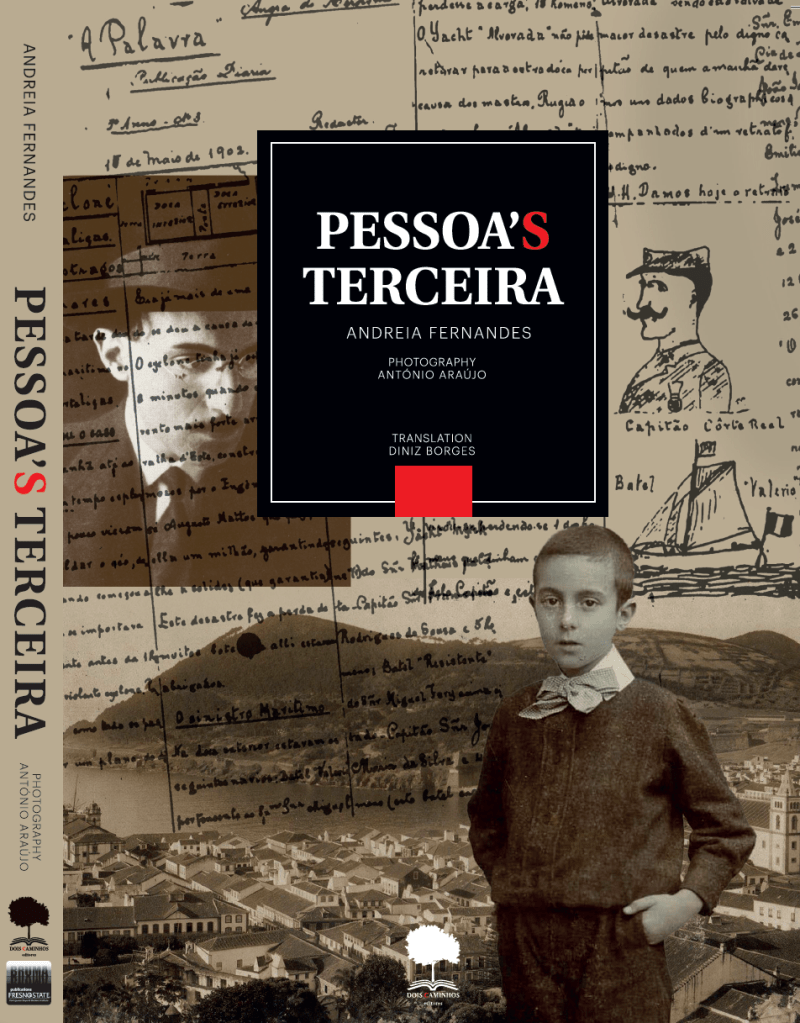

Translated to English as a community outreach program from the Portuguese Beyond Borders Institute (PBBI) and the Modern and Classical Languages and Literatures Department (MCLL) as part of Bruma Publications at California State University, Fresno, PBBI thanks the Luso-American Education Foundation for their support.

 Filamentos (artes e letras)