
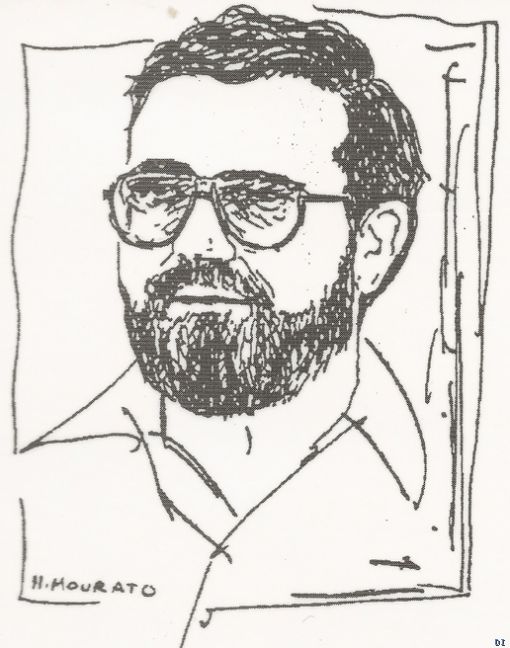
Efforts were made to find/recover the lost poem by Santos Barros (born in Angra do Heroísmo) “Não perecerás, ó destruída”. What justified such persistence, and how was the poem finally found?
My persistence has to do with the fact that I felt that the poem’s importance warranted its inclusion in the book “Alexandrina, como era – Todos os poemas”, published by Imprensa Nacional in 2018, in its “Plural” collection founded in 1982 by Vasco Graça Moura. I have nothing against the people involved in the project – Jorge Reis Sá, António Lobo Antunes, Urbano Bettencourt, or André Letria – but it seems to me that the absence of this poem in this book is a gross flaw. This poem was found thanks to the efforts of the poet Álamo Oliveira. It’s worth noting that the original was published on 17-1-1980 in the Context Supplement of the “Açores” newspaper.

What is the poem’s importance in question, both in the context in which it appeared (Angra do Heroísmo was destroyed by the earthquake of January 1, 1980) and as a poetic work?
As far as I’m concerned, having organized two anthologies with poems by Santos Barros (one on Work and the other on Sport), this is a great poem and is, as João de Melo wrote, “a chorus of the crowd, above its weeping and its silence”. In it, what all poets seek is whole and loud – to say the voice of the Earth. I mustn’t forget that Santos Barros was born on 1-1-1946, and because he was from Angrense, he felt the earthquake of 1-1-1980 more deeply, not least because he was already in Lisbon. Other poets have written on the subject (Álamo Oliveira, Vítor Cécio, João Afonso), but for m,e this is the key poem.
How important was Santos Barros in the cultural dynamics of his time, and to what extent does his work project itself into the present and the future?
Santos Barros’ work is not only poetic but also essayistic and dynamic through the Suplementos Culturais (Cultural Supplements) in the Azores. In the magazine he directed in Lisbon when the interests of the Terceira Farmers, the Church hierarchy, and the FLA forced him to flee by plane with his wife Ivone and young daughters Ana and Paula with only the clothes on their bodies. His work is so important that Onésimo Teotónio Almeida’s play (“No seio desse amargo mar”) includes figures from the Azorean arts and letters, Santos Barros being the only new one. The others are Armando Côrtes-Rodrigues, Roberto de Mesquita, Vitorino Nemésio, Antero de Quental, Teófilo Braga, Domingos Rebelo, Francisco de Lacerda, and Alice Moderno.

Is it worth recovering Santos Barros’s work, possibly publishing it, and displaying it in our schools?
It’s worth it. That’s my opinion, which, as an opinion, is worth what it’s worth. Nevertheless, it’s worth it. Schoolchildren in the Azores should get to know the authors who knew how to link the landscape to settlement. However, it is not just literature; the arts should also capture their attention. The viola, for example, popular songs, challenge songs, improvisations, everything. Folklore is extremely rich. I’m suspicious because I even have a poem in the book “Os Açores nos versos dos seus poetas”, organized by Olegário Paz. But I’m not from here, I’m from Santa Catarina – Caldas da Rainha. After all, nobody’s perfect.
In Diário Insular–José Lourenço-director.
Translated to English as a community outreach program from the Portuguese Beyond Borders Institute (PBBI) and the Modern and Classical Languages and Literatures Department (MCLL) as part of Bruma Publication at California State University, Fresno, PBBI thanks the Luso-American Education Foundation for their support.
 Filamentos (artes e letras)