

AZOREANS IN NEW ENGLAND
At the end of the 19th century and throughout the 20th century, Azoreans found refuge and safety in the United States of America. They fled poverty, volcanoes, and the colonial war, among other factors.
Portuguese emigration to the USA is classified into two waves. However, some authors defend the prehistory of Portuguese immigration, which began in the 18th and 19th centuries with the whaling industry. The history of the settlement of California tells us much about these whalers’ adventures.
The first wave dates from 1870 to 1920. In this wave, the Portuguese emigrated to New England and California in response to the need for cheap labor. In California, they concentrated in agricultural regions. Then, they settled in the urban areas, such as San Francisco or Sacramento, where they worked in construction and gardening, among other rural jobs. In New England, the Portuguese distinguished themselves in fishing and the textile industry. Thus, New England, a historically industrialized region, saw large waves of emigrants.
In the years 1920-1950, immigration was “put on the back burner”, as some authors argue. At this time, the process of Americanization and assimilation took on an important and primordial role in the lives of these immigrants, who began to feel a growing desire and need to become Americans. At this time, the first civic, recreational, and religious associations emerged (as a way of keeping together in a country that, despite everything, was still foreign to them), and many of them are still very active in the East Coast emigrant community.
The second wave began in the 1960s with the eruption of the Capelinhos volcano on the island of Faial. The wave of solidarity with the people of Faial gave rise to a movement of support for the victims. This support was such that it led to the drafting of new emigration legislation. This became known as the “Azorean Refugee Act” and had the support of some politicians, particularly in Massachusetts and Rhode Island, such as Joseph Perry Junior, born in the United States but of Faial origin, who channeled support from politicians such as John Kennedy, John Pastore, and Theodore Francis Green.

This new wave of emigration’s main destinations were New England and then California, where the former immigrants were preparing for their arrival and where industries and farms were based.
According to the US Census Bureau 2010, California, Massachusetts, Rhode Island, and New Jersey are the states with the highest population of Portuguese descent.
The state of California has 374,602 inhabitants of Portuguese origin, which corresponds to only 1% of its total population; however, the highest number of Portuguese are found in this state.
Massachusetts officially has 311,767 people of Portuguese descent, which corresponds to 4.4% of the state’s total population.
Rhode Island has 101,095 people of Portuguese origin, around 10% of the state’s population.
The population of Portuguese origin in New Jersey is 79,499. New York has 52,947 Portuguese and descendants, and Hawaii has 58,791.

Although not recorded here, it should be noted that people of Portuguese origin are estimated to exist in all American states, including Alaska.
All this information was collected and shared by Azorean researcher Nélia Alves-Guimarães in 2017, who in 2012 became the first and only woman to assume the presidency of the House of the Azores of New England.
Before her, the presidents were Paulo Bettencourt (1991), José Soares (1993), João Luís Morgado Pacheco (1995), João Carlos Tavares (2000), Mariano Alves (2004), again João Luís Morgado Pacheco (2006), and Mário Jorge Ventura (2010). After Nélia Alves Guimarães, Francisco Viveiros became president in 2020.
However, the Casa dos Açores of New England, based in Fall River, is heir to the Casa dos Açores of the State of Rhode Island, which was born in East Providence on June 8, 1982.
Its founding committee consisted of president John Correia, secretaries João Cabral and Rodolfo Ribeiro and founding members Virgílio Marcos, Vicente Correia, João de Deus Melo, João Carlos Tavares, Carlos Plácido, Florival Viveiros, António Cordeiro, Fernando Pereira, António Almeida, Florentino Bettencourt, Sérgio Simões, Joseph Goulart, John Faria, William Castro, Heitor de Sousa and Rolando Raposo.
Their names are recorded here in recognition of the first steps in a long journey in the service of the Azores on the east coast of the United States of America.
Translated by Diniz Borges
_____
José Andrade is the Regional Director for Communities of the Government of the Autonomous Region of the Azores. This translated piece is based on a writing from his book Açores no Mundo (2017)
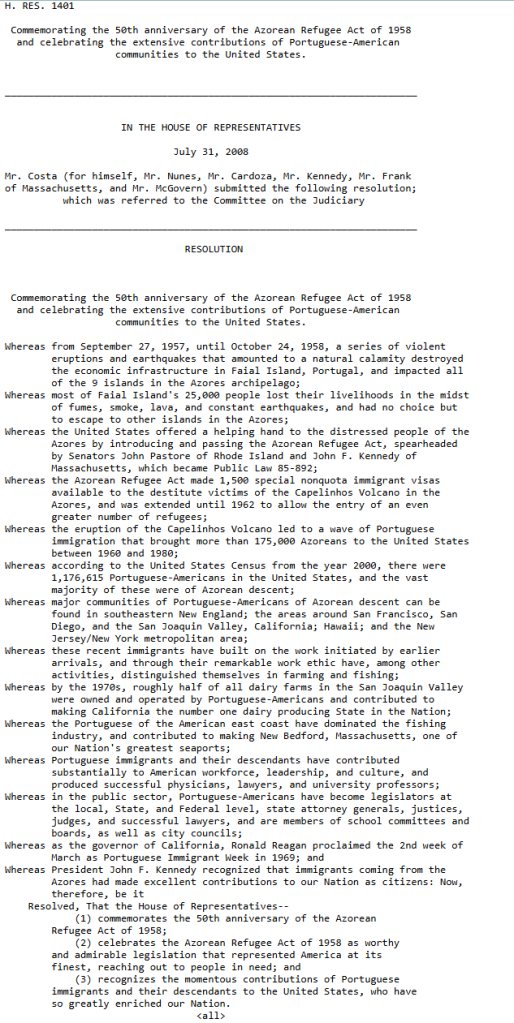
The following is the House of Representatives resolution commemorating the 50th anniversary of the Azorean Refugee Act of 1958.
 Filamentos (artes e letras)