

In the luminous and haunting collection, Rising of the Shadows, José Pedro Leite offers readers a poetic vision that is visceral, mythic, and intimately human. It is a vision rooted in a deep inner landscape, a place not merely imagined but profoundly lived. His poems, translated into English by Luísa Mira Corrêa and me, are not simply acts of writing but of excavation. They unearth memories, physical sensations, ancestral echoes, and the textures of time. In Leite’s poetry, language becomes breath, flame, and wound—both a human artifact and a divine revelation. For readers in North America, especially third- and fourth-generation descendants of the Portuguese diaspora, this translation serves as an essential bridge to the contemporary soul of Portugal and its poetic traditions, now reimagined for a wider audience.
José Pedro Leite’s work operates on a plane where poetic form and existential weight converge. His poems, often structured like prose blocks, unfold with meditative depth and cyclical rhythm. The syntax is rich, layered, and metaphor-heavy, yet never obtuse. Each stanza pulses with emotion and thought, often coalescing around central themes: memory, loss, the body, time, death, love, and the sublime terror of being. From the very beginning of the collection, the poetic voice emerges not from observation but embodiment. In the opening poem, he writes:
“We always return to the backyards and coronations of the past…
the mammal still alive and breathing
the rising of shadows
that in the pupils / from the white burns the surfaces.”
These lines establish a central motif of the book: the theme of return. Return not just as nostalgia, but as reckoning, as recursive descent into memory and matter. The “mammal still alive” suggests a primal vitality, even amid the crumbling detritus of modernity. The “rising of shadows” is both menace and possibility—a metaphorical ground zero where identity, time, and language are reborn.
José Pedro Leite’s poetic force comes from this constant collision between vision and body, abstraction and sensation. In his poem “2” from the first section The Time Spent in Practice, he writes:
“Childhood burns as a torch
within the walls and stucco of the house…
retreating through false doors / blades of mud
and trees where oxygen was lacking.”
The intensity of his imagery transcends mere symbolism. Here, memory is not a story, it is a searing presence that lingers in walls and architecture, in absences and distortions. The house, a traditional symbol of refuge, becomes a labyrinth haunted by loss and the memories of childhood fire. This is poetry that refuses comfort; instead, it exhibits.
His visual impairment adds a striking layer to this poetic interiority. As Leite states, in a quote used masterfully by writer and translator Richard Simas, in the preface, “My visual deficiency is an integral part of my work… My perception of the world is different, and thus, the images I create align with my idea of reality. This “idea of reality” emerges not as limited, but as reimagined. Leite doesn’t describe the world as seen—he translates it as felt, sensed, known. This is nowhere more evident than in the poem “6” from section three:
“When you name the world
each time you put in your mouth
the fig / the cry / the oxide / the noon
…
it’s fire as you say…
(and so the poem is intended to be
raw and carnivorously naked)”
To name is to ignite. To write is to reveal flesh. Leite’s humanism lies in this deeply corporeal relationship with language and the world. Words are not vehicles of detached thought, and they are extensions of the body and soul, charged with fire, hunger, and mortality.
But Leite is not only a poet of intensity; he is also a poet of tenderness, of love that defies linear time. In “5” from The Synthesis of the Fire, he writes of a relationship not as a metaphor but as cosmos:
“It was a love-mill in a continuous rush
a gill / a homeland / a diaphragm in resolution
…
I’ll say it: a love-quartz
a pearl of salt / the bloom / the blade of a fruit
intransitive like death.”
Love here is both kinetic and mineral, an act and an essence. It is physical, spiritual, and linguistic all at once. The “love-quartz” and “pearl of salt” suggest something beautiful but formed under pressure, enduring yet delicate. His poetic vocabulary borrows from geology, anatomy, and astronomy, and his metaphors always push against the limits of the sayable.
This humanism is not abstract but grounded in ancestral awareness. Leite’s poetry often conjures peasant life’s toil, rituals, and ghosts, connecting past and present, self and other. In “21” from the first section, he writes:
“He plans the harvest
pushes the wheel
erects the house…
and creates death…
and knows that all this
is more profound than any god.”
This is where Leite’s work feels both ancient and revolutionary. His poetry is rooted in a cosmos of labor and humility, where divinity is not above but within human action and endurance. The metaphysical is not divorced from materiality; it pulses through the cracked hands of a farmer, the tilt of an ox’s yoke, and the rhythms of domestic survival. This grounded mysticism speaks to readers in the diaspora who often inherit fragmented histories of rural life and immigration. Leite helps reimagine those roots as mythic rather than merely nostalgic.
This is where translation becomes not just important but necessary. I thank Luísa Mira Correa for partnering with me as we tried ardently (with many hours of translating and retranslating) to preserve the original Portuguese’s musicality, precision, and spiritual density while offering an English that breathes with its poetic gravity. We both tried very hard not to flatten Leite’s rich metaphors or syntactic daring; we tried to honor the complexity, ensuring that the English-language reader receives not an echo but a song with full resonance.
For the third and fourth generations of Portuguese-Americans and Portuguese-Canadians—those born into English yet hungry for their heritage—Rising of the Shadows is more than a book. It is a revelation. It demonstrates that contemporary Portuguese poetry is alive, inventive, and indispensable. It bridges time and distance, offering an ancient and utterly modern voice. In a world where many in the diaspora know only fragments of the language of their ancestors, translation provides a path toward reconnection—not just to culture but to a sense of belonging and feeling.
Leite’s poetry has no patience for clichés or platitudes. It dives into the psychic abyss and emerges with artifacts of truth. In “20” from the final section, he writes:
“Take from the poet the insurrection / the freedom of the night
the wide song where all pitchers crack open…
…
and he
nailed to the empty veneration of death
shall not write
another poem.”
The poet’s act is sacred, even when it trembles with darkness. If stripped of freedom and memory, the poet dies—not physically, but existentially. For Leite, poetry is the only viable handrail and tool capable of giving style to chaos.
José Pedro Leite reminds us that poetry is not a luxury but a necessity. It is not a genre but a way of being, a way of naming and navigating the world. His work teaches that we are “naked drunks of language,” haunted by memory and driven by longing, bound to the word as to breath itself. For members of the Portuguese diaspora who may feel severed from their language, land, and spiritual continuity, Leite’s poetry—rendered in English—restores that thread. It demonstrates that modern Portuguese writing is not confined to the past but is actively forging new paths through fire, shadow, and song.
Ultimately, José Pedro Leite’s Rising of the Shadows is both a testament and an incantation. It is a work of devastating power and shimmering light. It asks us to confront what we would rather forget, speak what we often leave unsaid, and feel—fully and unflinchingly—the burden and the beauty of our shared human inheritance.
Diniz Borges
You can order directly from Bruma Publuations in the USA and Canada.
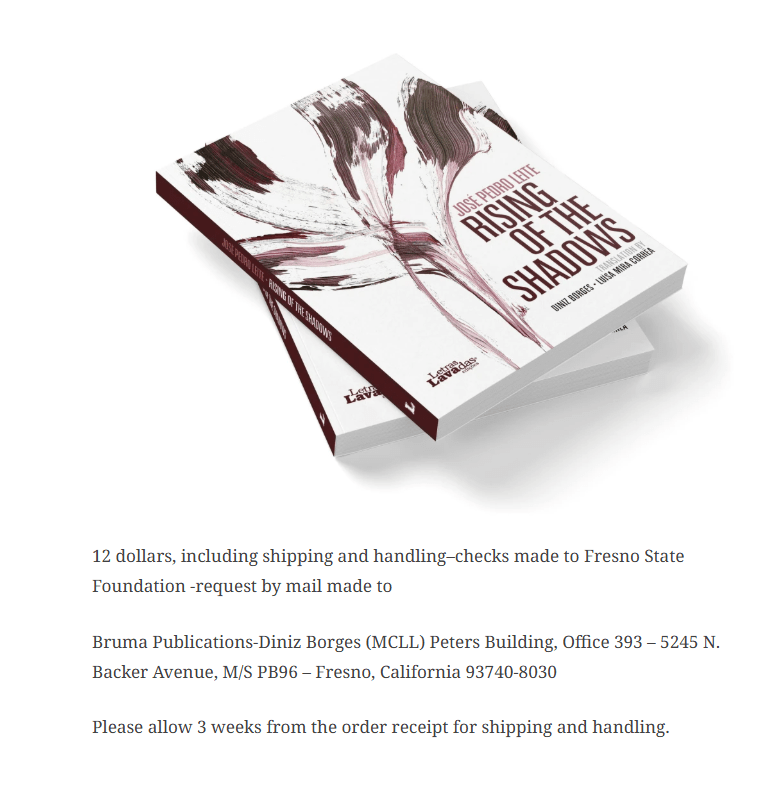
You can order it from Letras Lavadas in the Azores, Portugal, and any country in the European Union.
https://www.letraslavadas.pt/rising-of-the-shadows/

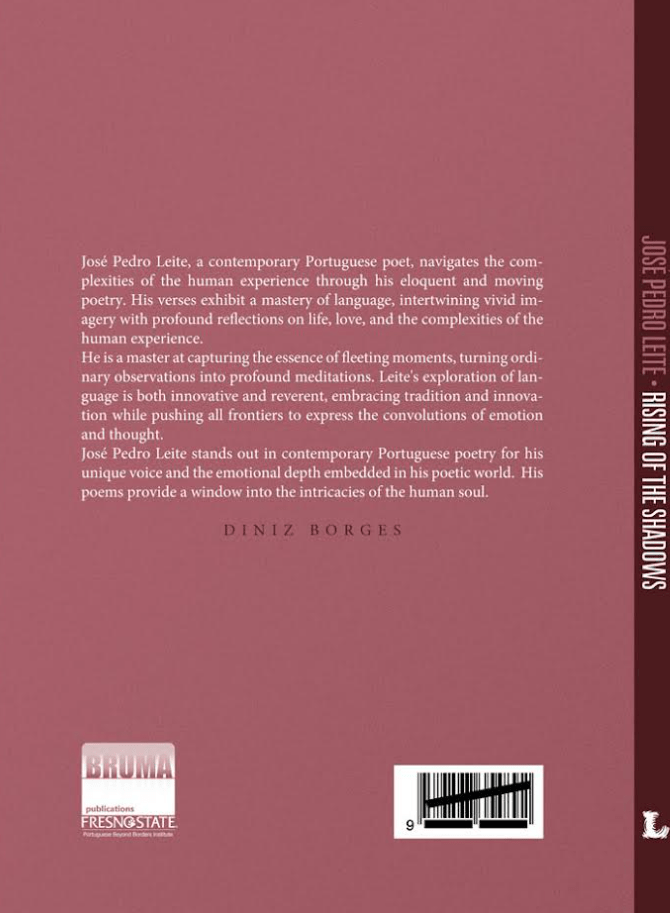
 Filamentos (artes e letras)