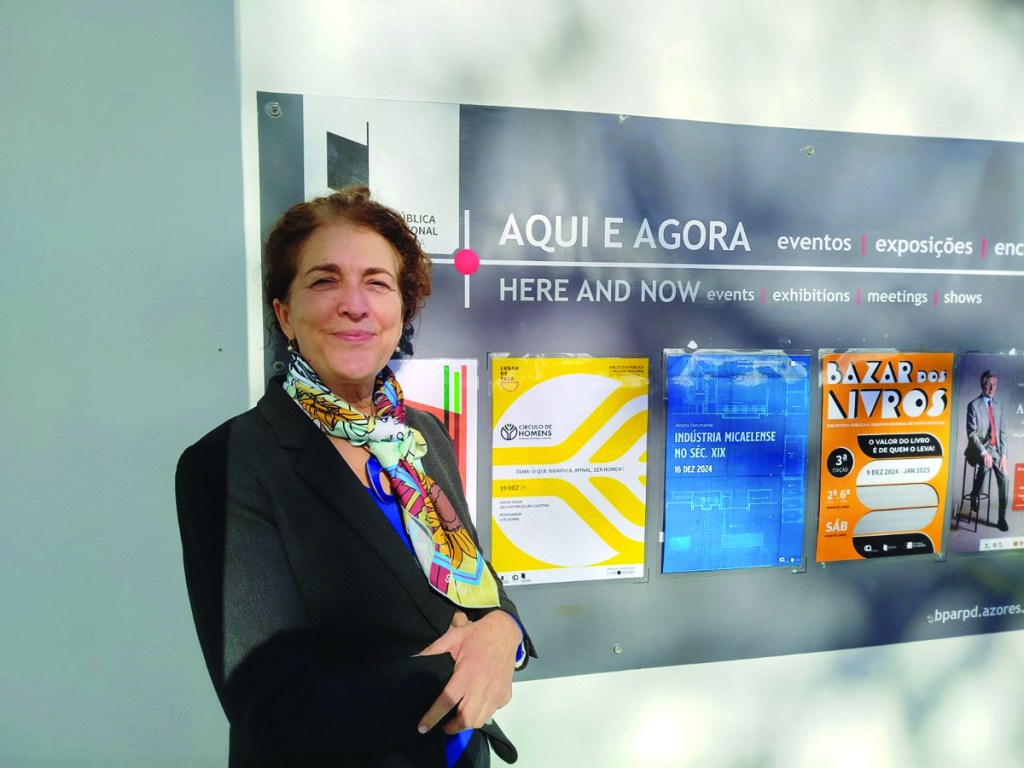
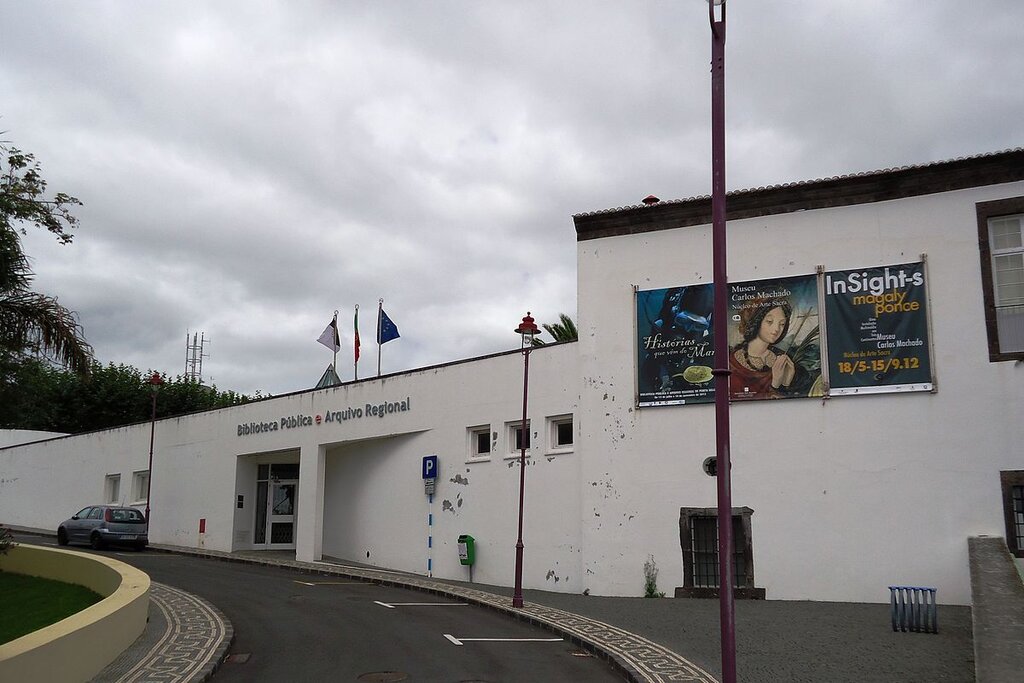
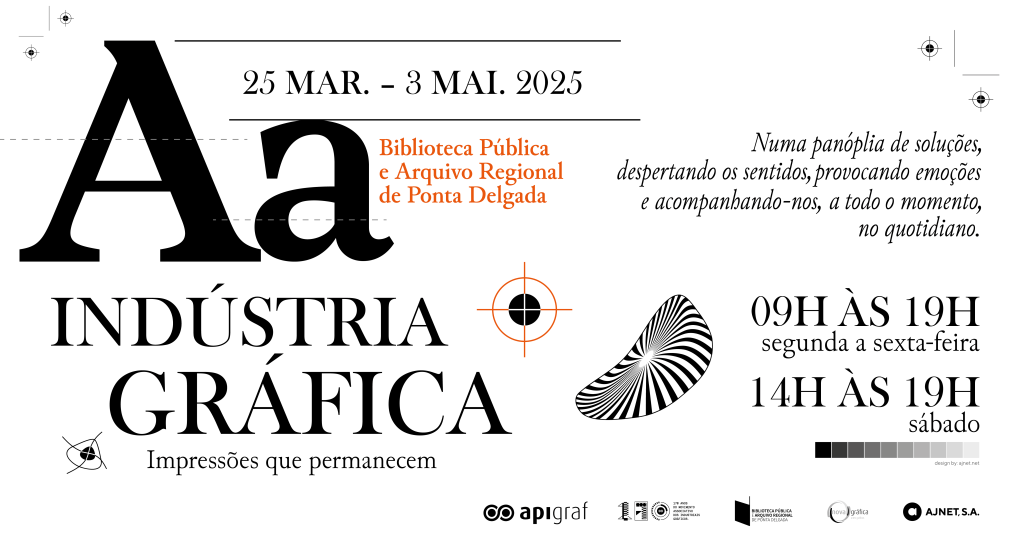
The Ponta Delgada Public Library and Regional Archive is hosting an exhibition dedicated to the printing industry as part of its Activity Plan for 2025. The exhibition, which runs until May 3, highlights the relationship between printing and preserving memory, presenting historical pieces and examples of the sector’s evolution. In an interview, Iva Matos, the Library’s director, explained that the initiative came about in collaboration with APIGRAF – the Portuguese Association of the Printing, Packaging and Digital Communication Industries, and aims not only to value graphic work, but also to bring the public, especially young people, closer to the impact of this industry on society. Among the highlights are a working printing press and rare documents from Antero de Quental and Teófilo Braga collections, who were also printers.
Correio dos Açores – What motivated this exhibition on the graphic arts?
Iva Matos (Director of the Ponta Delgada Public Library and Archive) – Every year, the Ponta Delgada Public Library and Archive plans activities for the following year. Last year, the APIGRAF – Portuguese Association of the Graphic, Packaging and Digital Communication Industries, in the person of Mr. Ernesto Resendes, one of its members in the Azores, contacted us informing us that the annual meeting of this Association would take place in the Azores in March 2025. He also mentioned that there would be an exhibition – the one now on display – already at the Faculty of Fine Arts in Porto, the General Library of the University of Coimbra, and the Joanina Library.
It was an exhibition on the printing industry, which immediately struck us as very interesting, not only because of the theme – since the printing industry is closely linked to the information medium of the documents we hold – but also because of the successful track record it has already accumulated in other libraries.
We, therefore, decided to host the exhibition and include it in our Activity Plan for 2025. We analyzed this proposal along with several others because the exhibitions at the Public Library and Archive are mainly intended to showcase our documentary collection. In the case of this exhibition, we managed to associate our documentary collection with it. As you can see, in addition to all the copies and objects on display, we also have copies of the Private Libraries of Antero de Quental and Teófilo Braga in our custody. This is a way of giving visibility not only to the work of printers – which is still very present today and, fortunately, generates a lot of employment on the larger islands, in newspapers and printing houses – but also a reason to exhibit some rare copies from the collections of Teófilo Braga and Antero de Quental, who were also printers. In other words, they both worked in this field. I also mentioned Alice Moderno, who owned a newspaper and a printing press in Ponta Delgada. It makes perfect sense for this exhibition to be on show because the Library and Archive work mostly uses printed paper – increasingly with digital as well – but we have 30 kilometers of printed documentation. It makes perfect sense to exhibit this relationship between memory and printed paper.
In this regard, I would like to remind you of Irene Valejo’s magnificent book, entitled ‘Infinity in a Reed’, ‘a tribute to the great leap in civilization that humanity has made by being able to record on paper its memories, its thoughts and its ability to communicate, not only with its own generation, but also as a way of passing on knowledge to future generations. In this respect, I think it’s very important to emphasize that the printing industry, heir to Gutemberg and Senefelder, has this value that it is essential to show and pay tribute to.
One of the highlights of the exhibition is the printing press. Can you give us more details?
Fortunately, our library and archives have a diverse audience, not only made up of researchers, but above all of the many young people who come here daily. It’s a public library in the truest sense of the word and we want it to be accessible to everyone. We work to ensure that everyone comes and uses our services and spaces and, above all, that they feel free.
An exhibition with only paper and documents isn’t that appealing, and exhibiting the printing machines and the opportunity to see printing with type is very important because it makes the younger generations see how it was and is possible to fix thought on paper.
On the other hand, this exhibition is very interesting because it demystifies that printers only work for newspapers and books, including examples of printing on medicine packaging, 3D printing, and printing on potato chips, cans, and plastic bags, which brings the exhibition closer to visitors’ everyday lives. It’s therefore very important to include printing machines in the exhibition, especially for the younger generations who are unfamiliar with this world of printing, an area of the economy that has evolved a lot and generates a lot of jobs, knowledge, and memory and also establishes the identity of a people.
We saw the labels of some Azorean products there, for example. It’s no coincidence that at the very beginning of the exhibition there are blank packages, with nothing printed on them. Those blank packages are worthless if they don’t have a message, a brand, some kind of identity, an impression. It’s very important to make people see this whole exhibition circuit.
What was the reason for paying homage to Antero de Quental and Teófilo Braga?
Both Antero de Quental and Teófilo Braga were printers. We have their documentary collections here and the collections of Natália Correia, Mota Amaral, the Canto brothers, Hintze Ribeiro, and Armando Côrtes-Rodrigues, among others. Fortunately, we have numerous collections of personalities that we are very proud of, but Teófilo Braga and Antero de Quental, contemporaries, also stand out for having been printers.
Teófilo Braga did it out of passion but probably also out of necessity. He said that with typography, he became stronger and made his way in life. He started this activity at Tipografia J.J. Botelho in Ponta Delgada, where he printed his first book, Folhas Verdes, in 1859. We know that he was also a printer in Porto later on. Antero de Quental followed this path out of political conviction. A staunch socialist, he wanted to get closer to the proletariat and gain experience working in printing houses in Portugal and abroad. At the time, printers mainly printed newspapers and played a very important role in society, whose hard and intense work marked a time of great technological and social transformation. Antero worked as a printer in the Imprensa Nacional Casa da Moeda workshops in Lisbon in 1866 and later continued his apprenticeship in Paris. Even today, the printing industry has its importance, but at that time, the weight of the printing industry was particularly significant and close to the intellectual milieu. We mustn’t forget that the printing press is the basis for all the literary work of these great Azorean intellectuals who have come down to us and are in the custody of this Public Library and Regional Archive.
In your speech during the exhibition’s opening, you mentioned that many schools would visit it. Who are the exhibition’s target audiences?
Mainly passers-by and various users who freely enter the Public Library and Archives. That’s why we’ve placed the exhibition right at the entrance to the library, both as a matter of space management and because it’s more appealing to passers-by. We’ll soon be celebrating José Dias de Melo’s centenary and have reserved the prime exhibition space for this. Not that it’s any less important, but it’s an exhibition that challenges passers-by and draws their attention to a medicine package or a printing press. The idea is precisely to make people stop, observe, and reflect.
In this way, the target audience is broad and diverse, but in particular young people, so they can learn about a profession and the whole circuit of value it represents for society. In fact, many of the illustrious people in São Miguel society have had their names associated with printing. I remember, for example, Alice Moderno and José Bruno Tavares Carreiro, who founded the newspaper Correio dos Açores, among many others.
We hope that this exhibition will also appeal to secondary school art classes. This learning niche can offer a lot, so it will be essential to bring students here, and that’s why we’re going to advertise to schools the possibility of organizing visits and creative workshops there.
How do you see the relevance of the printing industry today, especially in an increasingly digital world?
Well, that’s the old question. When computers began appearing, many people believed the book would end. However, reality has shown the opposite: today, we still print and read a lot on paper.
In fact, paper is still considered the longest-lasting writing medium and the easiest to preserve, even in a humid climate like ours. To ensure this, we use dehumidifiers and carry out periodic disinfestations, allowing paper to be maintained for a long time. So far, it has been proven that it can be preserved for at least 500 years.
Digital, on the other hand, is more complex. This is not only because access has to be mediated by a machine—which makes us less autonomous and dependent on technology to consult documentation—but also because digital information is easier for others to manipulate. By relying exclusively on digital information, we risk being less free. Today, the world is moving at a dizzying pace, with multi-millionaires dominating digital information and worrying about how we think and receive messages.
Although what is written on paper can also be censored—and has been throughout history—the fact that access to it does not depend on machines to be read gives human beings a different kind of power, freedom, and confidence. I believe that this is the great fascination of printed paper even today.
Filipe Torres is a journalist for the Correio dos Açores newspaper – Natalino Viveiros, director.
Translated to English as a community outreach program from the Portuguese Beyond Borders Institute (PBBI) and the Modern and Classical Languages and Literatures Department (MCLL) as part of Bruma Publication at California State University, Fresno, PBBI thanks the Luso-American Education Foundation for their support.

 Filamentos (artes e letras)