

In Dripping Words, the posthumously gathered and translated poetry of Madalena Férin, readers encounter a fierce, intimate, and metaphysical voice steeped in the memory of the Azores and driven by longing—for freedom, for expression, for a world that does not cage the soul, the body, or the woman. This collection is a portal to a world where mysticism, archetype, and feminist defiance intertwine. The poems invoke mythical women, maternal force, elemental landscapes, and an abstract and rooted language, all while echoing a deep yearning to be whole and free.
Férin’s poetic world is undeniably shaped by her Azorean heritage, especially from the island of Santa Maria, where she was raised. The sea appears everywhere, both as physical boundary and existential metaphor: “the ring of the sea / always locks around me!” (“Prisoner of the Sea”). The archipelago’s insularity becomes a symbol of isolation but also of mystical origin. In “Fisherwoman of Illusions,” the poet casts her nets into a moonlit ocean, chasing dream and desire: “My hammock was woven / of Dream, and the oars / were still of Illusion… / My heart was rowing!” This connection to the sea—simultaneously maternal and entrapping—recurs across the collection, linking the female condition to geography. “The island / promised…” she writes in “The Bird Woman,” signifying both physical place and spiritual destination, where the self might finally be whole.
The feminine voice in Dripping Words is never passive. It is restless, transgressive, and defiant. The speaker of “UGLY GIRL” dares to look at her reflection through myth and element, shaping her identity through seaweed and stars: “At the bottom of the waters / my face was scratched! / – What does it matter, what does it matter? / My eyes are seaweed and stars / and moons!” Here, Férin upends conventional beauty standards, finding worth and vision in what has been excluded. She refuses to see herself through the eyes of others; she imagines herself into being.
Férin’s feminism is mythopoetic. She does not explicitly rail against patriarchal structures; instead, she undermines them through allegory, symbol, and female archetypes drawn from the biblical, classical, and mystical traditions. The mermaid, the shepherdess, the queen, and the mother emerge as empowered and vulnerable figures. In “MERMAID,” inspired by Andersen’s tale, the titular figure sacrifices voice and self for love, but Férin’s version ends not in submission but in transformation: “Instead of killing him / she gave him a salty kiss!… / And his body finished / in a water lily, opened / and into foam!” The story resists finality. Love, here, is not passive sacrifice but a sea-bound metamorphosis—tragic and liberating at once.
Motherhood is another key motif through which Férin explores the female experience. In poems like “MATERNITY” and “AND YOU WILL GIVE BIRTH WITH PAIN,” the process of giving birth is elevated to cosmic magnitude. “From the kissed mouth / the river of screams is born!” she writes, fusing pain, creation, and divinity. There is something sacred in maternal agony. Yet, this sanctity does not erase complexity. The poet celebrates maternity without romanticizing it, expressing exhaustion and ambiguity, as in “FALLEN NOVEMBER”: “I can’t not be / November – a poet? – / I just want to be a mom!”
The longing for physical and metaphysical transcendence is central to Férin’s poetic project. Her poems ache with a desire to escape limitations: of the island, of the body, of time. In “IF I WISH… I HAVEN’T DIED!” she confesses, “I’m sailing in the mist… / there’s no reef! / There’s nothing I can grab / in my lost fingers!” This haunting image evokes a liminal state, as if the speaker has become a ghost of herself, still dreaming but disembodied. “Help me!” she cries, not merely for survival but for presence, for return to full embodiment.
That yearning extends to time itself. In “THE ESCAPE OF TIME,” Férin’s speaker mourns death and the passing of life: “I tried to hold Time in my hands… / It slipped through my fingers like smoke.” The poem becomes a plea not only to reclaim memory but to reinhabit moments of motherhood, joy, and sorrow. “I want to be Me inside of time again!” she declares. This is the cry of a woman who has lived deeply and who resists erasure.
In many ways, Férin’s poetry reads like a spiritual quest, what Angela de Almeida calls “a logos of initiatory and therefore inner flight.” The poet embarks on a metaphysical journey, summoning archetypes and dreams in a struggle toward wholeness. This is evident in the recurring image of wings and flight: “On the night I / die / I will spread my / multicolored / wings…” (“The Bird Woman”). The winged woman is not merely a fantasy; she is the poet, transcending prison and island, body and silence, in an alchemical ascent.
Despite these moments of transcendence, Férin never abandons the sensual world. Her imagery is lush and tactile, infused with color, smell, and rhythm. In “IMPERFECT MORNING,” the landscape itself seems alive with erotic and maternal force: “Gerberas open‑up like / mouths to a kiss… / A shiver of lushness shook the rose bushes: / it was the sun that kissed them / and roses are born…” Nature, in her work, is never neutral. It is gendered, emotional, and intimate. The poet’s relationship with the earth and sky mirrors her internal cosmos.
Férin’s Azorean context is not just geographical but emotional and existential. The sea, wind, and hills are not backdrops but participants in her spiritual drama. In “NOCTURN,” the night is alive with “an intense / longing,” and the hills receive “the moon / that languishes.” Her voice is shaped by the solitude and grandeur of island life and its distance from the mainland and dominant cultural centers. In this way, Dripping Words offers poetry from the Azores and deeply Azorean poetry—one that understands exile, distance, myth, and nature as part of the self.
As a translated work, Dripping Words is also a bridge. As the translator, I tried, maybe not successfully, to preserve the fluidity and mysticism of Férin’s language while making her work accessible to English-speaking readers, especially among the Azorean Diaspora. In this translation, I didn’t- never would- try to domesticate her poetry but allow its peculiarity, its archaic and surreal beauty, to resonate. This is especially important because Madalena Férin’s metaphors and spiritual references draw from a complex web of biblical, mythological, and literary traditions.
Ultimately, Dripping Words is a poetic testament to a woman who lived between worlds—between the Azores and mainland Portugal, between myth and memory, and between silence and song. It is feminist, not in polemic but in its profound assertion of female subjectivity and experience. It is mystical, not escapist, and uses symbolic means to reimagine the real. And it is deeply human in its vulnerability, celebration of life, and refusal to give up the dream of flight.
As the poet writes in “MESSAGE”:
“Poets, we need to break through tomorrow
where Poetry is virgin of words!
May the idea emerge pure from its nest,
pure as a jet of water!”
Here is Férin’s call—to purify language, reclaim the poetic voice, and break the molds that confine art and self. Her poetry is, above all, a call to freedom: aesthetic, spiritual, and feminist. Through this translation, I believe that such a call now echoes far beyond the Azores, reaching all who know what it is to long, fly, and return.
In a time when global voices are increasingly amplified, Madalena Férin’s poetry is timeless and timely. It speaks to the soul’s exile, the female self’s fragmentation, and the ever-present longing to return to the womb, the sea, and the voice. Feminist without didacticism, mythic without abstraction, and insular without isolation, Dripping Words is a stunning testament to the enduring power of a woman’s poetic voice to cross boundaries, defy erasure, and imagine new worlds.
As Férin writes in “Between Day and Dream”:
“I will build my tower.
Between Truth and Night
I’ll raise my thoughts
open windows to the inconceivable.”
Indeed, she has opened those windows for us.
Diniz Borges, translator
You can purchase the book in the US and Canada through Bruma Pyblications. Here is the info:
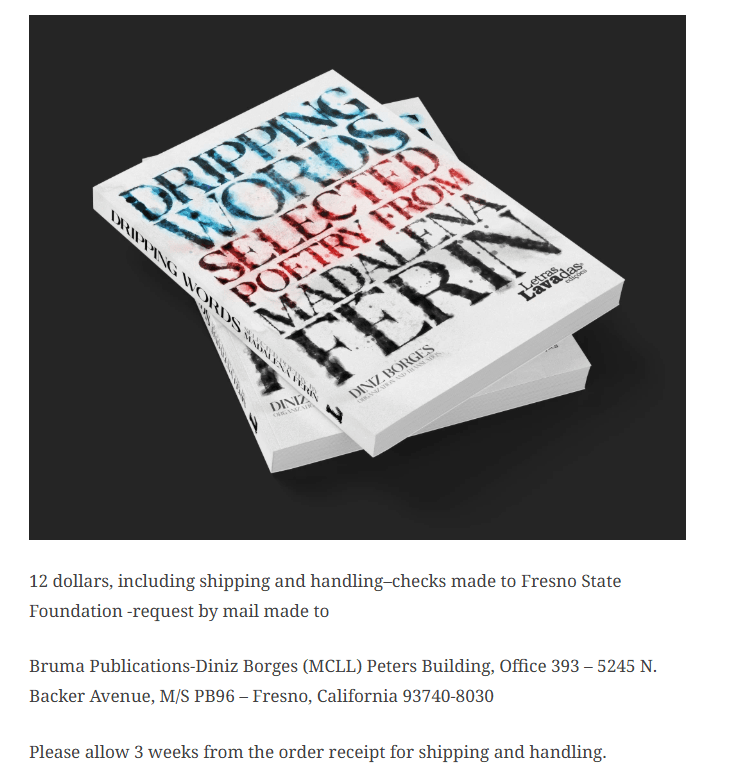
You can get it through Letras Lavadas in the Azores, Madeira, mainland Portugal, and any country of the European Union.
https://www.letraslavadas.pt/dripping-words-madalena-ferin/

 Filamentos (artes e letras)