
At the Minor Seminary in the early 1980s, we only went for walks on Wednesdays and Sundays. We couldn’t go out alone. So we went out in groups of three, four or five. Less than three was too few, and more than five was too many. We couldn’t go to the movies or to cafés. We would walk along the Avenida, by the dock, go to the Carlos Machado museum, wander through the narrow streets of Ponta Delgada, go to watch soccer at Jácome Correia or at the stadium, and I loved watching Lusitânia beat up Santa Clara and União Micaelense and Oliveirense da Fajã de Cima. Other times…
At that time and age, there was a kind of law of the jungle. There were forty or so seminarians between the ages of 10 and 16, more or less very difficult to handle. It was the age of personal identification, eternal friendships, boiling hormones, and observing the girls on the promenade like someone observing rare birds, that we were flesh and blood and not angels, as some people think. Following the alpha males, the dominators and rejecting the weak was a difficult age for all teenagers.
Dionisio (fictitious name) was doomed to be left behind. He had clumsy hands on the end of long, skinny arms and long legs, ending in shapeless feet. He was ugly. Large, sad, and deep almond-shaped eyes set against a half-twisted nose, a slightly twisted mouth, and an ungraceful gait. Nobody wanted to go for a walk with him. It was almost enough to make us laugh at him because, at that age, you have to lean on the weak to look strong. It was covert and devastating bullying. Dionisio’s eyes were the saddest, most innocent, and long-suffering in the seminary. I remember seeing him several times after lunch, begging one person or another for the favor of being able to go for a walk with them; I remember the denials he would get, accompanied by the most inexcusable excuses, such as “there are already five of us,” “find others,” “the group is closed.” And Dionísio wandered sadly among the others, begging for friendship, for affection, rejected. I don’t know how many times he stayed at home alone because he didn’t have anyone who wanted to go out with him. Children and teenagers are sometimes ferocious.
More than once, in these and other circumstances, I’ve seen Dionisio make faces to stop himself from crying, just like children do. And it was on a sunny spring Sunday that I found him sitting with his face in his hands as I entered the upper choir of the seminary’s beautiful chapel. He was crying. I sat down next to him and asked him why. He said: “It’s nothing”. And it was everything. In that ugly carcass of 13 or 14 years old lived a soul that suffered in silence without ever complaining. I wanted to give him one of those sweet, tight hugs, to be his soul mate, to know the depth of his suffering, to enter into his loneliness, to be his greatest friend. I invited him to go out with me, just the two of us, against the house rules. He didn’t want to; it was forbidden. But I convinced him, and we went for a walk in the São Gonçalo area, where nobody went for a walk. He told me about his family, about his father, who had always been a poor shoemaker and now worked in one of the best restaurants on the island, even though he earned very little; about his five brothers, and he was the eldest; about his mother, who was still young and already ill. With a voice that sounded like a chicken and a rooster, Dionisio sounded like an Italian because he spoke more with his hands than his mouth. We became the best of friends and, of course, began to be the object of teasing.
Father Laudalino, a director, called me into his office on Monday. Being called to the director’s office was always a cause for concern and fear: “I’ve heard twice that you and Dionisio are going out alone. Don’t you know that’s forbidden?” I plucked up the courage: “And haven’t you noticed that no one wants to go out with Dionisio?” “I have. But don’t do it anymore. It can’t be done.”
But it was on the soccer field that Dionisio became the party drummer. He had two left feet and was truly laughable. Clumsy on his long legs, he rarely hit the ball despite his desperate commitment to the game. Everything went wrong for him. He was always picked last, and whoever got him had every chance of losing. They always put him forward, and no one else remembered him; no one passed him the ball. By then, I already liked playing in goal.
It all happened in the space of a second. The ball came from a corner kick near the edge of the penalty area. Dionísio threw himself at the ball. By some miracle, the ball hit him square in the foot. It was a powerful shot. Everything was clear in my head. I had the chance to grab the ball. I threw myself at it with a bit of aplomb, pretended to slip, and let the ball go in. It was 4-3 for Dionísio’s team. And while my teammates protested at me for the “rooster” I’d taken, I, leaning against the post, almost cried with joy at the sight of Dionísio running desperately happy into midfield; it was his first goal, it was his team’s victory, it was his teammates running after him to hug him, and it was me, sitting there, soaking up that moment of glory for Dionísio.
There are small gestures.
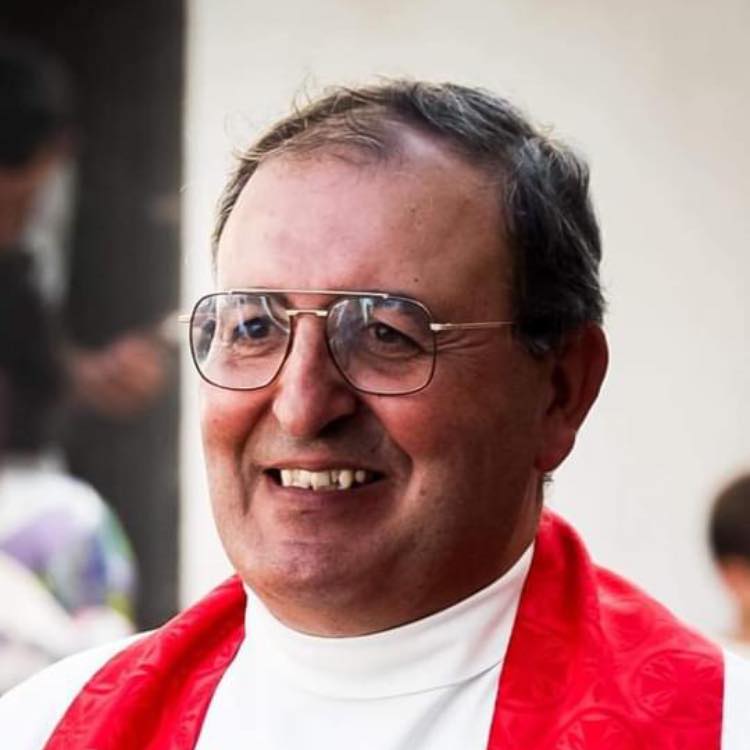
Júlio Rocha is a catholic priest in the Diocese of the Azores. He writes regularly for the newspaper Diário Insular in the city of Angra do Heroísmo.
Translated by Diniz Borges
Translated to English as a community outreach program from the Portuguese Beyond Borders Institute (PBBI) and the Modern and Classical Languages and Literatures Department (MCLL) as part of Bruma Publication at California State University, Fresno, PBBI thanks the Luso-American Education Foundation for their support.
 Filamentos (artes e letras)