
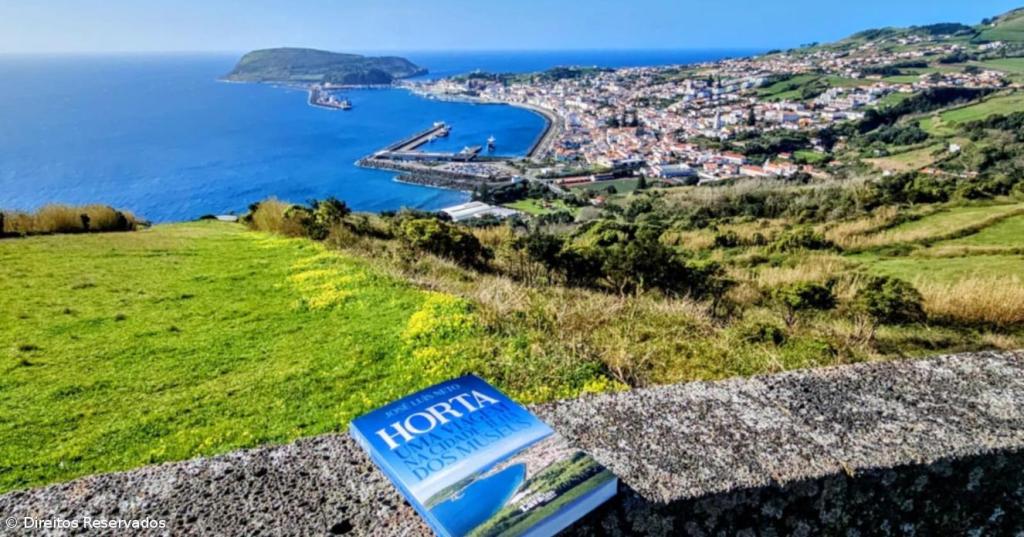
This is not the traditional tourist route, warns José Luís Neto, even before the interview. “Horta – a journey in the city-island of museums,” published by Letras Lavadas, was presented on Friday in Faial. It’s a tour of the island by the hand of its former museum director, with that personal side assumed from the first page, which seeks to contribute to Horta regaining its centrality in the Azores because, warns the author, “the archipelago itself is polysemic and cannot be centered in just one place.”
The book is a journey through the past by someone who is looking to the future in the present, by someone who was the director of the Horta Museum for three years, “who was given an exceptional welcome and had enormous contact with the people who live there and with the various social and cultural dynamics that the island embodies.”
It’s the history of Horta on paper, not just the history of the past but also the history that is being written today. For the author, who is more used to writing about those who are no longer here, it was an honor to talk about those who live there and make Horta so special.

“There are more than 100 personalities that I’m highlighting, in the most diverse areas, culture, the economy, the management of the city itself, the people who are pushing Horta to regain the place it once had in the archipelago. And when the island of Faial and Horta take it up again, we’ll have a much more interesting, rich and plural archipelago.”
The pages of the Letras Lavadas book feature Mustafa Gancho, a pirate who is thought to have inspired the character of Captain Gancho, Peter Pan’s archenemy, but also the “guardians of memory”, such as Carlos Lobão, Tiago Simões Silva and Victor Rui Dores, “because what they have been sowing has flourished and there are very strong initiatives and institutions in Horta that have been looking after its heritage and its memory”.
For an archaeologist, it’s inevitable not to pass by the island’s buried and underwater heritage, the monuments and a unique feature of Faial. “People don’t realize it, but Horta is the municipality in the Azores with the most museums per inhabitant – and most of them aren’t even museums run by the public administration, but private museums that have to do with people’s own lives,” he says.
The best known is the Scrimshaw Museum, part of the famous Peter Cafe Sport. Still, José Luís Neto highlights the Quaresma Museum in Ribeirinha: “It’s an absolutely extraordinary museum, made by a woman who takes the time to tell people her story. These are two of many museums that draw attention to and try to recover this common past. This right to memory is a very Faial characteristic”.

From the book, José Luís Neto would like a new idea and vision to emerge about Horta, which “we all know is not the most beloved island in the Azores. The main aim of the book, if we want, is for other Azoreans to get to know the island and understand it, and for any animosity and misunderstanding that exists to be overcome.”
Above all, the author sees the work as a “love letter” to Horta and its inhabitants. “It seeks to contribute to restoring a centrality to Horta, which is fundamental, because the archipelago itself is polysemic and cannot be centered in just one place. An island that has suffered three earthquakes in the 20th century, that has a volcanic eruption like the Capelinhos, that has been through a series of plagues, from the Black Death at the beginning of the 20th century to the COVID pandemic, and that has people who still insist on living and building there, has to be very, very special. In this city, which is the westernmost in Europe, there are people, there are stories, there are projects that should be known, shared and cherished.”
Nuno Martins Neves is a reporter for Açoriano Oriental-Paula Gouveia, director
 Filamentos (artes e letras)