
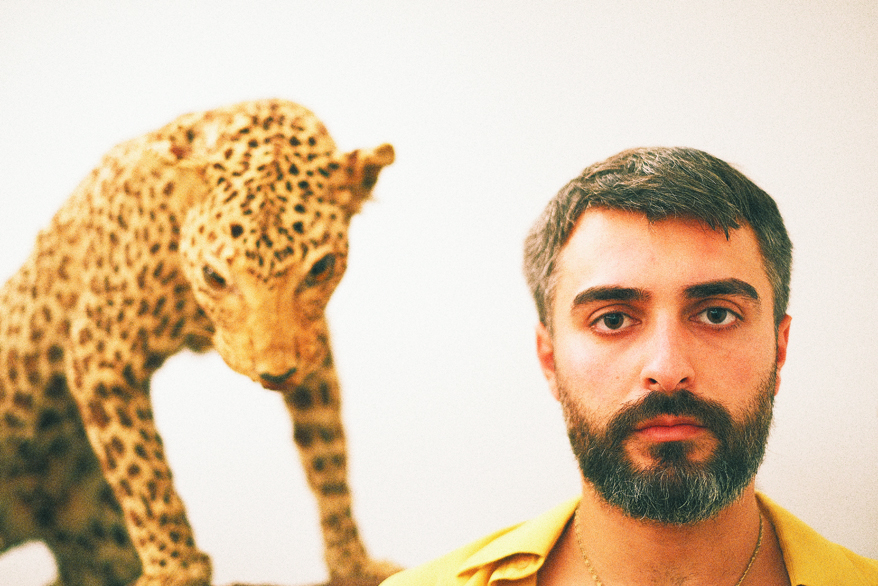
‘Romê das Fürnas’ is an album that sings with an accent and tells stories from the Azorean imagination. “It’s about regionalism,” says Romeu Bairos, who, with this album, wants to deconstruct the idea that you have to sing in a standardized Portuguese that “doesn’t belong anywhere”. The Azorean musician’s first album, produced by B Fachada, features three contemporary reinterpretations of traditional songs – ‘Sol Baixinho’, ‘Braços’ and ‘Manjericão’ – and four original songs: ‘Jacinta’, the first single, ‘Roupa Lavada’, ‘Pescadô’ and ‘Calços da Maia’, the music video for which has already won awards at two film festivals.
Correio dos Açores – The origin of ‘Romê das Fürnas’ was a conversation with B Fachada about accents. How did this idea develop into an album?
Romeu Bairos – It started with a conversation about accents and the fact that there is no accent on television or the radio. Portuguese on television is super standardized – you don’t hear the accent of São Miguel, but you also don’t hear that of the North, Alentejo, or Madeira… Most people in Lisbon ask me first if I’m from Madeira because they don’t know how to differentiate the accent. It’s not the people’s fault, of course; it’s the country’s fault, which, in this case, is culturally backward. It’s controversial, but it’s true.
A musician from Texas doesn’t bother singing in a New York accent. Willie Nelson, for example, has a southern US accent, and he’s still great. But in Portugal, we do a giant exercise to match a centralized pattern, a standardized accent that doesn’t belong anywhere. This album aims to break down that barrier. It’s not just about the São Miguel accent; it’s about all accents – it’s about regionalism.
I feel there’s a lack of identity in Portuguese music – I’ve always listened to a lot of Portuguese music, and there are artists I really like. However, since I started working on this album, it’s hard to feel satisfied. Firstly, because of the accent issue. Of course, there are hip-hop people and artists like Manel Cruz who sing with their accents, but in general, that doesn’t happen. And then there’s another issue: most people only write about themselves, but I want to know about something bigger. In a way, that’s what I’ve tried to do: a record of my people, what we do here, what we used to do, and, above all, who still does it…
Can you explain the graphics of the album’s name?
The album’s name is an instruction to the accent: ‘Romêu’, because that’s what they call me. And the umlaut in the ‘u’ is to be read as ‘das Fürnas’. The aim was to bring that identity to the record. That’s why the lyrics are all written with an accent.
I started working with B Fachada in 2022. First, we listened to many topics and researched themes to understand the musical language we wanted to follow. But then we spent a lot of time working on the accent because there’s no reference to how to sing with the São Miguel accent. No book says: “It’s like this.” And there isn’t because nobody does it. Or, if they did, it was a folklorist from Relva or Covoada. Many things had to be deconstructed, and I started writing songs about this exercise.
The album includes three contemporary reinterpretations of traditional Azorean songs: ‘Sol Baixinho’ from Santa Maria, ‘Braços da Terceira’, and ‘Manjericão’ from the island of São Miguel. Do you want to talk a bit about these choices?
We went looking for themes that made sense within what we wanted to do. The idea was not just to take old songs and give them a new look but to understand how they would play those songs if they had the means we have today. And to do this while preserving that energy they had—people who went to bed when the sun went down and woke up before the sun came up, people who had their jobs and played for fun.
Then there’s the question of folklore itself. As with all folk music in the world, there is a very strong pagan component. But in Portugal, many lyrics were adulterated with the dictatorship and the weight of the Church. References to the devil were removed, for example, and verses were changed. And, in fact, folk has an almost ‘heavy metal’ side—it’s dark but with a cheerful vibe.
First, I worked with B Fachada and then Micaela Sousa, who plays the violin. The idea was to try to capture that energy they had using the resources we have today. We can connect to a modern sound system, but the essence—the vibe—is almost there. I still have to work on it, but I’m happy with the result.
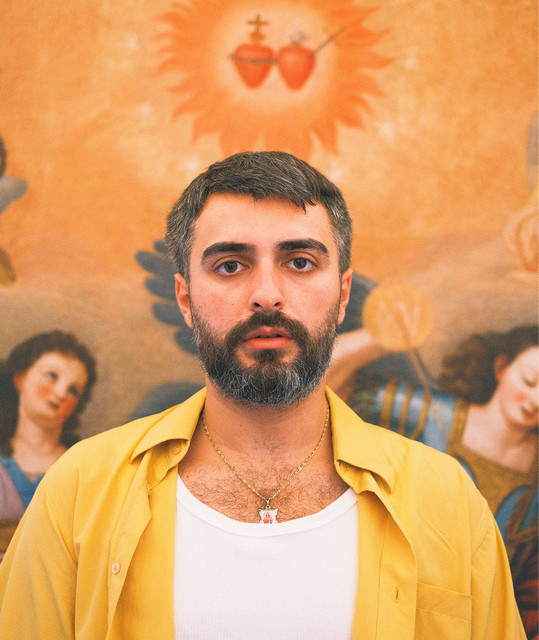
Can you tell us a bit about the line-up for ‘Romê das Fürnas’?
The album starts with ‘Sol Baixinho’, a song from Santa Maria, my father’s island. And for me, it makes perfect sense to start like that. I think it’s one of the most beautiful songs from the Azores, and it has its own vibe, even different from traditional Portuguese music.
Then comes ‘Braços’ from the island of Terceira. José da Lata, a very important figure in traditional Azorean music, wrote a version.
Calços da Maia tells the story of a farmer from Lomba da Maia who separates from his wife. He walks around the taverns and doesn’t pay any attention to her—an almost ‘cultural’ story, so to speak. He is that typical man who doesn’t speak, who doesn’t know how to communicate. He needs therapy, therefore. The music is intense; it’s a bit of traditional punk.
The song ‘Roupa Lavada’ is more personal. It talks about my family, the things I remember from my childhood, the family dynamic: my mother, my grandfather, my grandmother, my brothers, my aunt Angelina – hence the “blue and white soap” line.
Then there’s Jacinta. Anyone who listens to the lyrics realizes that it’s a courtship. In the old days, there was a whole protocol, a way of courting. Nowadays, of course, it’s faster and more immediate. But before, we took more care of things and people. When you married, you did it to make it work. That’s what you feel in the song: they were in a half-hidden courtship in that ‘jump out the window, don’t jump out the window’ situation. It was fun. Nowadays, nobody jumps out of the window anymore; you just go through the door.
Then comes ‘Manjericão,’ one of the first songs I heard with B Fachada, which completely blew us away. We listened to the version by an old man from Povoação who nobody knew. Nowadays, folklore plays it differently, without that raw part. Manjericão isn’t about the plant – it’s a mythical figure, almost a spirit of the forest. The lyrics show a dialog between the mountain basil and the woman. He says: ‘Only my good self, I don’t know how, isn’t afraid’, as if to say ‘she’s no longer afraid, it’s me who’s afraid’. And she’s there challenging him: ‘Come on, come on. There’s a certain malice in that song. Sometimes people forget that the ancients weren’t all saints, they were just like us. The lyrics end by talking about the Caldeiras das Furnas, which almost represent Hell. That pagan side has disappeared from many songs over time. ‘Manjericão’ is one of my favorite songs on the album – it has an incredible energy to play live.
Finally, I wrote the lyrics to ‘Pescadô’ thinking about the fishermen of Ribeira Quente and some of the people I met who died at sea. Ribeira Quente is very close to Furnas, and I have an emotional connection with that place and the people there. In fact, part of the music video for ‘Eu Não Vejo Chorar’ was shot in Ribeira Quente – it was supposed to be just camera tests, but it turned out so beautifully that we decided to use it.
The album is short—only seven songs—but it’s very concentrated. I’ve already realized that there will have to be a second volume because I haven’t talked about everything I wanted to.
What stories remain to be told?
I think there’s still a lot to say about Furnas. The album is called ‘Romê das Fürnas’ because I’m from Furnas, but there are many stories from there that I haven’t told yet. In the next volume, I want to focus more on that. I’m already working on speeding up the process. Maybe it will come out in 2026, and I want to try to release an EP later this year, but I’m not sure. Let’s see if everything works out because now many concerts are starting to appear. And, most importantly, I also have to live. I have to go to the beach, walk around Lagoa das Furnas, go to Poça da Beja and Terra Nostra. When a banker leaves the bank, it’s over. And I have to start looking at music a bit like that. Last year I went on vacation and realized I’d never been on holiday. It was like, ‘Wow! Life isn’t just about work’. As a musician, work goes with you everywhere. Work has been the most important thing in my life, but I have to learn to switch it off a bit.
Who collaborated on this album?
Micaela Sousa is on violin and vocals, Nuno Lucas is on bass, and Manuel Pinheiro is on percussion. The sound engineer was Eduardo Vinhas, and the producer was B Fachada. We recorded the album in a studio in Vale de Lobos, near Sintra – which is Rui Veloso’s studio – and the mastering was done by Mário Barreiros, a great Portuguese music star who produced Rui Veloso’s ‘Viagens’ and Clã’s albums, among others. I think that for Volume 2 I’m going to keep the same team – you don’t change a winning team.
The album cover recreates an Espírito Santo flag. Mário Roberto, an artist from Ponta Delgada with the Traça Studio Gallery, took the photograph, and Ana Filomena Pacheco designed it. The cover concept even simulates a flag of the Holy Spirit, with symbols representing each song.

Is there a difference between Romeu Bairos and ‘Romê das Fürnas’?
No. The album is called ‘Romê das Fürnas,’ but I’m still Romeu Bairos. I do various things and am involved in multiple projects, but musically, I don’t think I’m going back. This will be my record as a solo artist for a long time. And then, one day, it will end – I don’t want to do this for the rest of my life either.
What do you want to do after music?
I don’t know. Plant a garden, plant trees, and grow carrots to eat. I can’t see myself doing this forever. I’m still going to be involved in art, but there comes a point when you want to have a family, you want children, and then you won’t want to go around playing all the time. You want to be with your family and have a home, and that’s that.
What dates have you booked?
We have a lot of dates. We’re playing at Tremor, in Marinha Grande, in the United States, in Porto, Lisbon, and Coimbra, and we’re also going to Corvo.
I have three concert formats: solo, duo with Micaela, or quartet with the whole band. We’re going to try to do the concerts differently, and I like that dynamic. I’m not a big fan of repeatedly seeing a band play the same show. Overall, I’m very pleased with the result of this work. I’m satisfied when I eat a steak from the association, but I’m happy. It was worth it.
What other projects do you have in mind for the near future?
I have the Folkjada project with Gonçalo and Micaela Sousa, which mixes traditional and classical music. We’re recording an album. I also have the band Cavalo Marinho with Cristóvão, Sara Cruz, and João Félix, and we’re recording our first album.
In addition, I will be in the musical “Os Novos Bichos” – from Miguel Torga’s ‘Bichos’ – directed by Maria Ceia. I’m also producing a film directed by David Medeiros, in which I’m an actor. I guess I’m an actor too. Now I have an IMDb page and must fill it. (laughs).
Daniela Canha is a journalist for Correio dos Açores-Natalino Viveiros, director
Translated to English as a community outreach program from the Portuguese Beyond Borders Institute (PBBI) and the Modern and Classical Languages and Literatures Department (MCLL) as part of Bruma Publication at California State University, Fresno, PBBI thanks the Luso-American Education Foundation for their support.

 Filamentos (artes e letras)