

Carlos Paredes was born on February 16th, 1925, in Coimbra. Son of Artur Paredes, grandson of Gonçalo Paredes, and nephew-grandson of Manuel Rodrigues Paredes, he was heir to a large family of guitar tradition.
His father taught him how to handle the guitar, and just for fun, he accompanied his father when he was 9 years old. Later, when he was 14, he and his father played music of their authorship at Emissora Nacional every week.
Around 1931, his family settled down in Lisbon. He finished primary school at Jardim-escola João de Deus and then attended Liceu Passos Manuel. At this time, he had lessons in violin and piano. In 1943, he took the entrance examination at Instituto Superior Técnico but only attended for the first year.
In 1949, Carlos Paredes became a civil servant, working for several years at São José Hospital’s X-ray archive department until he retired on November 1st, 1986.
Carlos Paredes married twice: first, in 1960, he married Ana Maria Napoleão Franco Paredes, and then he married Cecília de Melo.
Carlos Paredes had a great influence on Portuguese popular music as well as Coimbra’s Fado and never rejected it. He was responsible for the renewal and re-invention of new tones of Portuguese guitar because he worked with singers such as José Afonso, Adriano Correia de Oliveira, Luís Goes, and António Bernardino, as well as he had the chance to play lyrics based on Manuel Alegre’s poetry, to play with António Portugal, and with the guitar players Rui Pato and Luis Filipe. Those names correspond to the generation of the ’60s, a generation of different socio-cultural ideas. To sum up, Coimbra’s generation made the guitar’s musical revolution and sang valuable principles of respect for ethnic cultures.
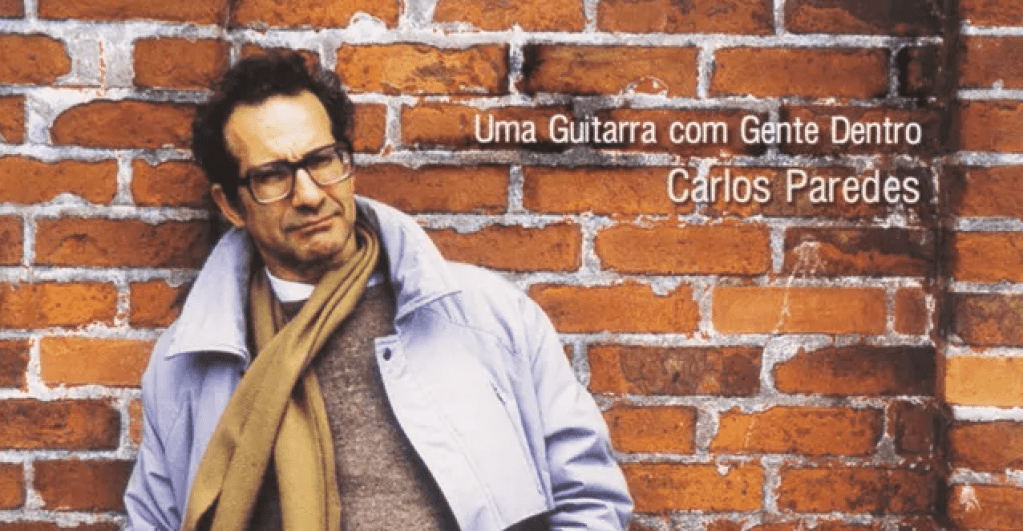
Carlos Paredes left us renowned musical works. His contribution to theatre, dance, and cinema was inestimable. He became one of the best composers/players of Portuguese guitar, despite never playing guitar, as it was his profession.
His career as a musician began when he recorded his first album, “Carlos Paredes,” in 1957. Three years later, in 1960, he composed the soundtrack of “Rendas de Metais Preciosos” directed by Cândido Costa Pinto. He started working on a partnership with Fernando Alvim for over 20 years.
This work wasn’t the last in cinema. He also composed for the film “Os Verdes Anos” (1962), his ex-libris composition, and the movie “Mudar de Vida” (1966), directed by Paulo Rocha, or “Fado Corrido” (1964), directed by Jorge Brum do Canto, he collaborated on “P.X.O” (1962), by Pierre Kast and Jacques Valcroze; “Crónica do Esforço Perdido” (1966), by António Macedo; “À Cidade” (1968) and “The Columbus Route” (1969), by José Fonseca e Costa; “Tráfego e Estiva” (1968), by Manuel Guimarães; “Hello Jim!” (1970), by Augusto Cabrita; and “As Pinturas do Meu Irmão Júlio” (1965), by Manoel de Oliveira, among others.
In 1964, he collaborated in theatre with José Cardoso Pires in the historical staging of Fernando Gusmão in Teatro Moderno de Lisboa, with Carlos Avilez in “Bodas de Sangue”, a CITAC’s play and in “A Casa de Bernarda Alba” of Garcia Lorca, presented by Teatro Experimental de Cascais.
The guitar player had composed lyrics for theatre and cinema until 1971. This year, he recorded his masterpiece, the record “Movimento Perpétuo,” a work of magnificent songs such as “António Marinheiro,” “Mudar de Vida,” and the track “Movimento Perpétuo.”
From 1971 to 1977, he composed the music to Agustin Cuzzani’s “O Avançado Centro Morreu ao Amanhecer” and chose the soundtrack of some shows performed by Theatre Group of Campolide.

Regarding dance, in 1982, Vasco Wallenkamp produced a play called “Danças para Uma Guitarra,” with music by Carlos Paredes.
After April 25th, 1974, the soundtrack of Revolution was his own music: the first democratic polls were daily TV advertised with his music. In 1975, the year of the elections, he recorded an LP in which the lyrics were poetry by Manuel Alegre. This record is called “É preciso um País”.
Carlos Paredes started performing at important stages all over Europe, and even without his producer’s agreement, an LP named “O Oiro e o Trigo” (1980) was sold in the Democratic Republic of Germany. This record has original songs recorded in 1973 and 1975. In that country, a record compilation named “Meister der Portugiesischen Guitarre” had already been sold in 1977.
In 1983, after he canceled the contract with Valentim de Carvalho, his new producer released a live-recorded album with original tracks in Frankfurt.
In the following year, he played guitar, and António Vitorino de Almeida played piano on a duet composition, recording the album “Invenções Livres” in 1988, Polygram, his new producer, sold the LP “Espelho de Sons”, achieving the 3rd position on the ranking sales.
His next work is a duet composition with the contrabass Jazz musician Charlie Haden (“Dialogues”) and the collaboration with Madredeus on the live record album at Coliseu de Lisboa.
His last record, “Na Corrente,” was produced in 1996 with originals when the genius guitar player was already ill and couldn’t perform or record.
The guitar player was raised in an opposition environment to Salazar’s regime, and in 1958, he joined the secret Portuguese Communist Party. On September 26th, 1958, the Government Police (PIDE) arrested him at his work. He was detained for 18 months, and then, when he was released, he was suspended from his job at São José Hospital. So, he worked as a medical propaganda commissioner for many years.

He was invited many times to cast Government Delegations despite suffering political persecution. 1967, he performed at the Varadero Festival in Cuba, the International Exhibition of Osaka in 1970, and the Sidney Opera House in Australia.
After the revolution on April 25th, 1974, Carlos Paredes collaborated in several events of the Portuguese Communist Party, not only in Portugal but also in countries of Eastern Europe.
His last performance to an audience was in October 1993 at Aula Magna da Reitoria da Universidade de Lisboa, accompanied by Luisa Amaro.
In December 1993, he found out about the serious illness that kept him away from his life as a musician. After that, he no longer played until he died in 2004.
His work is an inestimable legacy of Portuguese musical culture. From June to September 2000, the Fado Museum had the temporary exhibition “Estar com Paredes,” which showed Carlos Paredes’s biographic and professional life.

Prizes and Awards:
1961 – Prémio da Casa da Imprensa, como Solista
1981 – Prémio da Casa da Imprensa, para Música Ligeira
Prémio Consagração da Carreira
1984 – Troféu Nova Gente,
Troféu Prestígio do Jornal Sete
Prémio Bordalo da Casa da Imprensa
1987 – Prémio Antena Um
1988 – Prémio Antena Um
1992 – Foi agraciado com a Ordem de Comendador de Santiago e Espada pelo Senhor Presidente da República (10 Junho)
Discography:
1957 – “Carlos Paredes” – EP, Alvorada;
1962 – “Verdes Anos” – EP, Alvorada;
1967 – “Guitarra Portuguesa – LP Columbia;
1968 – “Porto Santo” – EP Columbia,
1968 – “Divertimento” – EP Columbia;
1968 – “Variações em Ré Menor” – EP Columbia;
1971 – “Movimento Perpétuo” – LP Columbia;
1972 – “Movimento Perpétuo” – Single Columbia;
1972 – “Mudar de Vida” – Single Columbia;
1972 – “António Marinheiro” – Single Columbia;
1972 – “Balada de Coimbra” – Single Columbia;
1977 – “Carlos Paredes-Meister der portugiesischen Gitarre-LP Amiga,RDA;
1983 – “Concerto em Frankfurt” – LP and CD Philips;
1986 – “Invenções Livres” – LP Philips, with António Victorino d’Almeida;
1987 – “Espelho de Sons” – LP and CD Philips;
1991 – “Dialog” – LP and CD Philips;
1996 – “Na Corrente” – originals.
Source:
Written text based upon the exhibition catalogue “Estar com Paredes”, CML/EBAHL, 2000.
From Museu do Fado

 Filamentos (artes e letras)