

In Pedro Laureano Mendonça da Silveira (Fajã Grande, Flores, 1922 – Lisbon, 2003), there coexisted a poet, fiction writer, essayist, literary critic, historian, translator, ethnographer, and folklorist – in short, a seeker. Some researchers studying his legacy have discovered a vast archive of periodicals and magazines. And there are countless unpublished works awaiting publication.
For over three decades, I had a quasi-friendly literary camaraderie relationship with this Flores native. I say “quasi” because the untimeliness of his openly ill-tempered outbursts was well known. I was a student at the University of Lisbon’s School of Arts and Humanities when I met him in 1977 on one of my visits to the National Library, where he was a capable and zealous employee. From his vast knowledge and scant erudition, I received much encouragement, suggestions, bio-bibliographic references, and precious information for my research – and during the five years I lived in the capital and was starting my writing journey, he mentored me simultaneously as both my “maître à penser” and sharpest critic.
By that time, I was already familiar with his poetic output, namely A Ilha e o Mundo [The Island and the World] (Centro Bibliográfico, Lisbon, 1953) and Sinais de Oeste [Signals from the West] (Textos Vértice, Coimbra, 1962) – books that constituted a valiant shake-up in the contemplative impressionism that characterized Azorean poetry then. Returning to the Azores to begin my teaching career, I continued a prolific correspondence with Pedro da Silveira for some years – each letter he received he always responded to with unusual generosity – and I never ceased being his attentive disciple.
Years later, we would encounter each other at various conferences and debate forums. I was his travel companion and roommate for the 49th Frankfurt Book Fair, part of a delegation of writers under the sponsorship of the Azores’ Direção Regional de Cultura. And I cannot forget other writers’ conferences: in Maia on São Miguel and in California, organized by Daniel de Sá and Diniz Borges, respectively, and yet other cultural events held in Lisbon and on the islands of Terceira and São Jorge.
His fascination with history, his grasp and pleasure in embracing his islander nature in the specific physical and social context that is the Azores led Pedro da Silveira to write the remarkable poem “Horta: quase réquiem” [Horta: A Quasi-Requiem] (included in Sinais de Oeste), which captures Horta’s essence in terms of experiences in its coal, maritime, commercial, telegraphic and cosmopolitan past.
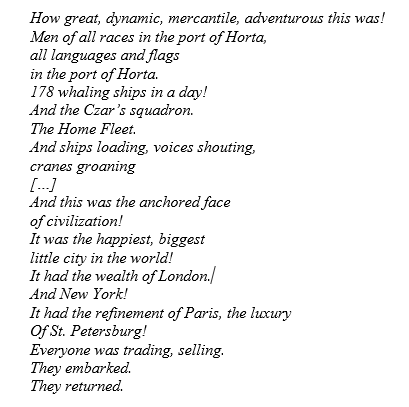
However, the poem does not close with this melancholy evocation of a city once dynamic and open to the world. In portraying the cycle of Horta’s decline, Pedro da Silveira cast a highly critical eye on it – as the city back in the ‘40s of the last century was slow to free itself from values that were crystallized in the past, preventing it from freely pursuing the future it desired. Even so, the poet displayed hope for Horta’s renaissance:

The poetry of Pedro da Silveira, “the westernmost European poet,” has already secured a prominent place among Portugal’s greatest. Now, one hundred years after his birth, perhaps it is time for us to (re)read him.
 Filamentos (artes e letras)