
Prof. Rogers of Colby Gives an interesting account of his summer vacation.
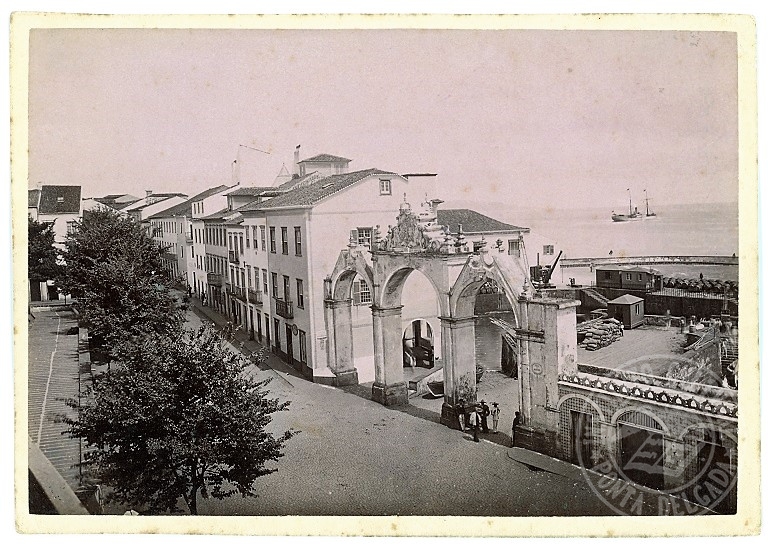
Kings in captivity and laborers working for fifteen cents a day.
Waterville, Me. [Maine], Dec.11 (Special).—Prof. William A. Rogers of Colby, professor of physics and astronomy, made a trip to the Azores this summer for his health and during the trip collected interesting information concerning those far-away islands, some of which was gleaned by your reporter on a recent call:—
“Tourists go to the Azores and many invalids seek its clime for their health,” said Dr. Rogers, “St. Michaels, where I made my headquarters is noted for its sulphur bath for rheumatism at Furnas, 25 miles inland. The government furnishes free baths for all. The bath house is about 200 feet long and contains 28 bath and dressing rooms, but no accommodations, not even as much as a looking glass. The bath tubs are of marble, each with four faucets connected with the springs on the plain outside. One of the faucets runs sulphur water, one iron water, one hot water and one cold water, so that the patient can mix the bath to suit his pleasure. The baths are taken, beginning at 4 o’clock in the morning, and each is compelled to wait his turn, no distinction being made between rich and poor. After the bath the custom is to go home and to bed until 11 o’clock, when breakfast is taken.
“It is claimed that if a case of rheumatism is not too far advanced, thirty baths will cure. I took 28 and was nearly cured, but to make sure, I brought 50 pounds of the sulphur mud home with me and am taking the baths daily. I feel almost cured.
—
“The poor there are very poor, and have little chance to rise. Labor commands but 15 cents a day in our money, and skilled labor will not bring over 60 cents a day.
“The most noticeable thing about Terceira is the fine division of the land. When a man dies, his property is divided equally among his heirs and cut up into small lots. The plots are very irregular in size, but exceedingly well cultivated. This subdivision and division again from generation to generation, each plot being cultivated by itself, gives the impression of a mammoth piece of crazy patchwork. There is a continuous village extending the whole length of the island about two miles up from the shore, although the island is from 30 to 40 miles in length.
“During my stay there, I acquired a vocabulary of 600 words of the Portuguese language, which I picked up, went over every day and made additions to. I acquired the pronunciation very easily, as it is not at all difficult to get. It does not differ much from the Spanish.

“There are no paupers there, as in spite of the low wages every man is able to earn his living, but though it is a health-giving place, the rate of mortality there is greater than at any other place in the world. The deaths are principally among the young.
“The government has charge of the roads and builds magnificent ones. There were two excellent ones at Furnas at right angles three miles each in length and they ran along among 24 mountain peaks, varying in height from 1500 to 2500 feet. Their roads are ideal bicycle paths, but are very uneven, as coming into Furnas from the north, it is necessary to have an ox team haul the load up a grade of two miles before entering the city. Donkey riding is the standing recreation, parties of ten or fifteen go riding every day. I acquired a great deal of respect for a donkey and much more than I did for his master who was very cruel. The donkeys are very surefooted and pick their way over the steepest mountain paths with absolute safety.
“The taxes of the people are very light, those of the poor man not being above five dollars per year.
“They have a queer custom in regard to burials. I found no graves over 20 years old. It seems that once in seven years, the dirt is spaded over and the bones all collected and placed in a charnel house which is attached to the chapel. This is done to economize space. Only the bones of the poor are placed in the charnel house. The bones of the rich are gathered together and placed in costly mausoleums, but their graves are spaded over like the rest. On the island of Peco [Pico], this grave delivery is performed every five years. The churches are very poor with few rare exceptions. One of these is a church built from stones brought from Paris and is built on a lake far inland away from the settled portion of the island [talvez a Capela de Nossa Senhora das Vitórias, onde se encontram as sepulturas de José do Canto e de Maria Guilhermina Taveira Brum da Silveira]. It cost nearly $100,000 and is almost never used on account of its distance from the people.
“The pineapple industry is one of the largest of the islands. The pineapples are cultivated in hot houses and grow to an enormous size; the larger ones weighing 10 to 15 pounds and selling in the London market for $5. The raiser figures that the first year, after building his hothouse and buying his stock, the pineapples will cost him one dollar each. After that with his hothouse paid for and his expense almost reduced to a minimum, it will be readily seen that the profit is enormous on this trade. Steamers go about among the islands and gather up the fruit. The banana and orange crops were very poor this year. I got peach hungry one day and went out looking for some. I hunted a long time before I found an old woman who had some in a drawer ripening after being picked green. I had to pay a higher price for them than I would if I had been in New York. The fresh figs there are delicious and grow there in abundance.
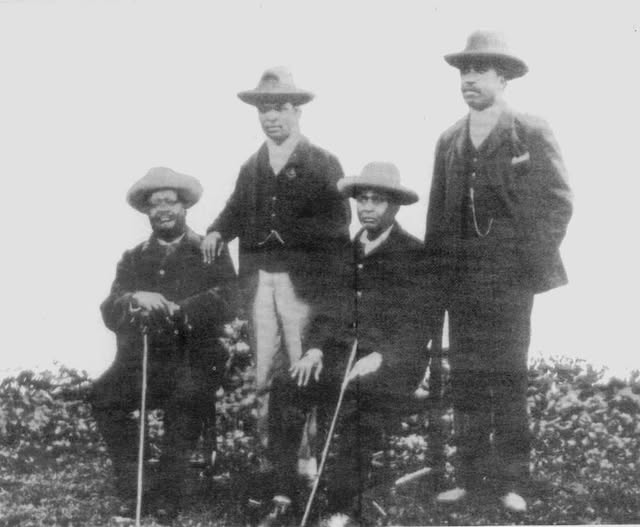
“A fact not generally known is that there are in captivity for life upon the island of Terceira four African kings [Ngungunhane, Godide, Molungo e Zixaxa]. There is a fortress there in which the royal prisoners of state are kept. These kings had defeated the English, the French and the Portuguese, but were finally captured by a ruse, 45 Portuguese soldiers capturing 3000 of the Africans. This happened three or four years ago [derrota em 1895; deportação para os Açores em 1896]. Two of the kings are young men [Godide e Zixaxa] and they are rapidly learning the Portuguese language. Each of the four looks every inch a king. One of the older kings [Molungo] wears around his rubber crown in confinement. Each visitor is supposed to give them a present of money and this one refuses with disdain any sum less than ten cents.
“The brother of this elder king [Molungo] has been recently captured and is soon expected to Join the captive quartette. This older king had 24 wives in his country, and he was granted the privilege of bringing one of them with him. However, he did not avail himself of the opportunity as these two dozen wives fought over the matter and finally decided that if one went, they all must go, so they all stayed behind.
“I gave each of the younger kings ten cents apiece when suddenly from some unknown place, the elder king appeared and politely invited me by his manner to do the same by him. Not long after the fourth royal personage appeared and the trip cost me 40 cents in the end. They are allowed the freedom of the fortress but are not allowed outside the fortifications.”
Published in the Lewiston Saturday Journal from Lewiston, Maine.
We thank Professor Emeritus Manuel Menezes de Sequeira for his research.
We thank the Luso-American Education Foundation for their support.
 Filamentos (artes e letras)