
Viola da Terra beginners’ video lessons are being launched this week. How did this initiative come about, and what was its aim?
The Viola da Terra initiation video lessons came about as a joint idea with Palco de Ilusões Produções AudioVisuais e Multimédia. We have collaborated regularly on various productions, such as the CD/DVD “Rafael Carvalho – 10 Anos de Origens” and “VSTi Viola da Terra,” among many others, and we got together to idealize a new partnership that resulted in this ambitious work. Over the years, I’ve shared many videos to support my classes so that students have more resources when studying at home. However, they are videos recorded with a cell phone, with poor image and sound quality, due to the need to record quickly and for the content of each lesson in question. What was missing was a recording with professional audio, video, and editing quality, which has now come to fruition with time to contextualize the Viola, explain the theory of major and minor chords and then exemplify their execution, and clarify ways of dividing the Viola scale simply, through the execution of traditional fashions. This initiative aims to preserve and promote Azorean culture, with special emphasis on the Viola da Terra, which symbolizes the musical soul of the islands. Through these classes, the aim is to ensure the training of new musicians who will perpetuate the practice of this traditional instrument, making it more accessible, especially in an island region like the Azores, where access to local trainers can be limited. In addition to providing a practical approach to learning the Viola da Terra, the video lessons highlight the richness of traditional Azorean music, which is part of the lessons’ content. This initiative encourages the continuity of this cultural heritage and strengthens the participants’ connection with their roots.
Who are these classes for? How can those interested watch these videos?
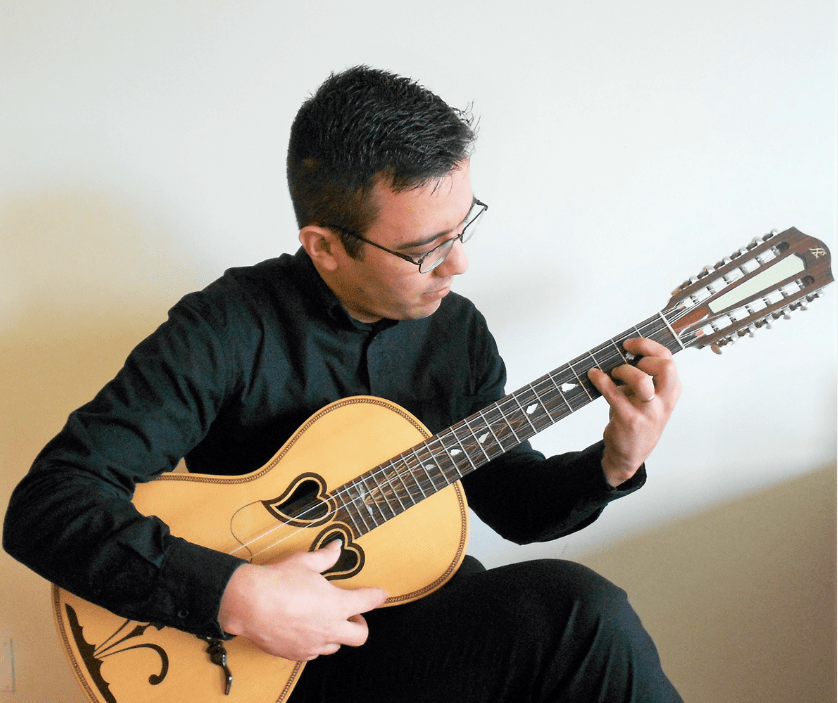
The classes are aimed at anyone interested in learning the Viola da Terra in our Region, Azorean communities, or anywhere in the world. I receive more and more requests for information from musicians worldwide about our Viola and support in learning it. The three manuals of my “Method for Viola da Terra” are an asset, books that I edited based on the work I did to structure the Viola da Terra curriculum course at the Ponta Delgada Regional Conservatory, where I taught from 2008 to 2022, but this material alone is not enough. The video lessons that we have now recorded are based on playing the 12-string Viola, with the tuning from sharp to bass ré-si-sol-ré-lá, which is the tuning used in São Miguel and Santa Maria, and with the thumb touch, which is the basis of my work. However, these lessons can be adapted to other tunings and playing techniques, as long as the apprentices can, or by asking for support from other Viola trainers. The nine lessons will be available online on Palco de Ilusões’ YouTube channel (youtube.com/palcodeilusoes). Yesterday, we launched the first lesson, which covers the context of the Viola, its characteristics, and tunings. The rest of the classes will be launched on Wednesdays every two weeks for those who wish to follow along.
Is the Viola da Terra a challenging instrument? Does learning it require more dedication than another stringed instrument?
The Viola da Terra is a challenging instrument and a daily discovery of new possibilities. In addition to the importance of its cultural context and the daily impact of its presence in our popular events and beyond, it has a captivating sound. It allows those who play and study it to always be in search of new challenges and technical excellence. Learning any instrument is demanding, and evolution requires effort and daily work. The Viola da Terra is not more difficult because it has more strings than other instruments, nor is the 15-string more difficult to learn than the 12-string. Each instrument has its own specificities and challenges, and learning any instrument comes from the dedication we give it.
Has the Viola da Terra gained momentum in recent years? Are more people playing this instrument?
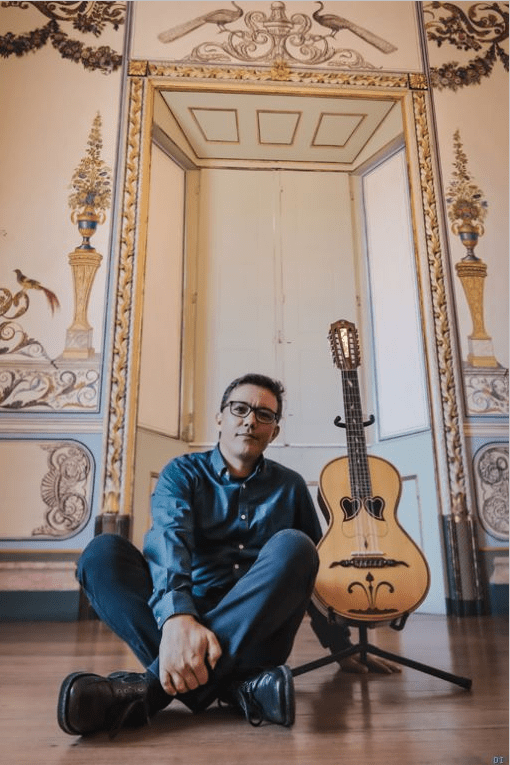
Yes, we can see the dynamism of our Viola in recent years, which is the result of the work of some associations, groups, and individuals responsible for promoting initiatives, events, training, and awareness-raising sessions around it. This work, often collaborative, either on the same island or in connection with various islands of the Azores and even communities, is recent and the result of greater openness and dialogue between players, builders, and entities that promote the appreciation and perpetuation of this, the main instrument of Azorean popular culture. We are seeing more people interested in learning the instrument, more people approaching the Viola, and, increasingly, witnessing the Viola and its players being challenged with new musical approaches. Thanks to this context of valuing our roots and the essence of the Viola da Terra repertoire, with the emergence of other challenges, sound strategies, and constant dynamism, we have seen interest in the instrument grow, especially among the younger generation.
Are the younger generations interested in the Viola da Terra? Do you believe this instrument’s future is assured in the Azores?
Yes. As has been the case so far, the new generations are eager for knowledge in any field. We have to get information about the Viola da Terra to the younger generation, make them aware of its importance and sound, and offer them the chance to learn whenever they are interested. I believe that the instrument’s future will always be assured as long as we continue the work we have been doing in the present. This always involves continuing with training, producing events, making more teaching resources available, and producing material like books and music albums. However, this work is only possible, credible, and consolidated if it is properly supported and recognized and, above all, if the current players continue this mission of dialogue and mutual collaboration. The responsibility for perpetuating Viola da Terra cannot only be in the hands of those who play and build it; it must be in the hearts of all Azoreans.
In Diário Insular-José Lourenço, director
Translated to English as a community outreach program from the Portuguese Beyond Borders Institute (PBBI) and the Modern and Classical Languages and Literatures Department (MCLL) as part of Bruma Publication at California State University, Fresno, PBBI thanks Luso-American Education Foundation for sponsoring NOVIDADES.
 Filamentos (artes e letras)