
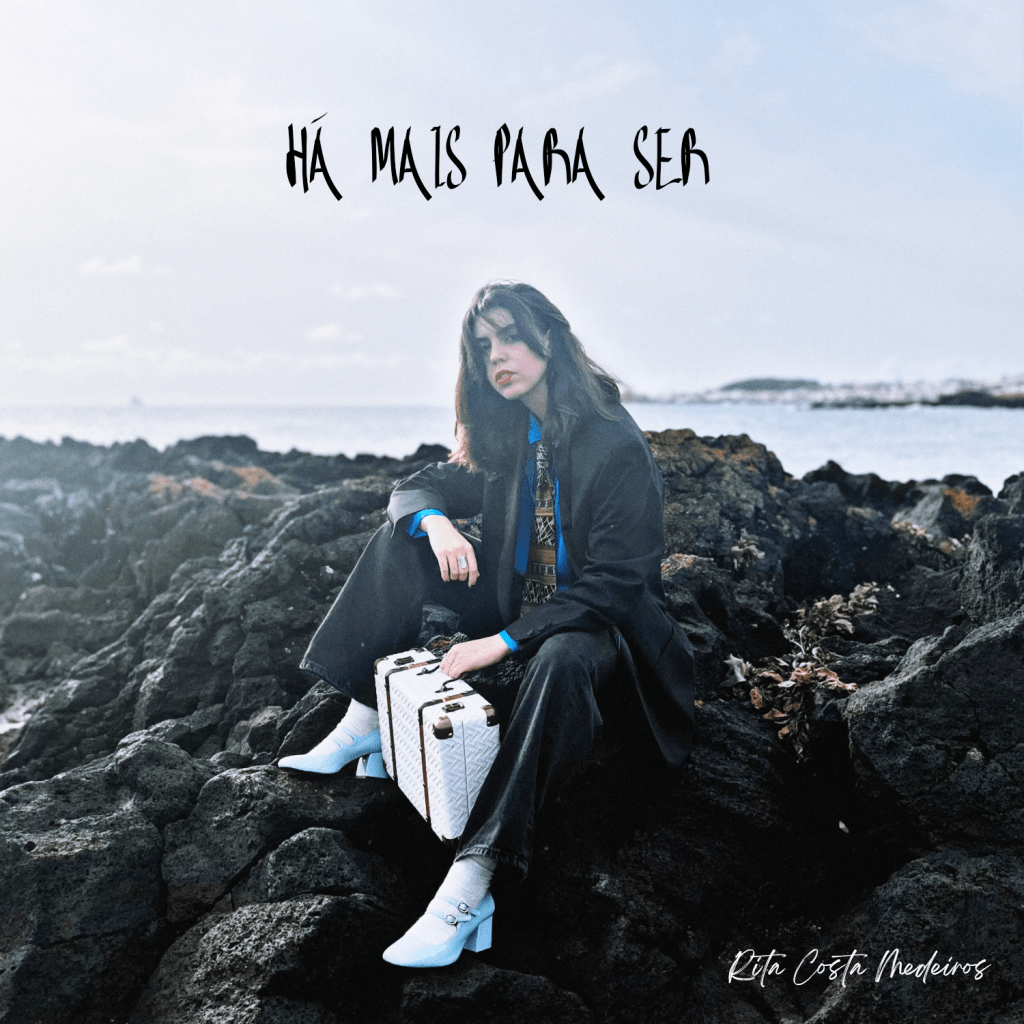
“Há Mais para Ser” is the debut album by Rita Costa Medeiros. With a release date of January 31st, the singer and Music Production student’s first full-length project deals with “mistakes, falls, failures, but also growth and achievements.” Her participation in the program “The Voice” in 2021 was central to her personal and professional development, but the Azores and being an “islander” have a “tremendous” influence and impact on the singer’s artistic creation.
Correio dos Açores – your debut album, “Há Mais Para Ser,” will be released on January 31st. Tell us about the concept and development of this project.
Rita Costa Medeiros (music artist) – This album will be released on the same day that, five years ago, my first single, “Tentei,” came out. It was the result of that time, which came about naturally, reserved for my professional and personal growth. It’s an album of stories from my life, transposed into music, from when I picked up my suitcases and left the Azorean scene for the capital. It, therefore, reflects the various feelings that have arisen along this journey, from happiness, sadness, nostalgia, and even loss. It sums up the central idea I realized: “There Is More to Be” always. In other words, we are mistakes, falls, failures, growth, and achievements. Precisely because we are always being more throughout our lives. It also begins with the “Tentei Pt. 2” track, exploring what remains after 5 years, what has changed, and what no longer exists.
Moreover, it was very special because I produced and assembled it from start to finish. It was a challenge I wanted to set myself, now as a Music Production student, so it could be as close as possible to what I imagined. Like it or not, this strengthened its concept and title, “There’s More to Be,” because it reflects how much I can still learn along the way. And it also lifted the weight off us that we have to be our best already because it’s actually over time that this happens, and this growth lasts for the rest of our lives.
You took part in the TV show “The Voice” in 2021. What was the experience like? How important was it for your career?
It was an experience that took me completely out of my comfort zone, and perhaps that’s why it marked the beginning of my introduction to the world of leaving my corner and singing outside. It gave me a lot of baggage and brought me closer to people and the public. Basically, I felt more listened to, I learned a lot about the behind-the-scenes of television, and I had the opportunity to understand more clearly what made sense to me and what didn’t. One of those things was that the path was not the best. One of those things was that the path must be our own authentically, not what they want to label us. On the other hand, it showed me that you can only keep walking if you do it yourself.
How important are your studies in music to you as an artist?
I think that any knowledge only strengthens who we are, so I’ve always placed great importance on expanding it first and foremost. This requires time and a willingness to recognize its value. However, it is of tremendous urgency to inform ourselves of what exists now and in the past, to pause the urge to do it right away, and realize that no journey is made with empty hands. From my perspective, filling those hands is precisely going after knowledge. I don’t think I could compose if I didn’t listen to music, for example. In the same way, no one can create without coming into contact with the creations that are part of history – past and present.
Are the Azores an influence on your musical creation? If so, how do you influence it?
Yes, tremendously. Whenever I go to the Azores, I get away with new music. The comfort I feel there, the nature always nearby, and the sea inspire me a lot. There is precisely this narrative in my album, where I have some songs that were born there. One of them (“Basta Olhar Para o Mar”) perfectly sums up this feeling of “home” that I feel and which, in a way, is an intense source of inspiration.
How do you see yourself as an “islander” broadening your horizons in the music and entertainment sector?
I think we’re often told that it’s impossible to believe in these opportunities, that to be an “islander” is to be far away from the rest of the world. The truth is that wherever I go, that feeling of belonging to the Azores is never lost. So I’ve realized that not only can we go anywhere, regardless of where we come from, but we always go back – and because we want to.
Do you have any concerts or other projects scheduled for this year?
Yes, I’m very happy to announce that we will have several concerts this year, both in the Azores and Lisbon. I’ll tell you what’s coming up soon.
Anything you’d like to add.
In the song “Ser Artista,” I wanted to make room for reflection on what it means to me to be an artist. As the song reveals, I’m talking about what I can’t talk about if I’m not singing, about how scary it is—both for me and for the world—to decide to be an artist—the fears you feel and the certainty that it’s your path and purpose.
I also wanted to strengthen and break down the stigma that art doesn’t have to be elitist. It’s not born in everyone (that would be impossible), but it’s not just for some either: it’s for everyone, it serves everyone, and, if it really is art, it has to reach everyone. And when I say “it has to reach everyone,” I mean that it has to be perceptible to everyone. In other words, it must have the power to convey a message to anyone.
Admitting this is fraught with fear because the journey is difficult, but if it’s kept away from the public in this way and is aimed at “those who say they understand it,” then it will also end up staying only in that core and will never have the strength to sound out here, where people really are.
José Henrique Andrade is a journalist for the Correio dos Açores newspaper-Natalino Viveiros, director.
Translated to English as a community outreach program from the Portuguese Beyond Borders Institute (PBBI) and the Modern and Classical Languages and Literatures Department (MCLL) as part of Bruma Publication at California State University, Fresno, PBBI thanks the Luso-American Education Foundation for their support.
 Filamentos (artes e letras)