

FROM A DOCK OF DEPARTURE TO A HARBORING SHELTER
The Azores have always been a port of departure.
We’ve lived on our islands for almost 600 years and have been leaving them for over 400 years. But we never leave them behind, and we always remember them.
With distance and nostalgia, we’ve come to love our beloved islands even more.
We take them with us in our thoughts and hearts and build new islands like ours on new continents.
This is the fate of our people.
They are right in their homeland but keep their emotions in the land of their birth.
This projects, affirms, and dignifies the Azores beyond the region’s borders.
This makes the Azorean people a transatlantic people and turns their culture into a global Azorean identity.
The Azores are only truly complete with our tenth islands.

The painting above is one of the most celebrated works in the Azores by the late Domingos Rebelo. It evokes the Azorean Emigrant.
That is why we evoke, with respect and recognition, the migratory saga of resilient and courageous people who enrich and enhance our islands at sea and in the world.
First, we embraced Brazil from north to south, from Maranhão and Pará to Santa Catarina and Rio Grande do Sul, passing through Espírito Santo and Minas Gerais, ending up in Rio de Janeiro, São Paulo and Bahia. And we got as far as Uruguay.
Then we left South America for North America, either in the United States, from New England to California, or in Canada, either in Ontario or Quebec. And we’ve been to Hawaii and Bermuda.
The Azores have always been a port of departure, but now they’re also a port of refuge – a harboring shelter.
According to the latest report from the Aliens and Borders Service for 2022, 5,123 foreign nationals from 97 countries officially reside on the nine islands.
There are 2,582 men and 2,541 women, showing a growing and almost perfect parity.
This figure represents an increase of 12.5% from the previous year and already corresponds to 2.1% of the total resident population.
The last two decades have generally seen an upward trend in the number of foreign citizens living in the Azores, with 2,605 in 2001, 3,402 in 2011, and 4,480 in 2021.
It is important to clarify that the statistics on foreigners do not, of course, take into account citizens who were not born in Portuguese territory but who have already acquired Portuguese nationality. So, in reality, we are talking about many thousands more immigrants living in the Azores.
According to the SEF report, foreigners live on all nine islands, in 19 municipalities, and in many of our 155 parishes.
There are 2,337 on the island of São Miguel, 833 on the island of Faial, 764 on the island of Terceira, 571 on the island of Pico, 204 on the island of Santa Maria, 183 on the island of Flores, 161 on the island of São Jorge and 12 on the island of Corvo.
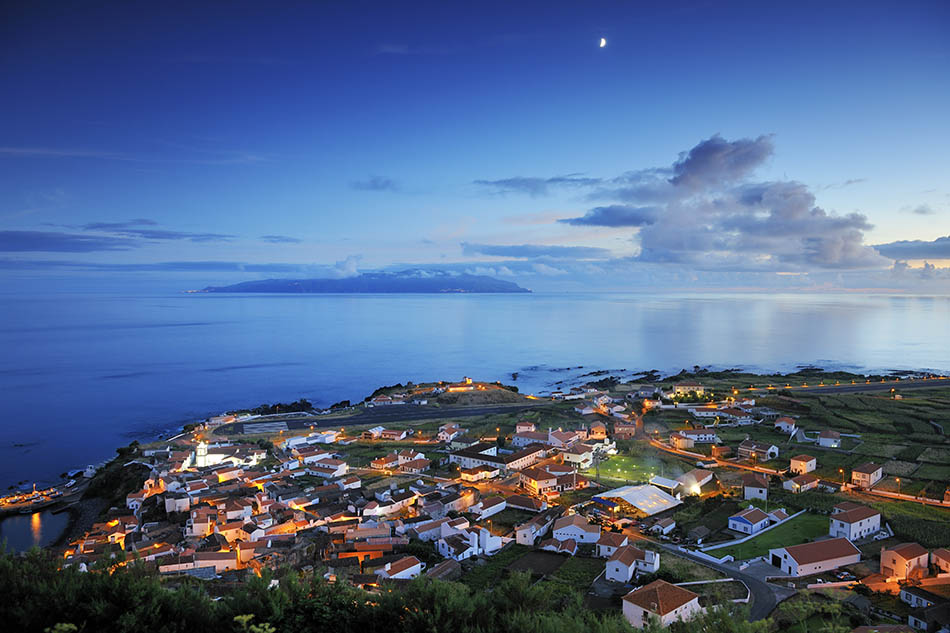
In proportion to the resident population, Faial is the most intercultural island in the Azores, as foreign citizens already represent 5.8% of the total resident population.
In Flores, foreigners make up 5% of the local population, and in Pico, 4.2%.
At the municipal level, Ponta Delgada has the highest number of foreign residents, 1,571, but Lajes das Flores is the most intercultural, with foreigners already representing 8.6% of the local population.
Of the 97 countries from which the 5,123 foreign residents in the Azores are from, Brazil stands out, with 1,021 citizens, corresponding to 20% of the total number of non-nationals.
In the Top 10 most representative nationalities, the other nine places are occupied by six European countries, one American, one Asian, and one African: Germany with 584 citizens, the United States of America with 466 (not counting the military detachment at Lajes Base), China with 337, Spain with 304, the United Kingdom with 262, Italy with 245, France with 204, Cape Verde with 200, and the Netherlands with 150.
However, we will already find residents here who were born in Albania, Egypt, Ethiopia, Nepal, Armenia, Iran, Iceland, Jamaica, or Uzbekistan.
They are all welcome because they come for good.
They come to compensate for our natural demographic erosion, to fill the shortage of local labor, and to help develop the Azores.
We, who have always been welcomed and well integrated into our emigration destinations, must welcome them back home, too.
_____
José Andrade is the Regional Director for Communities of the Government of the Autonomous Region of the Azores
Essay from his book Transatlântico II – Açorianidade & Interculturalidade (2024)
Translated by Diniz Borges

We thank the Luso-American Education Foundation for their support.


 Filamentos (artes e letras)