
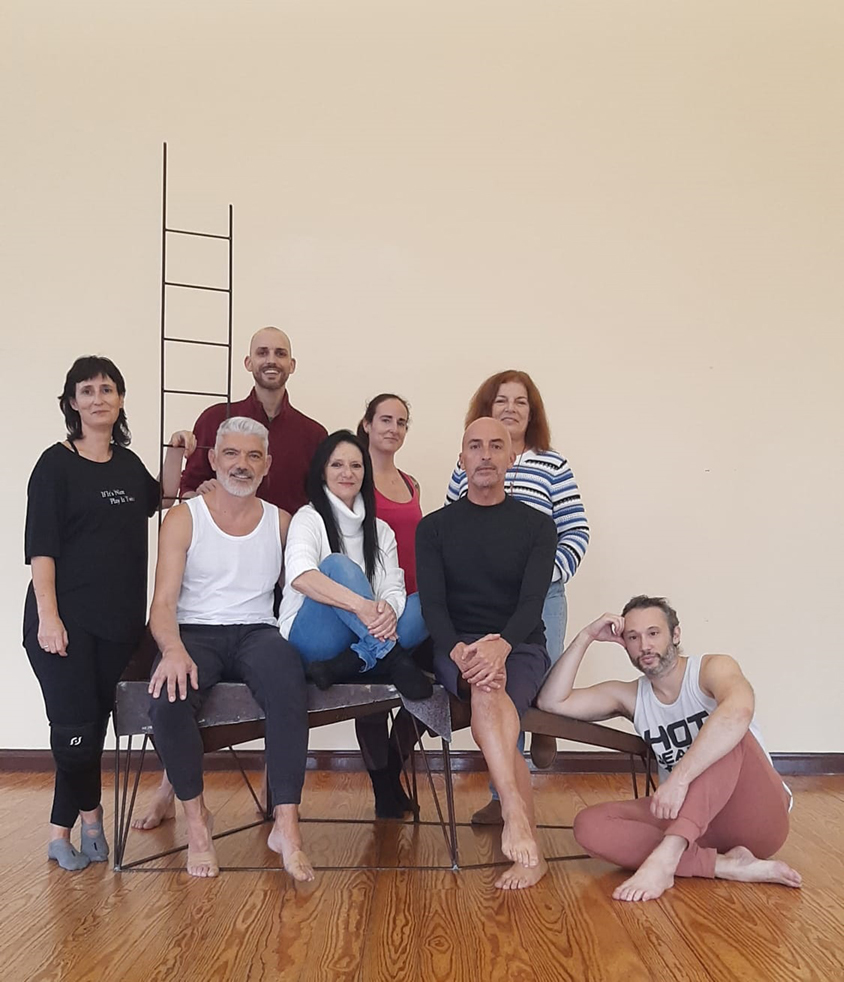
The show “Tell Me What Light Your Eyes See,” directed by Milagres Paz, combines five artistic languages: dance, digital painting, live poetry, original and live music, and sculpture. The production explores the inner development of the human being, with emotions represented by colors and movements. In an interview with Correio dos Açores, Milagre Paz says that the arena format at the Coliseu Micaelense brings technical challenges, such as lighting and adapting the space. The artist also highlights the collaborative process between artists and dancers, with everyone creating simultaneously toward a common goal.
Correio dos Açores – Can you start by telling us about the show “Tell me what light your eyes see”? What can you anticipate for the audience?
Milagres Paz (Artistic Director of the show “Tell me what light your eyes see”): This show incorporates several artists and five different languages. Dance unites everything, but we also have digital painting, live poetry, original live music, dance, and sculpture.
It was a project that Dr. Ângela Almeida made me lose my mind and my calmness (laughs). This project started with Paulo Andrade, her, and me. I’ve always wanted to work with different languages, but first, I was looking for texts that had already been written and props. It was very different this time because all the artists were creating simultaneously for the same purpose.
This makes the process much more beautiful and rich. The dancers also create because they are mature, like all the artists involved, and have much to give. I like to work by giving people freedom, helping them to do their best, and bringing out the most valuable things in them.
As artistic director, I had to bring everything together, which wasn’t easy. I attach much importance to the connection between elements and the common thread. With so many languages, keeping everything clean and clear for the audience was necessary.
The theme of the show is the inner development of the human being. It’s about someone who feels trapped and faces obstacles like emotions. I think we can all relate to that. There’s not always light, peace, or hate.
The play develops around agony, symbolized by red; struggle, symbolized by black; light, symbolized by yellow; and, finally, peace and tranquility. Without revealing too much, we end with a video depicting the journey of water in harmony with poetry. If the audience listens to the words, observes the images, and watches the dancers, everything matches.
It’s been a very happy time because the group is fantastic. It’s wonderful to work with people you respect and admire. This creates a very beautiful way of working. With no conflicts, everything runs smoothly, and everyone feels happy to be part of this project, truly believing in it.
Why create such a multidisciplinary production that mixes dance, music, poetry, sculpture, and graphic design?
Ângela Almeida is a poet, and as I love how she writes, I started with poetry immediately. Paulo Andrade has worked with me for many years and composed a lot of music for me, so we had the music. I have the dance part. I like Sofia de Medeiros’ work in sculpture, so I thought: if I enjoy working with props on stage, why not include another language? I invited Sofia to contribute in this area.
My son Miguel is a designer, but he makes digital paintings and artistic videos that go beyond conventional design. Ângela and Paulo already knew his work and suggested that he participate in the show instead of looking for external images.
We have these five languages, and then I invited dancers I thought had something to add. So I looked for mature people: Filipe Valla, Joana Ledo, Pedro Paz and Tiago Correia. Tiago and Pedro were in Lisbon but came here to do this work. Joana and Filipe were already here.
Meanwhile, Paulo and Sofia are also playing. Paulo has worked with me several times on movements, and Sofia, a student of mine, has also danced. As it’s a mature project, I knew it made sense for us all to be together.
What emotions and reflections do you want to arouse in the audience with this show?
I want to awaken the audience to the fact that we are all made up of many things, such as fears, anxieties, and happiness. But what do human beings want, at the end of the day? They want to find inner peace and light in life.
That’s why I ended up with a video of light, of a beautiful journey. At the end, there’s a song that I fell in love with. What I want is for the audience to see their emotions reflected in the images, words, and sculptures and realize that this is a human journey that we must take. Ultimately, I want the audience to feel and leave wanting to reach for the light.
What were the biggest challenges in this production?
The biggest challenge for me was combining all these elements. Also, the venue where we’re performing is different. I’m very used to performing at the Teatro Micaelense.
The first time I did a show in the Azores was at the Coliseu, and now we’re going back to the Coliseu, but it will be in an arena and with the auditorium set up. It will also be the first time they’ve done it this way because I wanted something more intimate, and I like the audience to have a good view of what’s happening. As it starts with one dancer on a structure and the others in a semi-circle, the arena is fantastic for this.
Another challenge is the space, which is completely different, and the lights because we don’t have a web – the web is on the stage. One of the sculptures is suspended, so we’ll have to find a wire to suspend it. We will start working on the lights on Monday, and I’ll see what I can do because the light is very important.
The light completes what I see in my head. The images are all reflected in light—darker, lighter, and more intimate. I would really like it if I could implement that.
Starting on Monday, we’ll start rehearsing in the arena. So far, we’ve been rehearsing here [Sala Santos Figueira] and, before that, at the Judo Club, for which I’m very grateful. I no longer have my own school or my own space. As I had already taught Judo and was a judoka, they provided a space for the dancers. When the outside dancers arrived, the Coliseum kindly gave up its afternoons so we could rehearse. It was fantastic.
Is there any possibility of taking this show to other islands or even outside the Azores?
Nothing is impossible until it’s done, but I have two dancers who aren’t here and have their own lives. Pedro Paz, who is my son, is a singer, actor, and dancer, and he’s full of shows. I was lucky that he happened to finish one of the seasons he was working on in January.
Working with people who aren’t permanent cast members is always more complicated, especially living on an island. However, it’s done, and it’s worth seeing because the actors are local artists, and we all have a lot to give.
Do you believe that culture is growing in the Azores?
Culture is always a struggle: it grows and shrinks depending on the budget, support, and policies. We mustn’t forget that we’re on an island, and being autonomous and independent is difficult.
I’ve fought to professionalize the arts in the Azores all my life. However, bringing them here is always complicated. It seems much easier to get them here than to take them abroad.
I think that continues today. In this respect, no evolution has occurred in the last 30 years. I’ve worked in various countries, such as Brazil and the United States, and I studied in the United States. I don’t think our arts are taken advantage of at an extra-regional level.
Filipe Torres is a journalist for Correio dos Açores-Natalino Viveiros, director.
 Filamentos (artes e letras)