

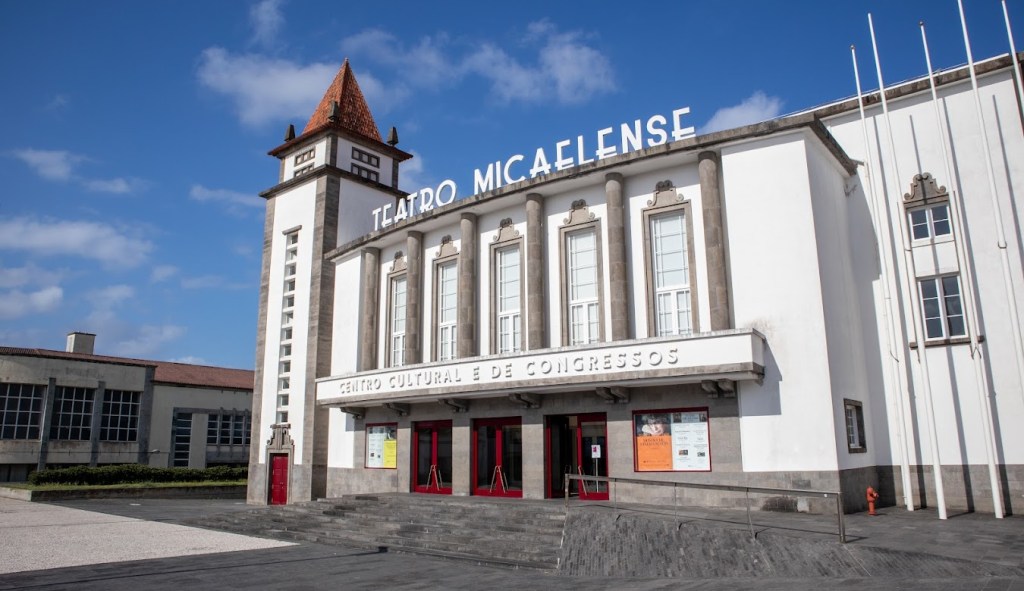
Maria José Duarte, President of the Board of Teatro Micaelense, reveals her expectations for 2025, highlighting the continuity of the work started in 2022, focusing on improving the working conditions and infrastructure of Teatro Micaelense. In an interview with Correio dos Açores, the institution’s president stressed the importance of salary updates for staff, who received substantial increases after years of stagnation. She also details the work in progress, such as installing security systems and acoustic improvements. Teatro Micaelense also seeks to get closer to young and school audiences with its diverse educational programming while aiming to attract new sponsors and strengthen its relationship with local communities. This year’s good financial prospects, sponsor support, and excellent audience augur a successful year. Looking to the future, Maria José Duarte sees the Teatro Micaelense as a better-equipped space with an eclectic and solid program, consolidating itself as a cultural center of reference in the Azores.
Correio dos Açores- What are Teatro Micaelense’s expectations for this year?
Maria José Duarte (President of the Board of Teatro Micaelense) -2025 will be a year of continuity in achieving the objectives this board set out to accomplish when it took office. When this administration took office, it faced several problems that had to be resolved: employees with very low salaries, the building needing work, obsolete equipment needing replacement or repair, and bank debt of almost half a million euros.
Regarding staff salaries, a senior technician with almost 20 years experience took home around €900. Just imagine how much a technical assistant, for example, would earn. I’m delighted to say that this administration, together with the supervisors, namely the Regional Secretary for Education, Culture and Sport, Dr. Sofia Ribeiro, and the Regional Secretary for Finance, Dr. Duarte Freitas, have managed to update the salaries of the Teatro Micaelense staff in line with the pay scale and career progression of the regional public administration, since November last year (2024) with retroactive effect to July of the same year, which we are very pleased about. This was possible because the amount of our program contract, allocated by the Regional Government, increased from €675,000 in 2023 to €900,000 in 2024 and 2025. I would like to point out that in 2023, this administration had already updated the staff salaries, which had not been updated since 2008 and had also reinforced the technical team in 2022.
We have been doing the necessary work on the Teatro Micaelense building and replacing/repairing equipment in phases, in accordance with our financial availability.
For example, since 2016, the Micaelense Theater has had no system against atmospheric electrical discharges, better known as lightning rods.
This gap was filled last year, so we can sleep easier now. We also carried out maintenance on the stage’s mechanical systems last year.
In 2023, for example, we had to do a small intervention on the tower, we also replaced the fire alarm system, the smoke extraction system, we reinforced the emergency lighting, among other things. This year, 2025, we intend to carry out major work on the stage box and replace some of the windows on the 2nd floor, which are in a very poor state of repair.
Also, in 2025, our auditorium will have better sound conditions. We’ve bought two sound desks, one for the stage, which will be delivered to us later this month, and which will certainly improve the sound quality at our events while saving money on equipment rental. As far as our Congress Center is concerned, we will equip one of our rooms, the Natália Correia room, with technological equipment, namely a videoconferencing, sound and image system to enhance the room for corporate events. Teatro Micaelense will also start providing coffee breaks for meetings of up to 40 people at more attractive prices for our clients.
This administration has also aimed to provide better working conditions and training for Teatro Micaelense employees. We want employees who are increasingly knowledgeable, proactive, and happy. This is a goal that we will continue to achieve throughout 2025.

How was 2024 for Teatro Micaelense?
I can say that, in general, 2024 was a good year. It was within our expectations.
I would like to highlight the increase in our program contract from €675,000 to €900,000 allocated by the Regional Government of the Azores; the excellent occupancy of our Congress Centre; the considerable support for our cultural programming and agenda from our sponsors and the good occupancy of our auditorium and Salão Nobre in terms of our artistic programming.
In addition, we were able to update the salaries of Teatro Micaelense employees in line with the pay scale and career progression of the regional public administration, which was one of the great desiderata of this administration since it took office in 2022. We could equip and replace various equipment in our theater, such as installing the lightning rod. Training has also been made available to our employees. I repeat that 2024 was a good year for our theater and its workers.
What is your outlook for financial support?
We have good prospects for 2025 as far as financial support is concerned. The budget for our program contract has remained at €900,000, which is excellent. We get good support from our sponsors when they sponsor our shows. Regarding attendance at our events, I can say that the New Year’s Eve concert was a success; it was practically sold out. We’ve already had Fernando Daniel’s concert on February 8th sold out for many weeks, and our Congress Center is also getting very busy. So, we predict that 2025 will also be a good year for our theater.
CA- How does Teatro Micaelense collaborate with schools, artists, and other cultural institutions?
Maria José Duarte – One of our objectives is to create new audiences. To this end, we have increasingly invested in our educational service with programming aimed at schools, families, and the elderly, covering various areas, such as dramatic expression (“Once upon a time”), body expression (“An ageless body” and “What body does the body have? “); musical expression (“MinimicroNanoMúsicos”), circus arts (“Oficina multicirco”), visual arts (“Teatro Mascarado”), cinema (“Cinema sem conflitos”), and we also hold “Visita ao Teatro,” where visitors are shown our theater, the other side of the stage. On February 16, we will have a show for the youngest, from the age of 3, with Alda Casqueira, whose songs are much appreciated by the little ones.
I’d like to point out that BCP has sponsored us to transport students from more distant schools, such as in the municipalities of Nordeste and Povoação, to our theater. So, I would like to find a sponsor who can help these students who are more disadvantaged because they live further away from Ponta Delgada. That’s why, so that the schools also have time to arrange transportation with the town halls and parish councils, we’ve started to publicize the activities of our educational service not on a quarterly or four-monthly basis as we used to, but by school year, i.e., in September we meet with the schools, we present our programming until June.
This way, they’ll have a better chance of arranging transportation. However, I’m telling you it’s always very difficult because sports and other organizations also share their transportation.
In recent years, schools have started to include drama in their curriculum…
It’s very important. It’s funny because many years ago, theater on our island was very strong, practically every parish had its own theater group, but then it disappeared… Now, it’s more focused on Terceira Island, while here, it’s more of a thing, as they say. On the other hand, there’s a greater focus on dance.
What role does the Teatro Micaelense play in strengthening the Azorean cultural identity?
I think it plays a very important role, not only in creating new audiences with our educational service, not only in promoting and publicizing our local artists, because Teatro Micaelense gives priority to local artists, but also by inviting artists from abroad so that there can be some interaction and exchange of experiences with the artists from here.
I think it’s always a good idea to bring in outside artists, but never forget the local artists. Our artists and cultural agents are important at the regional and artistic levels; we must promote and publicize them.
Teatro Micaelense has various shows, such as theater and music.
We have an eclectic and diverse program. We have various musical destinations. We will have a dance, theater, comedy, cinema, and an exhibition. On top of everything, our educational service’s programming is aimed at schools, families, and the elderly.

What are the biggest challenges in filling the theaters at these Teatro Micaelense events?
It’s difficult because there are shows we think will fill up, but they don’t. And there are other shows that we think will fill up. There are other shows that we feel won’t fill up, and they do. So it’s always difficult to predict whether a show will fill up, but some shows do, for example Fernando Daniel. But others… We often don’t know if it’s going to fill up or not.
Now, if you said to me, “If you bring in a big international or national name, obviously it will fill up,” Teatro Micaelense wouldn’t have the money to bring in big international names, who would obviously fill the house. In addition, our auditorium is not large; it has 739 seats, plus 6 seats for wheelchair users, which means 745 seats.
Tickets can’t be too expensive because people can’t afford them; we’re in a time of restraint. The Teatro Micaelense will never be able to bring in these great artists because it will never be able to make a profit. Why is that? Because these great artists pay very high fees and always bring large entourages, Teatro Micaelense doesn’t have the capacity to charge or cover these expenses, even if it’s full.
It’s not just our island expenses. It’s the cost of tickets, accommodation, food and transfers. These are huge expenses. Our auditorium doesn’t have the capacity, in terms of size, for us to make a profit.
Because of our financial constraints, we always have to be very careful when choosing outside artists to perform on our stage.

Ponta Delgada will be the Portuguese Capital of Culture in 2026…
Teatro Micaelense, as one of the most important concert halls in the municipality of Ponta Delgada, on the island of São Miguel and in the Azores, and as the only Congress Center on our island, will certainly be involved in the programming of Ponta Delgada as the Portuguese Capital of Culture. You wouldn’t expect anything else.
How do you see the Teatro Micaelense in 10 years?
I’m optimistic, and I see the Teatro Micaelense, with all its works already completed, very well equipped in terms of equipment, continuing its eclectic and quality programming. I think we’re on the right track in terms of programming. This is what we want: to value local artists, to bring in artists from abroad, and to attract new audiences with our educational service. So, as long as this administration is here, that will be our main objective.
We also want to ensure that our employees are happy and proactive and that, deep down, they enjoy coming to work here. It’s not a burden because, if you think about it, we spend more time in our workplace than we do at home.
I think and hope that Teatro Micaelense will have a bright future. This is important, and I believe it is, given the work that Teatro Micaelense needs.
Filipe Torres is a journalist for Correio dos Açores, Natalino Viveiros, director.
Translated to English as a community outreach program from the Portuguese Beyond Borders Institute (PBBI) and the Modern and Classical Languages and Literatures Department (MCLL) as part of Bruma Publication and ADMA (Azores-Diaspora Media Alliance) at California State University, Fresno, PBBI thanks Luso Financial for sponsoring NOVIDADES.

 Filamentos (artes e letras)