

Established by Estoril Sol, the Vasco Graça Moura Cultural Citizenship Award, in its tenth edition, was awarded to Helder Macedo, “an illustrious poet, novelist, essayist, critic and teacher who has an exemplary career in the field of cultural citizenship,” said the jury.
Chaired by Guilherme d`Oliveira Martins, the jury chose Helder Macedo on the basis that “living in Mozambique since his youth, he affirmed himself as a free conscience, considering freedom to encompass literary and artistic creation, but also the recognition of the right of peoples to self-determination and independence.”
The jury’s minutes also state that Helder Macedo, “exiled to London from 1960 onwards, was a contributor to the BBC and lectured at King’s College where he taught Portuguese Language and Culture, establishing himself as a prestigious researcher. After the Revolution of April 25, he held important positions in Portugal in the cultural area, having pursued, alongside literary and essayistic creation, a persistent action in culture and education in favor of Portuguese culture in the world.”
Helder Malta Macedo was born on November 30, 1935, in Krugersdorp, South Africa. He spent his childhood in Mozambique and returned to Lisbon at 12, later attending the Faculty of Law in Lisbon. He took his first steps in the field of literary fiction, writing a novel and some short stories that the dictatorial regime in Portugal censored and prevented from being published – after the 1974 revolution, the book was revised by the author, who decided not to publish it. However, he published his first book of poems at age 21.
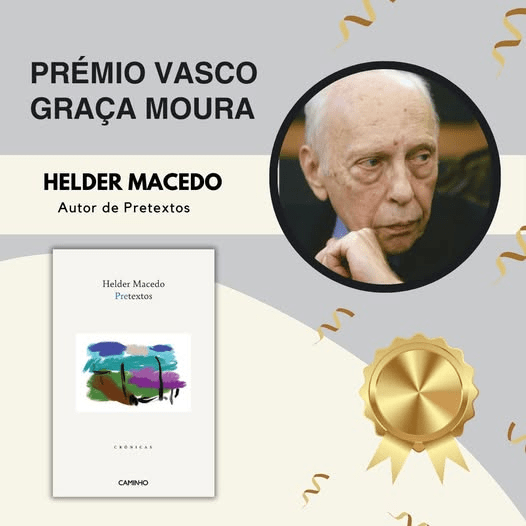
Committed to his academic life, he took a break from writing and only resumed years later. A young man with anti-fascist convictions, he was persecuted by the PIDE (International and State Defense Police). He went into exile in London in 1960, graduating in Literature and History. A lecturer at King’s College, he did his doctoral studies there.
Helder Macedo published the novels “Parts of Africa” and “Pedro and Paula” in 1991 and 1998 respectively. Co-organizer of Folhas de Poesia, he has collaborated with various publications, such as Graal, Hidra I, and Colóquio/Letras. In essays, he distinguished himself with literary criticism studies that presented innovative perspectives on the connection between the literary text and the mental and cultural horizon in which it was produced. In the field of poetry, he published “Vícios e Virtudes” in 2000 and the book “Viagem de Inverno” and “Outros Poemas,” a collection of his poetry published by Editora Record in Brazil.
Having lived in Portugal between 1975 and 1980, where he held public and political office for a short time, Helder Macedo became a professor of Portuguese Literature at King’s College London. However, he never gave up his status as a free Portuguese citizen.

Established by Estoril Sol, the annual prize, worth 20,000 euros, was created as a tribute to the memory of Vasco Graça Moura. It should be remembered that previous editions have honored Eduardo Lourenço, José Carlos Vasconcelos, Vitor Aguiar e Silva, Maria do Céu Guerra, Carlos do Carmo, Emílio Rui Vilar, Zeferino Coelho, Graça Morais and José Pacheco Pereira.
The jury that awarded the prize, chaired by Guilherme D`Oliveira Martins, was made up of Maria Carlos Gil Loureiro, José Manuel Mendes, Manuel Frias Martins, Liberto Cruz, José Carlos de Vasconcelos, Ana Paula Laborinho, and Dinis de Abreu, invited by Estoril Sol.
It should also be noted that the Vasco Graça Moura Prize “aims to distinguish a writer, essayist, poet, journalist, translator or cultural producer who throughout their career – or through an innovative intervention of exceptional importance – has contributed to dignifying and projecting the sector to which they belong in the public arena.”
The award ceremony will be announced in the next few weeks.
In A Voz da Póvoa

Translated to English as a community outreach program from the Portuguese Beyond Borders Institute (PBBI) and the Modern and Classical Languages and Literatures Department (MCLL) as part of Bruma Publication and ADMA (Azores-Diaspora Media Alliance) at California State University, Fresno, PBBI thanks the Luso-American Education Foundation for sponsoring FILAMENTOS.

 Filamentos (artes e letras)