
At the 45th anniversary of the New Year’s quake in the central Azores, Filamentos presents this revised, updated version of an essay that originally appeared ten years ago on the Azores’ Comunidades blog.
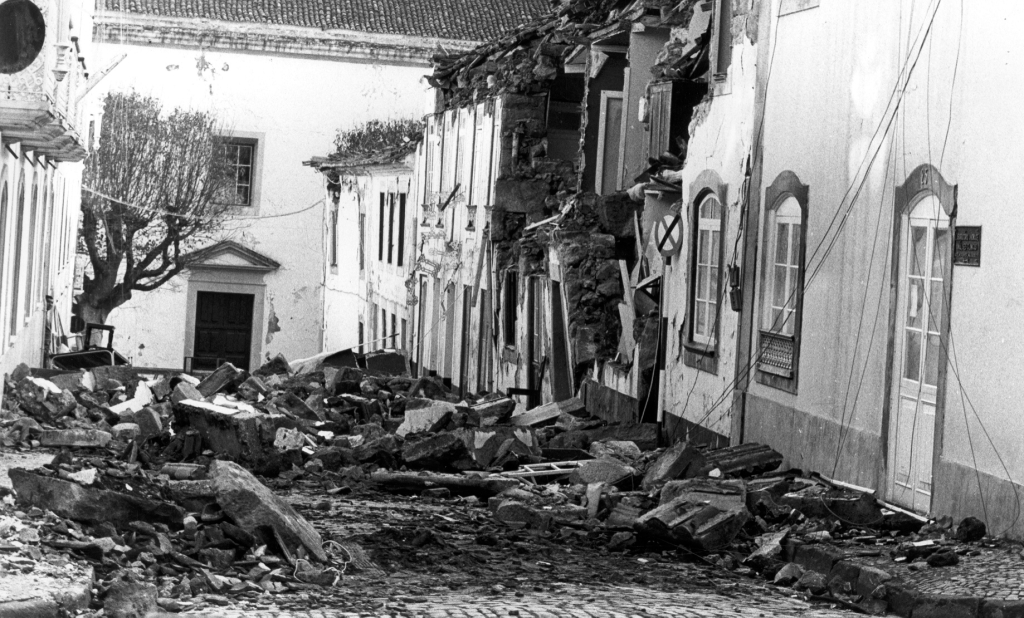
in https://www.ceru-europa.pt/pt/galeria.php?page_foto=2
Katharine F. Baker’s personal note: My paternal ancestors must have experienced many earthquakes over the centuries in their native Azores. Then, in the 1870s, my two sets of great-grandparents immigrated with their respective young children to different parts of Northern California, another seismologically active area. There, they and nearly all their American-born descendants experienced one or the other of the Bay Area’s two most severe temblors of the 20th century: the 1906 San Francisco quake, with an estimated magnitude 7.8 on the Richter scale, and the Loma Prieta (World Series) quake of 1989, which registered 6.9 MW. Both earthquakes broke some of their glassware and china, and did minor damage to their houses, but caused them no major harm.
Due to having long ago moved far from California – as well as being unaware of my half-Portuguese heritage) – I paid no heed to the scant news coverage of the magnitude 7.2 earthquake that devastated the central Azores islands of Terceira, São Jorge and Graciosa on New Year’s Day 1980. It was only after I learned of my Portuguese paternal origins that I began reading everything I could find on the Azores, which is how I learned of the archipelago’s seismological and volcanic activity, including the January 1, 1980, cataclysm (coincidentally, one of my great-grandfathers was born and raised in Topo, São Jorge, which was badly affected by that quake). However, most of what I could find out was of a sterile, just-the-facts-ma’am nature:

Location of New Year’s Day 1980, Azores earthquake. Map courtesy of http://volcano.oregonstate.edu
Date: January 1, 1980
Time: 3:43 PM
Magnitude: 7.2 MW
Aftershocks: 400 +
Epicenter: North Atlantic Ocean, between Terceira and Graciosa islands
Depth: 5-6 miles
Tsunami: Small tidal wave at Angra do Heroísmo, Terceira
Deaths: 67 on Terceira; 4 in Topo, São Jorge
Injured: 400 +
Homes destroyed: ca. 15,000
Statistics alone, while important, cannot convey the human suffering of thousands of Azoreans that afternoon and thereafter, nor the worry experienced by faraway families and friends starved for reliable news. So, when the 30th, 35th and 45th anniversaries of the 1980 quake approached, I emailed friends and colleagues seeking their personal recollections (whether in the Azores, mainland Portugal or the United States). Here are some responses I received; English translations of Portuguese replies are mine.
1. Even after thirty years, memories were still so painful that when asked in 2010, one Terceira friend demurred, replying that he hated remembering this. Another friend, in Lisbon at the time, was unable to contact family on Terceira, and still recalls the terrible feeling of not knowing.
2. Fernando Alvarino Vieira, who later become the longtime head of the Azores government’s Gabinete da Comunicação Social in Angra do Heroísmo, was then a student on hiatus from the University of the Azores. He recounted that when the quake struck, he was in the now-defunct Chá Barrosa on the east side of Rua Direita in Angra, eating an ice cream. Although in the back of the café, he said he dashed out faster than all the other patrons, then sprinted all the way home to his parents and younger brothers, whom he was relieved to find safe, and their house undamaged. He returned to the University later that year.
3. Native Graciosan author Victor Rui Dores, a recently-retired longtime educator in Horta, Faial, emailed:
I was not in the Azores. A university student at the Faculty of Arts of Lisbon, I found myself in Odemira in the Alentejo then, on Christmas vacation at my sister Conceição’s. The quake caused communications in the Azores to be cut off, so for two days I knew nothing of my family, who at the time lived in Angra do Heroísmo, Terceira.
Being far from the islands was terrible for me. On television I saw lists of the dead and injured resulting from the quake. And it was thanks to an amateur (“ham”) radio operator that on the third day I found out my family was safe.
However, our house on Rua de Santo Espírito had suffered irreparable damage. My father Elmiro, my mother Judite, and my brothers José, Duarte and Raimundo temporarily stayed in a classroom at the Angra do Heroísmo Secondary School. A month later, they were moved to housing in a shipping container, where they resided for a year and a half until our home was rebuilt.
4. Dr. Eduardo Mayone Dias, late Professor Emeritus of Portuguese at UCLA, wrote in 2014:
I visited Terceira that summer, and the damages were [still] impressive. My friend told me he was driving his new car for the first time when a wall fell on top of it. His wife had a broken leg, but at the hospital they only took care of it the following day, as they had to care first for the more seriously injured. Very sad.
5. Blogger Paula Belnavis recalled:
At that time we were living in Santa Luzia [Angra do Heroísmo]. The street where we lived suffered quite a lot of damage, but the house where we lived happily escaped. That day is still quite present in my mind. I was 14 and at home with my family, still at the table as we had just finished lunch. We were all together and happily nothing happened to us. Our house suffered very little or no damage. We had such luck, I know. But to see my land all destroyed, to see the sorrow, pain and despair that they lived in the days that followed, is a thing that marks us forever.
The event that most affected me was the death of a neighbor who was in the final trimester of her pregnancy. Her own house suffered nothing, but in panic she fled to another neighbor’s house, which collapsed and she was trapped underneath the debris. When they found her she was already dead and so was the baby. I don’t remember her name because I think she and her husband had been living on our street for only a short time. But I certainly knew her on sight, and the fact that she was pregnant and died in such a tragic manner, especially in the final term of her pregnancy, was something that shocked me very much at the time, and when one speaks of the ‘80 quake this memory is the first thing that always come to me. I think she was perhaps under 30, and I know that she also had a little boy. It was a most sad story. That was a most sad day.
6. Blogger Rosa Maria Silva of Angra do Heroísmo was 15 at the time, so still living at home with her parents in her native Serreta, Terceira. At the end of 2009 she posted a poem she composed to commemorate the 30th anniversary, which the late Dr. Bobby J. Chamberlain and I translated:
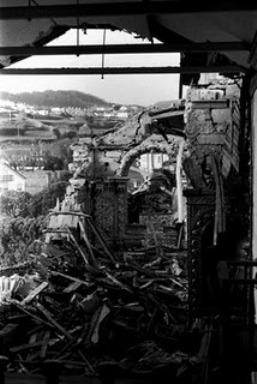
Photo provided by Rosa Maria Silva.
The earth shook in January
Of a time forever standing still;
We wept uncontrollably
In the presence of everything in ruins.
The Day of St. Mary
And of Peace announced itself…
New Year of agony
On the afternoon that pitched back and forth.
Eighty, year of pain
And great consternation;
The central island group in a frenzy
Only saw destruction…
I recall how my mother’s yellow jacket
covered me
(it was beautiful)
And it marked me forever.
I was trembling so very very much,
And my fear was ignited…
The Divine Holy Ghost
And Our Lady protected us.
Another sorrow ran through me
Upon learning of a young woman:
Rocks fell on her… She died…
Zita, my good friend.
I wept so much over her death,
She was from Doze Ribeiras, my closest classmate,
At school she was strong
I remember well her surrender.
Then later I found out
That a cousin from Altares,
Aída da Conceição,
Engulfed her Terceira home into mourning.
And other deaths stained
Other homes with bitterness
And relatives wept
Their sad fate at grave’s side.
Thirty years have now passed
Since the island tragedy;
Rebuilding without delay
Put everyone to work.
Much help arrived from outside,
From the Continent and abroad,
They will forever deserve
Our heartfelt Praise.
And our institutions,
Rescue Squads and Armed Forces,
People from the overseas communities
May they always be praised.
Portuguese version originally published at: http://silvarosamaria.blogs.sapo.pt/802905.html
7. Marilia Wiget, a Californian who has long been active in Sacramento’s Portuguese Historical and Cultural Society and edits its newsletter O Progresso, emailed:
I’m sure that Frank Dias was involved in broadcasting and assisting with donations. St. Elizabeth [Portuguese National] Church did some collections. There was a very large California effort throughout the East Bay and Central Valley.
8. Dr. Elmano Costa, now-emeritus professor at California State University-Stanislaus, who immigrated as a child with his family to Turlock, California, emailed:
Actually, our house did not suffer any damage. Two girls were killed in my home town [Altares, Terceira] when a wall of their houses fell and buried them in the rubble. I have only sporadic notes from my relatives, but most actually survived with only minimal damage to their houses. What my farmer cousin talks a lot about was the fallen walls that divide the fields, and the work rebuilding them.
The only thing I can add is the reaction from this side of the Atlantic. 1980 being before the Internet and cell phone and instant communication, we would rely on Frank Dias who had a radio program out of Sacramento to hear the daily news. He was able to establish daily phone communication with someone there and run the conversation over the radio on his program. We listened attentively to get tidbits of what was happening in Terceira. I have a faint recollection of a radio program doing a peditorio, a sort of telethon to collect funds.
9. Because the Azores are a seismologically active area, it was only natural that renowned Terceiran author Álamo Oliveira would employ earthquake imagery in his novel I No Longer Like Chocolates (English translation by Diniz Borges and me), about a family who immigrated to Tulare County in California’s San Joaquin Valley in the 1950s from a town reminiscent of his native Raminho. Álamo addressed the Portuguese-American community’s response to the disaster through the persona of socially ambitious daughter-in-law Milu, a nettlesome Portinglês-spewing immigrant character of sometimes comic relief, who nonetheless enjoyed her finest hour directing the Tulare area’s earthquake relief effort. He described it thus:
They all wept when the island collapsed to the ground, reduced to rubble by an earthquake so severe it buried people alive. They filled an enormous warehouse with clothing and canned goods, coming to the aid of anguished appeals that arrived in spotty and often contradictory news reports. And they filled the church in order to implore Our Lady of Fátima not to allow Our Lord to send more temblors to the island. At that point Milu was again on the front lines, giving orders like a battlefield general.
“Uel, that boxe comes over here! Uel, that bundle of clothes goes apestér! Uel, who donated that piece of junk? Do they think this is for pigs? Uel, put everything in the gábiche. Uel, aimetaia!”
And then she would sit down to rest on top of a case of powdered milk. [p. 109]
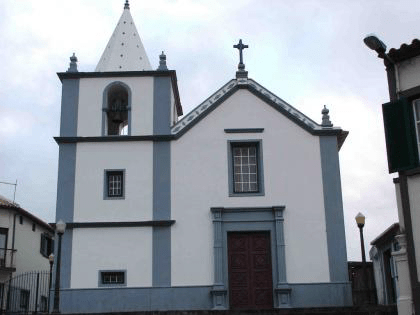
São Bento, Terceira, church. Courtesy of Wikipedia]
10. Joe Beirão provided the following information about his parents’ generosity in the relief effort:
In 1981, poet Maria das Dores Beirão and guitar virtuoso Hélio Beirão hosted approximately 100 guests at a fundraising night in Napa, California, to benefit the rebuilding of São Bento, Terceira’s, main parish church in Maria’s hometown. She and poet Dr. Décio Oliveira served as presenters and also read poetry, while Portuguese Tribune publisher João Brum was keynote speaker.
Music consisted of Azorean folksongs performed by Urânia Gomes and Damasceno Leal (the first time Hélio ever played the Viola da Terra [Terceira-style guitar] in public); Lisbon-style fados sung by Henrique Cordeiro and Ariovalda Maria, accompanied by Leonel Medeiros on Portuguese guitar and Hélio on classical guitar, presented by fado expert António Guimaraes; and, Coimbra-style fados sung by Leonel Garrido accompanied by Leonel Medeiros and Hélio, presented by former Coimbra University student Helder Castro.
Writer and translator Katharine F. Baker is a second-generation native Californian with roots on the islands of Flores and São Jorge. She earned degrees from the University of California-Berkeley and the University of Maryland, and studied Portuguese at the University of Pittsburgh. The worst earthquake she has ever experienced measured 5.2 on the Richter scale – and she hopes never to be in a stronger one than that.
Although in Portuguese, here is a link to a documentary about the January 1st Earthquake.
https://acores.rtp.pt/cultura/jorge-monjardino-apresenta-documentario-sobre-o-sismo-de-1980-video/
 Filamentos (artes e letras)