
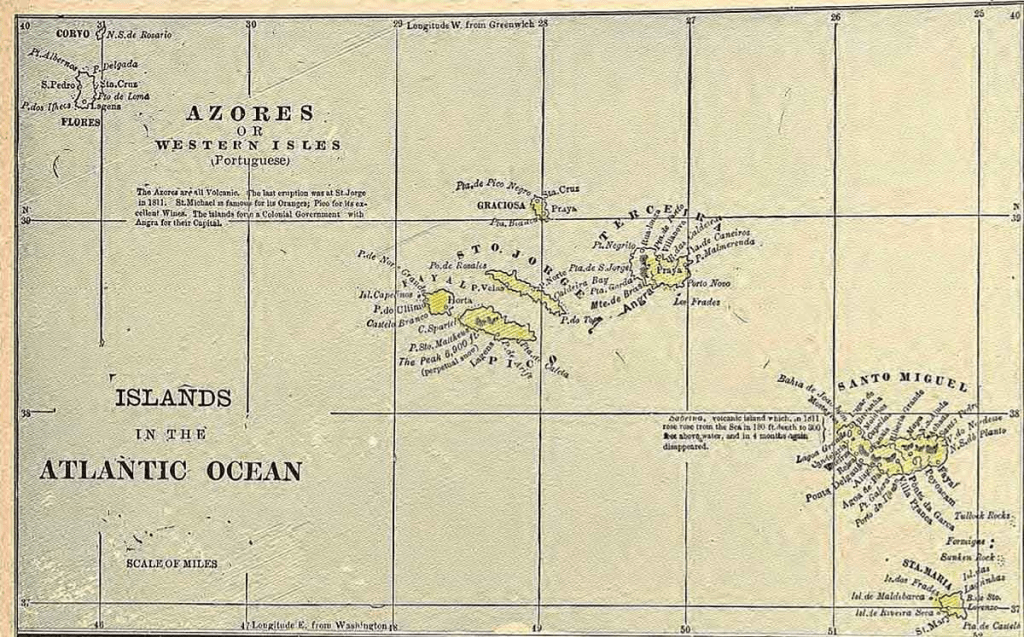
St. Michael—The Azores.
«Wallaby Jack» continues his writings about the Azores in The Field. This one was published on 18 June 1874, after spending the winter in the Azores. From the research of Manuel Menezes de Sequeira, professor emeritus, now living in Flores Island, Azores.
The very numerous inquiries that have been made to me with reference to these islands since my last communication to The Field on Oct. 18, 1873, induce me to forward the following particulars, gleaned during some months’ residence this winter:
St. Michael’s was discovered by the Portuguese in the year 1444, by Francisco Gonzalo Velho Calzal, who gave it the name which it bears. Like the rest of the group of Western Islands, it was without human inhabitants, but abounding in hawks; modern botanists say it was then destitute of timber trees. The passage from England occupies ten days; the cabin fare is £10. Tatham and Co., of 35, Pudding-lane, City, run regular lines of steamers during the orange season, commencing in October and ending in April. It may be said that oranges and pineapples are the sole export, for forty steamers and seventy-one sailing vessels have been despatched with fruit during the season of 1873-1874; after which there are some small cargoes of beans, wheat, maize, and other produce forwarded to Lisbon. When the fruit season ends there is no communication with England except via Lisbon, when the expenses of the voyage will be found to be about £20 a head.
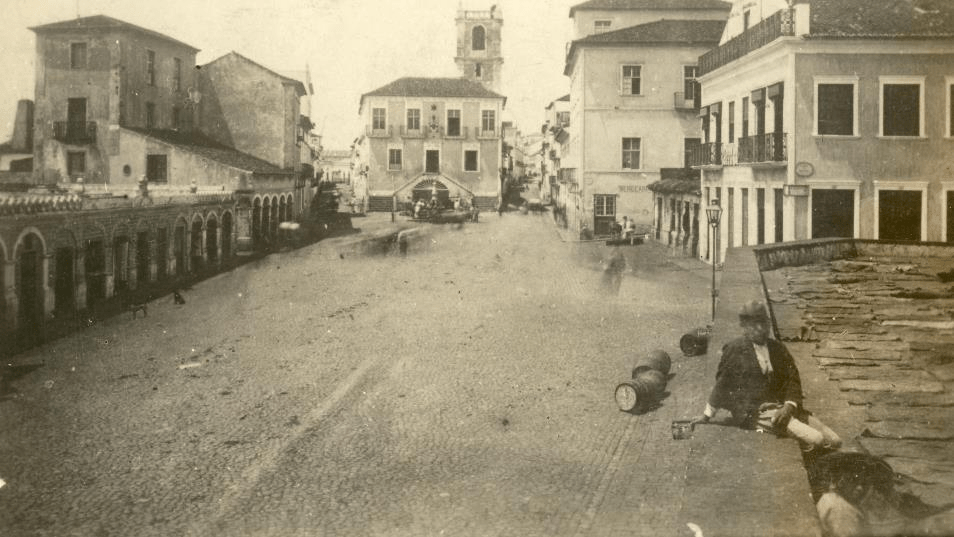
Ponta Delgada, the principal town of these islands, contains about 1400 inhabitants. The streets are well paved and clean. There is an hotel or boarding-house, kept by Bird, an Englishman; charges from 4s. 3d. to 20s. per day, according to the accommodation required. The cooking is good, the beds are clean, and the table liberally supplied. The house has been full the whole of this season; but it possesses considerable expansive capabilities. There is also a very dirty Portuguese hotel, a Café Central, a club, a theatre, a branch bank of the Banco Lusitano, Lisbon; agents in London the Alliance Bank (Limited). The manager at St. Michael’s, Clement Joaquim da Costa, speaks English. There is a public market twice a week, where poultry, vegetables, fruit, eggs, butter, and all kinds of other things are sold. There are carriages, with mules or horses, for hire, and ambling asses and porters for baggage. There are no lodgings or furnished or unfurnished apartments to be had, nor are there, as a rule, any furnished houses to let; nor are any of the residences there fitted with the conveniences or furniture we are accustomed to find in very moderate houses at home, as a few chairs, two card tables, a piano, and a hearthrug constitute all that is considered necessary for a drawing-room, whilst the bed and other apartments are fitted up in a like simple manner. In the kitchen two or three three-legged iron pots, with some earthen pipkins and a water jar, constitute the batterie de cuisine of a Portuguese cook. Pianos cannot be hired, and are expensive to buy, new or old, being subject to a duty of about £6.

Carpets are not generally used, being very expensive, requiring great care to preserve them from moths in summer; native matting, more suitable to the climate, is reasonable. Custom-house regulations are easy for travellers’ luggage; examination similar to what is usual in England or France. No duties on personal clothes or luggage in your trunks; but duties on imports are high, ranging from 15 to 35 per cent. ad valorem. Groceries are double the price in England; spirits the same as in Great Britain; wines from Lisbon not dear; clothing much the same as in England, but inferior; boots and shoes cheaper, but not so good; tobacco and cigars—nothing fit to smoke to be had in the island at any price, worse than the French weed cigars—are subject to a duty of about 3s. a pound; house rent is reasonable, but good houses are not to be had in town; in the country near the city, about £30 to £50; taxes are moderate. Petroleum is the lighting medium indoors and in the streets; good lamps cannot be bought. Iron bedsteads (with square tops for mosquito curtains) are also not procurable; fleas are abundant in certain seasons. Wood for fuel is plentiful; coal can be had at high rates; abundance of good water at the public fountains. Servants are very indifferent; the men, who do part of the household work, are best; one good home girl is worth six of the Portuguese servants. Provisions: Meat is as cheap as it is indifferent in quality; fish is very soft rubbish, cheap in summer, very dear in winter; poultry is abundant and not dear; eggs fresh, about 6d. a dozen; vegetables are common, coarse, and cheap; the like remark applies to most of the produce of the island. There are no shops in the European sense, with plate glass and well set-cut windows; all are stores, with goods on back shelves, roughly kept. The leading merchants all import, and have large retail establishments attached to their premises. During the winter months there is no fruit but very expensive pines; oranges, windfalls, about 20 for a penny. In April the loquat comes in, as also strawberries. Other European fruits follow in due course. Pines are grown in thousands under glass without artificial heat, for export to London, where they are sold as the best English hothouse fruit, realising wholesale from (?)s. to 80s. each. But there is no other fruit or any vegetables to compare with such as is found in the markets of England or France. The resident gentry grow fair vegetables for their own use; only butter is of very indifferent quality. The like remark applies to milk; the farmers do not understand dairying. With English population there would be an opening for an English dairy farm. Good macadamised roads are found on all the main routes of the island, with no turnpikes, and no inns to speak of by the roadside. There is no English resident medical man; but Dr. Bouteillier [Botelho], who has graduated in Paris and London, attends all the English families. Homœopathic or allopathic medicines cannot be purchased without a prescription. There is no shooting but rabbits and quail; the former are scarce, and cannot be got without ferrets. Of quail a day’s sport yielded 40 brace, another 35 brace, another 9 brace, with two guns. No dogs to be had; the best would be short-ranging retrieving spaniels. Terriers are next best, or both; but it is a disputed point amongst English sportsmen which work best; one day one does, and another the other, depending upon the weather. Portuguese gentlemen use pointers. The shooting season commences in September, ends in April. No foxes or wild animals of any sort, or venomous creeping things; no toads, but there is the edible frog. The black rat abounds in the country, having been driven out of the towns by the brown Norway rat; the former builds and rears its young high up in the thick foliage of the trees which surround the orange gardens as a break-wind. These rats, with good terriers, afford excellent sport at times. Land, either to purchase or rent, is very high in price, from £20 to £200 and £300 per acre; the demand for it is great, and there are many wealthy landowners. Land rented commands higher rates than in England; but the barren wild lands near the Furnas, requiring clearing of heath, boxwood, and St. John’s wort, can be rented at low rates—one shilling an acre, more or less.
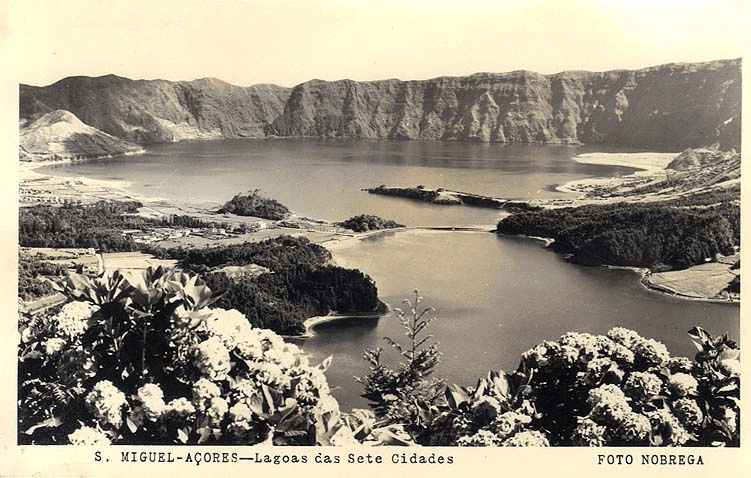
There is no means for providing for sons or daughters. No governesses are required; there is more than one English school; whilst native professors of music, drawing, and languages, supply all the talent required at reasonable charges. There is not much opening for the investment of capital; merchants keep accounts current with orange growers, advancing money at 6 per cent. There is no opening for any business, in the opinion of the writer, except it be a cotton mill, which, from the abundant water power, low rates of labour, high duties on manufactured goods, and low duty on raw material, should prove a profitable speculation. Field labourers get 10d. a day, women about half, and find themselves in food. There are no warm baths in the town, and the sea-bathing, though good as far as the beach is concerned, is destitute of accommodation for bathers, though the climate would permit of its enjoyment on most days throughout the year.
There is a pretty little English church and churchyard, with a few graves in it. One of the merchants officiates and reads the prayers of the Church of England to the congregation, to which denomination the whole of the British residents belong, with one or two exceptions. The want of a resident clergyman of the Church of England is much felt. A Presbyterian minister was sent out on a visit this year by some ladies from Ireland, who officiated a medley service; when he left £50 was subscribed for him.
An établissement des bains, with a casino and hotel, on the beach, where they are now building the floating dock, is a speculation worthy of the attention of those who float companies, as it might, if properly advertised, become a fashionable watering-place for the native and Lisbon population. Gloves, washing, labour, servants’ wages, are none of them expensive.
There is a resident civil governor, a military governor, and some troops, with a military band, which plays on fine Sundays and fete days. There is also a British consul, absent, represented by his vice, Mr Reed. There are numerous Roman Catholic Churches and many priests, processions being one of the principal amusements of the inhabitants, who are ignorant, superstitious, and bigoted, the peasantry being entirely devoid of education—not any of them able to read or write, or know the time by the clock. There are some nunneries with nuns, but their number is not allowed to be augmented by law, and those who have taken the veil are simply allowed to die out. Connected with one is a baby box, where parents are allowed to get rid of and turn in their infants by ringing a bell. There are no mattress or palliasse makers; beds are stuffed with the husks of Indian corn, others with dry moss or the fibrous roots of the fern. Crockery and glass is indifferent in quality; but, as all is imported, it should be brought. Good red clay pans and water jars of the old Roman shape are manufactured on the island, with some rough articles of crockery. There is no accommodation for Invalids, nor can they obtain at present any of the comforts they require, as at Torquay or Madeira. There is only one boarding house—Bird’s—and the difficulty of obtaining decent cooks or decent servants of any sort will prevent any competition for some time to come. The duty on carriages is very high—from from £16 to £60 on each. Those built on the island are inferior and dear. Hack carriages are bad, and high for short drives, but visiting at night is cheap. There is eight months’ summer and four months’ winter, therefore clothing should be brought accordingly. People dress the same as they do in London or Paris, and a Portuguese belle out in her carriage to show her new bonnet is a caution! As to society, the residents who wish to make acquaintances call. The inhabitants are the most kind, polite, and obliging people in the world. Strangers may do anything but fight or get drunk, which is an unpardonable offence, as no drunkenness whatever is seen in the streets, and the labouring population are very civil; no brawls, or fighting, or drawing knives, are ever heard of. There is a club, the reading room well supplied with Portuguese newspapers, the Revue des deux Mondes and the illustrated French and English newspapers, the Times in the orange season. There is a billiard room for whist, and a large one for voltaret; no books, no library. In the season a few good balls, with many private parties. Admission to the club by ballot: fees about £4 the first year. Fishing—there is no fresh, but plenty of deep-sea fishing to be had, with boats and tackle; the latter had better be brought, with some good hooks. Horses—very few on the island: most of them come from Spain. Donkeys and mules plentiful. Asses cost from £5 to £10, and are wonderfully good. No English saddlery to be had worth buying. Flour is dark; bread very bad, unless made from American. A good French baker much required. There are about fifty resident English, and the place is so utterly foreign that few would like to reside there permanently, with one mail a month after the orange season, and no telegraph nearer than Lisbon, 700 miles away. Promenades—several very fine gardens, private property, open to the public, with some pleasant walks and drives. Steamers—all kinds of repairs can be effected in the Government workshops, designed by Sir John Rennie for making the breakwater, which is completed so far as to be of great service and protection, but at the present rate of progress it promises to take another fifty years to finish. It will be seen by the above that the policy of the Government is very restrictive and protective, in order to foster native manufactures, which do not exist, except a small nail and a manufactory for producing execrable tobacco. The expense of living is about the same as it was in the South of France before the Prussian war, wine being always more than double the price it was in France at that period. Agriculture is in much the same state as it was in England after the improvements introduced by the Romans, whose models of ploughs, hoes, harrows, and other farming tools are still in vogue. Stone hand mills are used, same as in Abyssinia now, and in Egypt in the time of the Pharaohs; there are also windmills of ancient construction. Messrs Tatham and Co., of Pudding-lane, père et fils, having both of them resided on the island, are able to answer all inquiries if this communication should not be found exhaustive enough. Climate in winter is something like Torquay, or Penzance, or Ventnor; and if fires are not used, they are none the less badly required on some days throughout the winter, as there are many cold half-hours, with boisterous, cloudy, or rainy weather.
Invalids suffering from bronchial or pulmonary complaints should certainly avoid St. Michael’s, as well as those who have had attacks of pleurisy, whilst those with asthma seem to derive considerable benefit, the climate is so very equable, if moist, the thermometer ranging between January and May from 50° to 73º Fahr. Situated about 1400 miles from London in the middle of the Atlantic, at times all the winds of this ocean seem concentrated round Ponta Delgada, where it blows with astonishing fierceness, throwing down the end of the breakwater and scattering spray and foam high over it. The absence of fireplaces renders it necessary that invalids should bring a stove with them in which wood could be used as fuel. The Portuguese language is by no means easy to acquire by adults, but the best books are A. J. D. D’Orsey’s [«A Practical Grammar of Portuguese and English»], B.D. (Trübner and Co.) with J. P. Aillaud’s Dictionary [«A Dictionary of the Portuguese and English Languages, in Two Parts: Portuguese and English and English and Portuguese»]—at best a bad one, numerous words being left out. I fear I have made this communication too long; but in another, with your permission, will forward descriptive details of the objects of interest.
Wallaby Jack.
St. Michael’s, The Azores.—Just having read a letter in your paper of July 18, signed “Wallaby Jack,” will you allow me to correct a few errors for the benefit of those sportsmen or others who are inclined to pay St. Michael’s a visit? Your correspondent in his letter does not quote the return fare, which is £16, available within the six months; average passage six to ten days. Messrs Collings and Co., of Eastcheap, run regular steamers as well, from October to April. In respect to house rent, a margin is to be drawn from £18 to £36. In the last four months the only four English families who required houses have succeeded in procuring them within the above rates, one of whom is “Wallaby Jack,” with an acre of land attached to his house; so the “very indifferent beef and soft rubbish of fish” has not prevented him from renting and furnishing and making this his home. The contract is already signed for a fortnightly mail, commencing on January 1, 1875. We do not depend on Dr. Botelho alone, having four or five clever medical men, all more or less speaking English. The variation of the thermometer is so little during the year, amounting to 12°—between 60° and 72°—that it is unnecessary to call it winter. “Wallaby Jack” quotes inhabitants 1400. Allow me to ask him to add another cypher, so as to make it 14,000 inhabitants of Ponta Delgada. The population of the island is 100,000. The market tariff at present is—beef, equal to English seconds, 4d. per lb.; mutton, equal to English seconds, 4½d. per lb.; pork, 5d. per lb.; potatoes, 10d. for 32lb. Vegetables, peas, and beans thrive wonderfully; rock melons grow out of doors, and all other vegetables are to be procured. Fowls, 1s. 8d. to 2s. per couple; ducks, 2s. 6d. per couple; eggs, thirty-five for 1s. The Lisbon wines are extremely cheap and good. The above prices, I think, may be useful to visitors. “Wallaby Jack” is here only a few months, and that time spent in hotels. Having resided at my own residence for two years, I think I may be allowed to know respecting the above matters.—A Canoeist (St. Michael’s, The Azores.)

 Filamentos (artes e letras)