
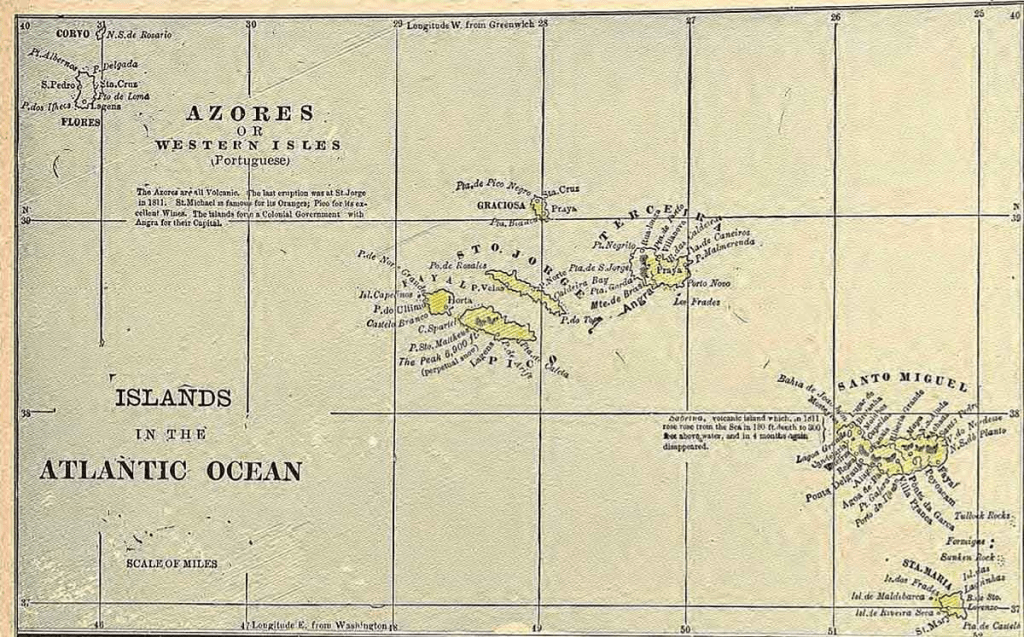
The writing comes from the English Newspaper The Field. We will publish a few of these writings to give our students at Fresno State and our readers worldwide a taste of how folks saw the Azores in the late 1800s. These writings are the product of the great scholarly research by Professor Emeritus Manuel Menezes de Sequeira, now retired and living on the island of Flores. He has graciously published these on his Facebook page.
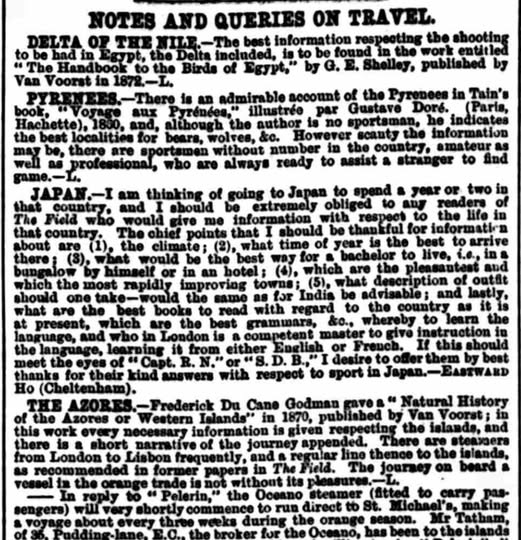
On the English “social network”, in “The Field”, dedicated to travel information, in the issue of October 11, 1873, p. 377, there are two requests for information about the Azores. The replies appear in the following two issues of October 18 and 25, 1873:
- October 11, 1873, p. 377:
The Azores.—I am thinking of going to the Azores this winter [época da laranja], and shall be much obliged for information about St. Michael from any of your readers. Is there any sport, and should I take rod and gun? Is there a good doctor; English service at the Consulate; and are furnished houses to be had? Are the hotels good and moderate?—Pelerin.
— Will some one give me any useful information about living in the Azores for the winter—whether living in the hotel at Fayal or taking apartments would be cheapest for a party of four; whether plate or linen would be required, the best route to get there, and an idea of the cost?— R. M.
[Some letters giving information about the Azores, though not answering all the inquiries here made, will be found in Nos. 937 and 1025 of The Field,-ED.]
The Azores.—Frederick Du Cane Godman gave a “Natural History of the Azores or Western Islands” in 1870, published by Van Voorst; in this work every necessary information is given respecting the islands, and there is a short narrative of the journey appended. There are steamers from London to Lisbon frequently, and a regular line thence to the islands, as recommended in former papers in The Field. The journey on board a vessel in the orange trade is not without its pleasures.—L.
— In reply to “Pelerin,” the Oceano steamer (fitted to carry passengers) will very shortly commence to run direct to St. Michael’s, making a voyage about every three weeks during the orange season. Mr Tatham, of 35, Pudding-lane, E.C., the broker for the Oceano, has been to the islands several times, and is, I am sure, well able and willing to give “Pelerin” all necessary information. CUM.
— R. M. will find no vessel direct for Tayal [Fayal], but plenty for St. Michael’s going out to be ready for the orange season, which begins about the first week in November. Messrs Collings and Co., Cross-street, St. Mary-at- Hill, E.C., or or Messrs Tatham and and Co., Pudding-lane, will be able to give him all the information he may require. On the 15th of each month a steamer (in correspondence with the Royal Mail River Plate steamer from Southampton on the 9th) leaves Lisbon for the Azores, carrying the mails. She reaches St. Michael’s on the 19th, and after stopping there a day or two goes on to some of the other islands, including Fayal. At St. Michael’s there is a very respectable hotel, kept by an Englishman named Bird; the charge for board and lodging is a dollar (4s. 2d.) a day. Furnished houses or apartments are are only to be had occasionally. Plate and linen should certainly be taken. The doctor who has the chief practice among the English received his medical education in Paris, and spent some time in the London hospitals—his name is Botelho; he is held in high repute there. There is service at the English chapel every Sunday morning, prayers being read either by the Consul or one of the residents, as there is no chaplain. The quail shooting is very good, 40 couple in the course of three or four hours not being at all unusual, and in some parts of the island rabbit shooting may be had. As the importation of gunpowder is strickly prohibited, all cartridge cases must be taken empty. The powder sold there is inferior; one of the English captains “accidentaly” brought a canister ashore in his pocket, which he let me have. Of Fayal I have no personal knowledge, but I I can assure both R.M. and “Pelerin” that they will find St. Michael’s well worth visit; the scenery in many parts is magnificent, and the kindness and hospitality of the members of the little English community I shall not soon forget. I forgot to mention that the sea fishing is good. Inland nothing to be caught except goldfish, which are abundant, and grow to a large size in many of the lakes. If “Pelerin” wishes further information, he can have my address.—Ramalho.

— An excellent and detailed account of the Azores will be found in Dark Blue for Dec. 1872 [see earlier translation], but there is nothing about furnished houses, apartments, or plate and linen, nor is there anything on these subjects in the following letter received by me in August of the same year from my friend Capt. W., who, if he should peruse this, will I am sure pardon me for the free use I have made of his communication. “After a pleasant but cold and cloudy voyage, we reached St. Michael’s on the night of the 24th, and next day I landed from the steamer on this Isle of Oranges. The port we put into was that of the capital town, Port Delgada, not very striking on account of its buildings—in fact, rather squalid looking—but everything is redeemed by the luxuriant beauty of the surrounding country, which is for miles one continual grove of oranges. I found here a fair English hotel, kept by an ex-gardener of the name of Bird and his wife; they had just started the hotel, and certainly everything was wonderfully good considering the charge for board and lodgings—a dollar a day; this is to be raised, and only those who stay for some time will get off with such a very modest charge. I here met two Englishmen, both in the law; we fraternised, and I went with them to stay at one of the most striking places in the island, called the Furnes—a very beautiful lake among the mountains, in the immediate neighbourhood of which issue from the earth springs of scalding hot water; so you could here boil potatoes or anything else without being at the trouble of lighting a fire. The steam and roaring noise produced by these streams is very striking; the vapour from them rises sometimes to a great height, and the water is agitated to the greatest degree of violence, and seems as if it were working might and main to make up for lost time. One of these springs—through the sheer force of its boiling power—shoots into the air three or four feet. A man once fell into it, and was scalded to death. The most curious of them is one called the Mouth of Hell, a gloomy cavern besmeared with a dark slate-coloured mud. From this ever proceeds the noise as of a subterraneous steam engine at work, and constantly are thrown out to various distances showers of mud, so hot that if any drops strike you they burn through to the bone. The natives believe the Old Gentleman is constantly at work here, and that if you shout cut and chaff him he gets furious, and endeavours to bespatter you with his mud—said to be a very good remedy for cutaneous diseases. It is gathered on that account. With such abundance of hot water, it is not surprising that there have been constructed good baths. The Portuguese Government have constructed a capital bathing-house, where you can go and souse yourself day and right in either hot iron water or hot sulphur, free from all charge. A man is employed to look after this establishment, and he has no objection to an occasional douceur, but this is not obligatory. They say that the sulphur baths are of the greatest benefit to rheumatic patients: the iron ones I found most strengthening. With the great natural advantages of beautiful scenery and medical baths, there is a third here: the house where English travellers reside, kept by people of the most extraordinary name of Brown, has every comfort you could wish for. Mr and Mrs Brown are very nice people; you have all the benefits of a first-class English house at the small charge of 6s. a day. For an invalid with moderate means there could hardly be a better place. From the Furnes I went to the next great resort of the travelling islander, the Seven Cities. You see a circular crater of hills of from 2000ft. to 3000ft. above the level of the sea, about four miles in diameter. Inside this crater, down about 1000ft. above the sea level, are two beautiful lakes—one wooded, and of a deep green colour; the other of a deep blue, and without wood. Here you have a bit of the Scotch Highland or Swiss scenery at the bottom of the crater of an extinct volcano. Within this crater, besides the lakes, which are themselves water-logged craters, are four other craters, three of which have some water in them; the fourth is perfectly dry, and under cultivation as a field. A wild, strange, beautiful scene the whole makes; and, if you are a lover of the picturesque, you can enjoy a week or or so very much at the snug little inn by the banks of the green lake. Here you are lodged and boarded for 3s. a day—boarded certainly well; the lodging is not quite so good, but the rooms are wonderfully clean; in fact, a person would be very fastidious who was not greatly pleased with what he gets for his 3s. a day.” In a subsequent letter he says: “I do not think there are any riding horses or ponies to be had for hire. Some of the resident gentry have them for their own use, and you occasionally might be able to buy one, but this is a rare chance. Donkeys and mules are always to be had, but no English saddles. You have to use the common ones of the country, and sit sideways.” He also adds: “For a sportsman the attractions of the island are not great; the shootings consist, I think, entirely of rabbits and quails. There is no fresh-water fishing; there is deep-sea fishing of course. House rent, servants, and firing are reasonable.” I may add there is an English church, but no clergyman; no bank. Bank notes are almost useless; sovereigns are found to be the handiest currency. There is a British consul, Mr E. Smallwood. A steamer of 1200 tons (the Oceano) was advertised in the Times to sail this month—agents, Tatham and Co., Pudding-lane, E.C.; and other information might be obtained from the consul in London for Portugal, Viscount Duprat, 8, St. Mary Axe, E.C., or his vice, Mr Richard Van Zeller. I trust these extracts may be of service to your correspondents.—Wallaby Jack.
[I believe that “Wallaby Jack” is confusing the owners of the hotel in Ponta Delgada, the Browns, with the owners of the hotel in Furnas, the Birds].–Note from the Researcher
 Filamentos (artes e letras)