
By Victor Rui Dores
Translated by Katharine F. Baker
“I would like my poems to be the hooks
On which you hang your feelings…” (p. 301)
It is a well-known truism that poets have reasoning that reason cannot fathom. Desecrators of all knowledge, they realize that words are corrupted in people’s daily commerce. That is why they reclaim, replace, transfigure and subvert these words – because they know that poetry does not explain, it implies; a poem does not affirm, it suggests. The meaning of the poetic image always reminds us of a Sphinx-like secret and powerful ambiguity. From this perspective, poetry will always be an attempt to comprehend the incomprehensible.
Readers are posed with a challenge: to unveil the other side beyond the haze of the poet’s verse. In other words, they must be able to decipher and decode the poem’s meaning(s) so its text can be enjoyed. Poets face the task of polishing unique, exact and essential wording, and finding rhythms and pulsations, silences and sounds in it. Being tireless) workers of the word, they will never stop observing reality and dissecting their lives and souls – like Claude Joseph Vernet clinging to a ship’s mast in order to study a storm.
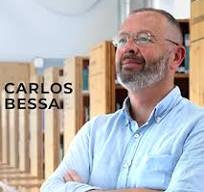
In this sense, all poetry is about circumstance. It is only necessary for the circumstances be those of the poet: the outer one must coincide with the inner, as if the poet had produced it. In fact, it is from multiple and varied circumstances that the book that brings together the poetry of Carlos L.P. Bessa – who was born in Viana do Castelo but has long lived on the island of Terceira – is woven. These are his collected books (Tinta da China, 2024), a work of circumstance because it was forged in the light of his observation of the real, of the lived and of meaning, in a game of the mythical and symbolic, in an intimate connection between life and writing.

A poet of acute sensitivity and appreciable sensory resources, a subtle researcher of visible and invisible realities, Carlos L.P. Bessa, seated in the shade of a terrace, collects impressions of fleeting moments of everyday life in a poetic discourse marked in large part by an urban realism that makes enumeration and discursive juxtaposition one of his techniques for summoning suspended time. The poem is now and forever the moment and its circumstance. In this way, the poet (re)visits places, people, brief events, capturing emotions, sensations and states of mind.
And, concerned with mankind’s destiny on the world stage, attentive to the great tragedies of humanity and reckoning with loneliness, emptiness, absence, boredom, disappointments and disappointments in life, the poetic subject combats the hypocritical simplification of life, seeking to decipher the enigma of existence. To this end, the poet denounces illusory truths and renounces the masks of an alienating quotidian life – and makes the poem the place for a confrontation, translated into an inquiry the reality that is constructed and deconstructed through words. This is above all poetry that acts and reacts, that thinks and feels. (Hello, Álvaro de Campos.)

It is a book of itineraries, pilgrimages, and shared affections, of books gathered together to bring us vibrations, impressions, and loose memories. This is “backpack” poetry, a dialog (“mouth” and “mirror” are recurring words) aimed at the other, with more nouns than adjectives.
Love is also here – both philia and eros – and “Blues with Fog in the Background” is one of the most erotic poems I have read in recent times. I appreciated this work, which was rich in its evocative density, the naming, and the significant burden of this naming, with a notable power of observation and meticulous detail. The most beautiful poetry for those who know how to read.
Originally published on the Graciosa blog as “Carlos L. P. Bessa ou a circunstância dos dias”:
https://graciosadigital.blogspot.com/2024/08/cronica-victor-rui-dores-carlos-l-p.html
 Filamentos (artes e letras)