

THE NEW CHALLENGES OF THE AZOREAN DIASPORA
“Navigating the Future: Our Diaspora in California” – the theme proposed for the 46th Congress of the Luso-America Education Foundation (2022) – is as interesting as it is challenging. Because it looks at the largest Azorean diaspora community with more concern for the times to come than the contemplation of past achievements.
This is a necessary debate. Because we face different challenges in preserving, boosting, and affirming our diasporic identity in California as in other important Azorean communities, whether in Massachusetts or Ontario.
For example, the preservation of cultural identity, the dynamization of the associative movement, or political affirmation in the sense of electing and being elected with proportional representation. But of all of these, and related to them, the greatest challenge involves the new generations of the Azorean diaspora.

The children and grandchildren of our emigrants are the future of our identity in North America. And that future only depends on what we do in the present.
In general, our young people are already born and raised in American society, they no longer speak or understand Portuguese, they no longer feel or live the identity references of Azorean culture.
We have to know how to reach the younger generations in their language and with their language. Show them the contemporary Azores as a developed and cosmopolitan region of the European Union, with a geostrategic position between the Old Continent and the New World. Explain the advantages of dual nationality, mastering Portuguese, and strengthening Azorean identity.
In short, it is important to convince our young people that they can be full American citizens and proud Azorean descendants simultaneously and with double advantage.

Rejuvenating the Azorean diaspora is as important a challenge as harnessing its economic potential.
The Azorean diaspora is an important, interesting, and integral part of the Autonomous Region of the Azores itself.
There are fewer than 250,000 of us on the nine islands. Still, there will be well over two million Azoreans and Azorean descendants in the different communities of America – from Brazil and Uruguay to the United States, Bermuda, and Canada.
For 400 years, our emigration has always had a social motivation and maintained a cultural affirmation. Still, today, it also has, and can increasingly have, an economic potential that must be exploited to the common advantage of both parties.
This new paradigm for the Azorean diaspora is a two-way bridge.
On the one hand, it is important to encourage the export of Azorean products, taking advantage of the so-called – Mercado da Saudade- “nostalgia market.”
On the other hand, it is important to speed up the conditions for investment by entrepreneurs from the diaspora in the region itself.
In both cases, it is important to count on the decisive partnership of the entities representing the Azorean economy as qualified intermediaries for economic investment on both sides of the Atlantic.
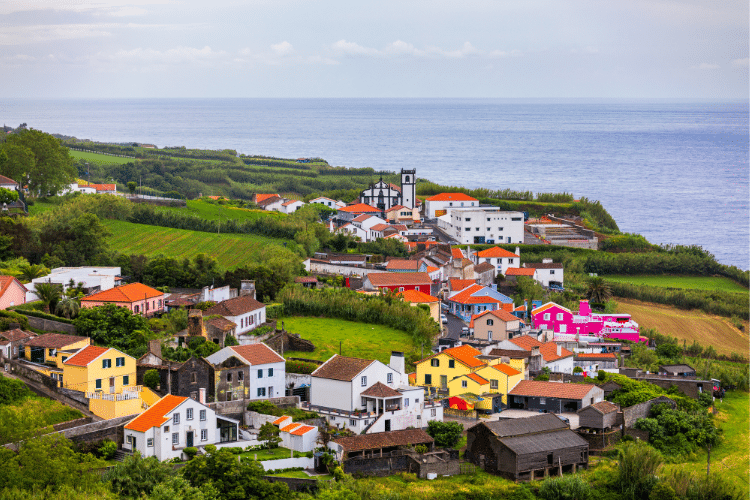
The way forward has been defined. Now it’s time to walk side by side, step by step, to make it easier to invest with the dollars of nostalgia in the islands of our birth.
Our investors want complete and accurate information without blockages and with predictability. They know that time is money. They need and deserve to know what they can count on, when and how. Anyone willing to invest in our country deserves respect and consideration.
They need answers, not bureaucracy. Don’t be discouraged.
Diaspora investment in the Azores is a regional imperative, but it is also a national goal.
When we talk about the Portuguese diaspora in North America, we mostly talk about emigration from the Azores, which identifies with us and interests us.
The contemporary path from the Portuguese mainland to the American continent cannot fail to pass through the Azores and count on the Azoreans.
Strategically positioned halfway between the Old Continent and the New World, the modern Azores are an open door for transatlantic investment.
And this process, if it is to be successful, must be led by those with knowledge on the subject, the entrepreneurs themselves.
_____
José Andrade is the Regional Director for Communities of the Government of the Autonomous Region of the Azores
This article is based on a text from his book Transatlântico – As Migrações nos Açores (2023)-Letras Lavadas.
Translated by Diniz Borges

 Filamentos (artes e letras)