

The writing comes from the English Newspaper The Field. We will publish a few of these writings to give our students at Fresno State and our readers worldwide a taste of how folks saw the Azores in the late 1800s. These writings are the product of the great scholarly research by Professor Emeritus Manuel Menezes de Sequeira, now retired and living on the island of Flores. He has graciously published these on his Facebook page.
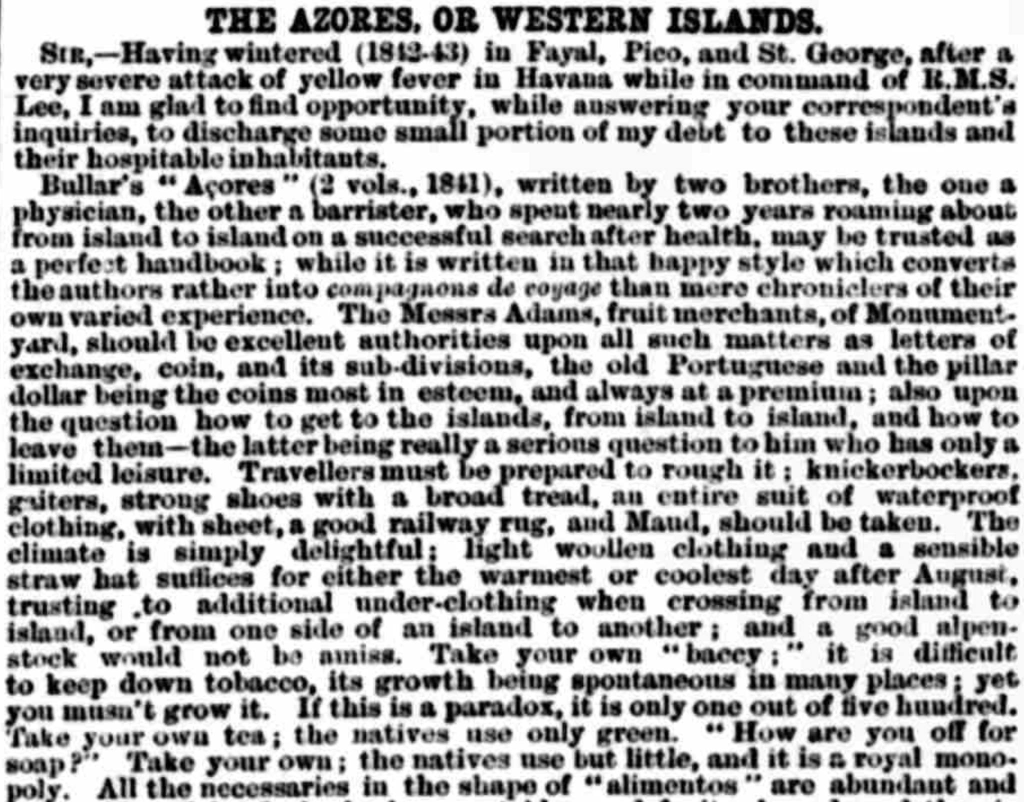
Sir.—Having wintered (1842-43) in Fayal, Pico, and St. George, after a very severe attack of yellow fever in Havana while in command of R.M.S. Lee, I am glad to find opportunity, while answering your correspondent’s inquiries, to discharge some small portion of my debt to these islands and their hospitable inhabitants.
Bullar’s “Açores” (2 vols., 1841), written by two brothers, the one a physician, the other a barrister, who spent nearly two years roaming about island to island on a successful search after health, may trusted as a perfect handbook; while it is written in that happy style which converts the authors rather into compagnons de voyage than mere chroniclers of their own varied experience. The Messrs Adams, fruit merchants, of Monument-yard, should be excellent authorities upon all such matters as letters of exchange, coin, and its sub-divisions, the old Portuguese and the pillar dollar being the coins most in esteem, and always at a premium; also upon the question how to get to the islands, from island to island, and how to leave them—the latter being really a serious question to him who has only a limited leisure. Travellers must be prepared to rough it; knickerbockers, gaiters, strong shoes with a broad tread, an entire suit of waterproof clothing, with sheet, a good railway rug, and Maud, should be taken. The climate is simply delightful: light woollen clothing and a sensible straw hat suffices for either the warmest or coolest day after August, trusting to additional under-clothing when crossing from island to island, or from one side of an island to another; and a good alpenstock would not be amiss. Take your own “bacey;” it is difficult to keep down tobacco, its growth being spontaneous in many places; yet you musn’t grow it. If this is a paradox, it is only one out of five hundred. Take your own tea; the natives use only green. “How are you off for soap?” Take your own; the natives use but little, and it is a royal monopoly. All the necessaries in the shape of “alimentos” are abundant and reasonable; fish, flesh, fowls, vegetables, and fruit abound, and the air stimulates the appetite to frequent consumption. Pico furnishes excellent onions, and a good vin du pays. Upon this latter the traveller might display some curiosity, but should never be tempted into tasting. Pico Madeira, prepared in an “estufa,” and cooked into a fictitious old vage—the very antithesis of venustas—is a villanous compound, totally unfit for the climate, and certain to derange stomach and brain by poisoning the blood. The ordinary wines are cheap, and cost about 3d. per bottle retail. After a little experience and acclimatisation they are simply delicious, inasmuch as they are the pure juice of the grape, alike unadulterated and unfortified. My physician’s remedy (recovery from yellow fever retarded by sciatica in the left hip, and one hundred grains of calomel) was open air all day, open window at night, and haustum, bis in die, sumendum—say about a quart, more or less. The brandy made from the grape of these islands is execrable, totally unfit for “fortifying” wines previous to removal. All other brandies are prohibited. The sportsman will find quail after harvest, and the artist plenty of work for both pencil and brush; bright skies prevail, and, as a rule, the people affect bright colours. September and October are the best months in which to ascend the Peak of Pico, 8000ft. The view is magnificent, and well worth the trouble which awaits all those who have to do with such a born set of “Paulo post-futurists” as the gens du pays of these islands. The story of “Eyes and No Eyes,” in Mrs Barbauld’s “Evenings at Home,” contains the moral of these islands. Many modern tourists, who are only happy when in a chronic spasm of sensations, would pronounce them unutterably dull; but the man who can say after some humble and truthful fashion “my mind to me a kingdom is,” may cross from one to another, as did the Brothers Bullar aforesaid, always contented and charmed. The island of St. George is very interesting on account of the great earthquake and volcanic eruption, 1808 (?). Cross over from Fayal to Madeleina, in Pico, by one of the market boats. Walk round to the Key of Pico, a village on the north side, and thence across to Velhas in St. George; ascend the hill on the rear as if bound across the island; then along the ridge and down into Ursuline, where you will find they make a luscious sweet pine, used in blending the wines of Pico; and so on to the next village, and back to Velhas. Look out for squalls, and remember that you are on the Western Ocean. This is a most enjoyable cruise, and may be made, with gun and pencil, to last a week at least. The people are hospitable and kind after their fashion; being much given to small ceremonies, they appreciate the stranger who, falling in with their little courtesies, learns to give the “time of day” in their vernacular, and doff his cap to all ladies in all balconies at all times. There are lodging houses (casas de pasto), and there are houses or cottages which may be hired. Provide plentifully for the destruction of vermin, which abound. Fayal, being a port of sêlache, affords by far the greatest number of chances to a person desirous of returning to Europe. It is singular that, in these days of steam to everywhere, not one of the rival companies has ever made St. Michael a port of call, since there are furnas there quite equal to the baths and spas of Germany: and, what is most wonderful of all, within a few yards there are springs of water totally dissimilar in character, the water of the one being as smooth as glycerine, the other toothed like a rasp. To these springs the islanders resort with much profit; being given to gluttony and gross feeding, they are obliged to fine down after a heavy season, purge, and live clean. There may be a regular packet, either from Lisbon or Madeira to St. Michael, but in that case the regularity must be dubious. The man who goes to wander about from island to island must remember that he’s off the line of wires. Always have your agreements witnessed at your consulate, and ascertain about passports and bills of health from the Portuguese Consul-General in London before starting. Carry a note book, and on return keep The Field “posted,” as matters must have undergone some change during thirty years. Bullar’s “Açores” may be overhauled in the reading room of the British Museum, and at the Royal Geographical Society’s Library; Mudie could find it, probably, if not otherwise procurable. Purday’s “Memoir of North Atlantic” may be consulted at any navigation warehouse.
Robert Greaves.
Sir.—Having spent seven months of the winter of 1870-1 in the island of St. Michael’s, one of the Azores, I can strongly recommend “Draugey” to stay there the ten days that he talks about, and shall be surprised if he does not find that too short a time. The only sport is quail shooting; this is first-rate. It is absolutely essential to have a good dog, and one that will retrieve well. A fair shot can bag fifty couples in a few hours without any difficulty. Licences are not required, and you can go anywhere provided you do no damage. Living is cheap, and there is a good English hotel, kept by a Mr and Mrs Bird. The climate is mild, and, though of course much warmer than ours, still is free from those intensely scorching days which we often have in August and September. There is always a sea breeze, as the island is only eight miles wide. The magnificent scenery alone is worth going for, and would take some weeks to see thoroughly. The kindness and hospitality of the English residents can only be realised by those who have experienced it, as I and my family did during our stay there. If “Draugey” requires more information, you can give him my address, and I shall be happy to answer any questions.
F. H.
 Filamentos (artes e letras)