

There’s no resisting the extraordinary appeal of Christmas celebrations that infect everyone with their mystique, sowing dreams and desires enhanced by love, cradling longing, consoling sadness, sharing joy, making wishes for peace, harmony, unbreakable friendship, and believing that the miracle of Holy Night will be reproduced in 2025.
Therein lies all the magic of Christmas, which goes from the enchantment of children to the child who resides within us and who, for a brief moment, reappears on Holy Night under the blessings and complacency of the Child-God. As the years go by, we build our family, our children form theirs, and grandchildren and great-grandchildren arrive. We grow old. However, when Christmas comes and “the Nativity scene of the world is lit once again,” as the Portuguese writer David Mourão-Ferreira called it, we are reborn in faith and hope for a new tomorrow. Year after year, repeating an ancient ritual is always the same and special.
I immerse myself in the season’s spirit and try to live it!

I make a point of recalling the Christmases of my home, the Christmases of our children: Clarisse, Murilo, and Caroline, and of sharing Christmas traditions, many of them inherited from our ancestors who crossed the Atlantic carrying the customs of their people in their travel bags and in their hearts, and here, in the New World, they were reproduced and interwoven with other peoples. Santa Catarina is a true ethnic patchwork. This is the real charm of Christmas in Santa Catarina. Its essence lies in celebrating and socializing in the cultural diversity that identifies us. The Indians, Portuguese, and Spanish were joined in the following centuries by the Portuguese from the islands (Azoreans and Madeirans), the Germans, Swiss, Austrians, Italians, Greeks, Poles, Ukrainians, Dutch, Russians, Latvians, Lebanese, Syrians, Japanese and, in recent decades, Latinos and migrants from other Brazilian states. It’s a mosaic of people from all corners of the world who reveal themselves fully in their work and in major community and religious celebrations such as Christmas traditions. Traditions that go back centuries and, even today, are celebrated in the same way as their ancestors because they are perpetuated in the collective memory.
Over the last few weeks, I’ve been able to see this ethnic melting pot in the music of the choir, in the crafts, and in the cuisine, where delicacies have been enriched over the years with the knowledge of the Indians and the incomparable spice of African cuisine. Interculturalities have been woven together and kept as family recipes that pass from hand to hand. My family preserves the customs of our Azorean ancestors, who, 277 years on, are still very much present in our towns and villages, especially on the coast of Santa Catarina. The rites of Catholicism, Advent, and midnight mass (celebrated today at 9pm). In the domestic sphere, the preparations for welcoming the Child have suffered cultural and commercial influences, with so many offers to tantalize the eye and countless technological novelties arriving from all over the planet in real-time. The lunch of old Christmases has now been transformed into the traditional Christmas dinner with roast turkey, farofas, mixed fruits, desserts, and the exchange of gifts at midnight.

The first news about the celebration of Christmas and New Year’s Eve in Desterro was published in the newspaper “O Mercantil” in the January 1, 1868 edition as a great novelty arriving from Rio de Janeiro, the capital of the Brazilian court. I remember the pine tree erected in my parent’s house in 1956 and my mother telling stories and sharing her memories. Today, I will share them on my own. The crib has always been the center of everything, and all the celebrations revolve around it. The image of the Child Jesus was enthroned on Holy Night and the Magi on January 6th. Nothing was forgotten: the old man’s beard, the pebbles for the grotto in Bethlehem, the tinsel, the green grass that had been cultivated weeks before… everything was done the local way, as my grandmothers Sinhá and Carola did, as my mother Zuzu did and passed on to her children and grandchildren, and I’ve been doing it for 54 years…
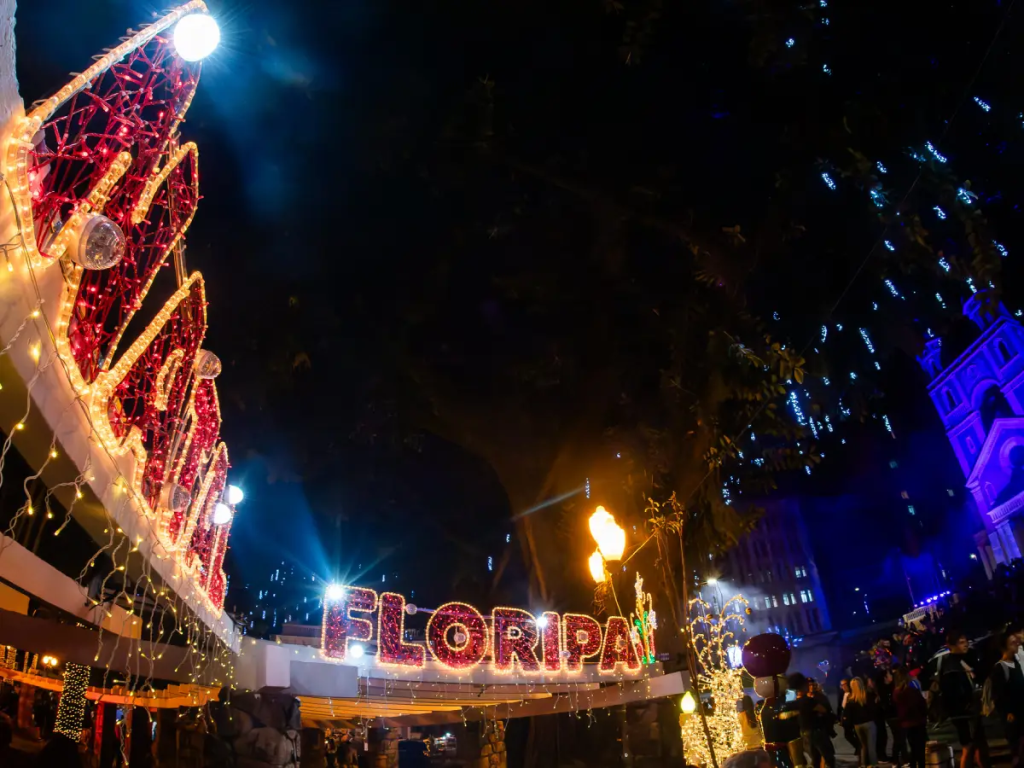
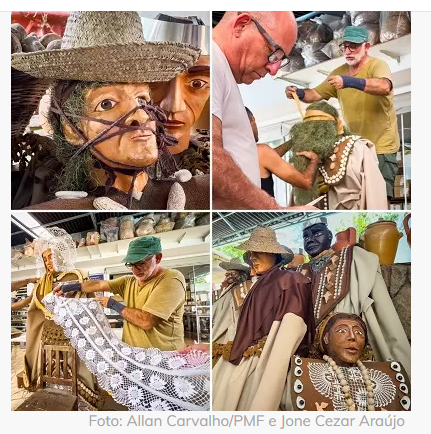
In Florianópolis’ main square, where the village of N.S. do Desterro was born, for 51 years, there has been a magnificent pre-sepium that spreads throughout the garden. It was the brainchild of researcher Franklin Cascaes, developed by his disciple Gelci Coelho, Peninha, and, since 1993, the artist and presepista Jone César de Araújo has maintained the tradition. Floripa’s nativity scene is Azorean in the originality of all the materials used in the assembly, alongside the universal tradition, since its first staging in 1223 by St. Francis of Assisi. Life-size images of fired clay, gourds of all kinds, bobbin lace, fishing nets, household utensils, shells, and starfish. An infinite profusion of elements makes the Nativity scene a work of art to raise in everyone the Christmas spirit impregnated by our most legendary island tradition, which arrived on the morning of January 6, 1748, aboard the ship Jezus, Mary, and Joseph.
Here’s my Christmas song! Let’s open the door to the Child and praise forgiveness and hope.
I want to continue singing all the praises with the energy that still drives my life and that I carry in the way I am. Until the time comes for me to pass the baton on to my children and poetize like the great Davi Mourão-Ferreira:
The Nativity Scene is lit again in souls. Jesus is lit in my children’s eyes.
Lélia Pereira Nunes is a Brazilian writer of Azorean ancestry living on the island of Santa Catarina in Brazil.
Translated by Diniz Borges

 Filamentos (artes e letras)