
Florbela Espanca was born on December 8th, 1894, 130 years ago.
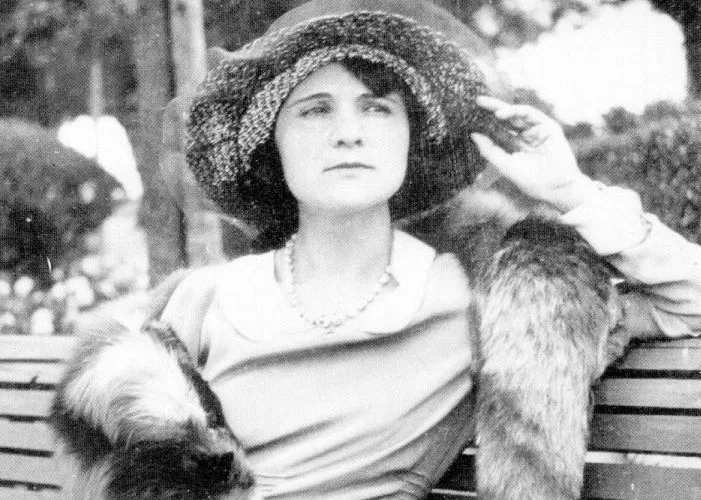
Florbela Espanca (birth name Flor Bela de Alma da Conceição) was a poet and precursor of the feminist movement in Portugal. Her tumultuous and eventful life shaped her erotic and feminine writings.
She was baptized as the child of an “unknown” father. After her mother’s death in 1908, Florbela was taken into the care of Maria Espanca and João Maria Espanca, for whom her mother had worked as a maid. João Maria Espanca, who always provided for Florbela (she referred to him in a poem as “dear Daddy of my soul”), officially claimed his paternity in 1949, 19 years after Florbela’s death.
Florbela’s earliest known poem, A Vida e a Morte (Life and Death), was written in 1903. Her first marriage to Alberto Moutinho was celebrated on her 19th birthday. After graduating with a literature degree in 1917, she became the first woman to enroll at the law school at the University of Lisbon.
Between 1915 and 1917, she collected all her poems and wrote “O livro D’ele” (His book), which she dedicated to her brother.
She had a miscarriage in 1919, the same year that Livro de Mágoas (The Book of Sorrows) was published. Around this time, Florbela began to show the first serious symptoms of Neurosis. In 1921, she divorced her first husband, which exposed her to significant social prejudice. She married António Guimarães in 1922.
The work Livro de Soror Saudade (Sister Saudade’s Book) was published in 1923. Florbela had a second miscarriage, after which her husband divorced her. In 1925, she married Mário Lage (a doctor who treated her for a long time). Her brother Apeles Espanca died in an airplane crash (some might say he committed suicide due to her fiancée’s death), which deeply affected her and inspired the writing of As Máscaras do Destino (The Masks of Destiny).
In October and November of 1930, Florbela twice attempted suicide, shortly before the publication of her last book Charneca em Flor (Heath in Bloom). Having been diagnosed with pulmonary edema, Florbela died on December 8, 1930, on her 36th birthday. Her precarious health and complex mental condition make the actual cause of death a question to this day. Charneca em Flor was published in January 1930. After she died in 1931 «Reliquiare», a name given by the Italian professor Guido Battelli, was published with the poems she wrote on a further version of “Charneca em Flor»
in https://www.goodreads.com/author/show/541034.Florbela_Espanca

Florbela Espanca: A Lyrical Feminist Voice of Sorrow and Longing by Dan Costinas
Remember? Forget? Nonetheless!…
Retain or release? Is it wrong? Is it right?
Whoever says one can hold on tight
To love all through one’s life is telling lies!”
The daughter of João Maria Espanca, a photographer in the provincial town of Vila Viçosa, near Évora, Florbela d’Alma da Conceição was born in 1894 within a love triangle (three-person relationship). Her birth mother was a beautiful 15-year-old housemaid. At the same time, her father’s wife was not able to conceive children and agreed to the newborn being brought up by both herself and the baby’s biological mother. Her out-of-the-ordinary childhood influenced her outlook on life, love, children, and loss, graciously expressed in her evocative poetry.
She began rhyming – mainly sonnets – early; the poem ‘A Vida e A Morte’ (The Life and The Death) was written when she was only eight. After graduating high school, she was accepted by the University of Lisbon, where she was one of seven women out of 313 students enrolled in the School of Law. During her short but intense life, the unfortunate poetess was married three times. She suffered a series of miscarriages, quite severe pulmonary health problems, and major depressive disorder – all contributing to her three suicide attempts. Unfortunately, the third (and last) one was successful, and Florbela died on 8 December 1930, her 36th birthday, from an overdose of Barbital.
It was not just her sad, deeply personal history that made Florbela Espanca interesting. She had quite revolutionary ideas for that conservative time. But her passionate and melancholic personality led to a dark style of poetry, rich in imagery and symbolism. Florbela contributed weekly prose pieces to a few Portuguese periodicals. She was a contemporary of Fernando Pessoa and Manuel da Fonseca, and her readers were impressed mainly by the unusual raw honesty and the intensity of feelings and passion her writing expressed. Even though she was not a declared feminist, Florbela demanded and expected to be taken as seriously as any man, challenging societal old-fashioned norms at a time when female voices were often brutally silenced.
There have always been many fans of her powerful and poignant poetry. Still, for many years, critics did not recognize it (they dismissed her work as overly feminine and narcissistic), and the literature departments of European universities (who failed to acknowledge the depth of emotion and the innovative use of language that characterized her poetry). Nowadays, Florbela Espanca is one of Portugal’s most cherished poets. She is an undeniable towering figure of 20th-century Portuguese literature whose work is the object of serious critical study.
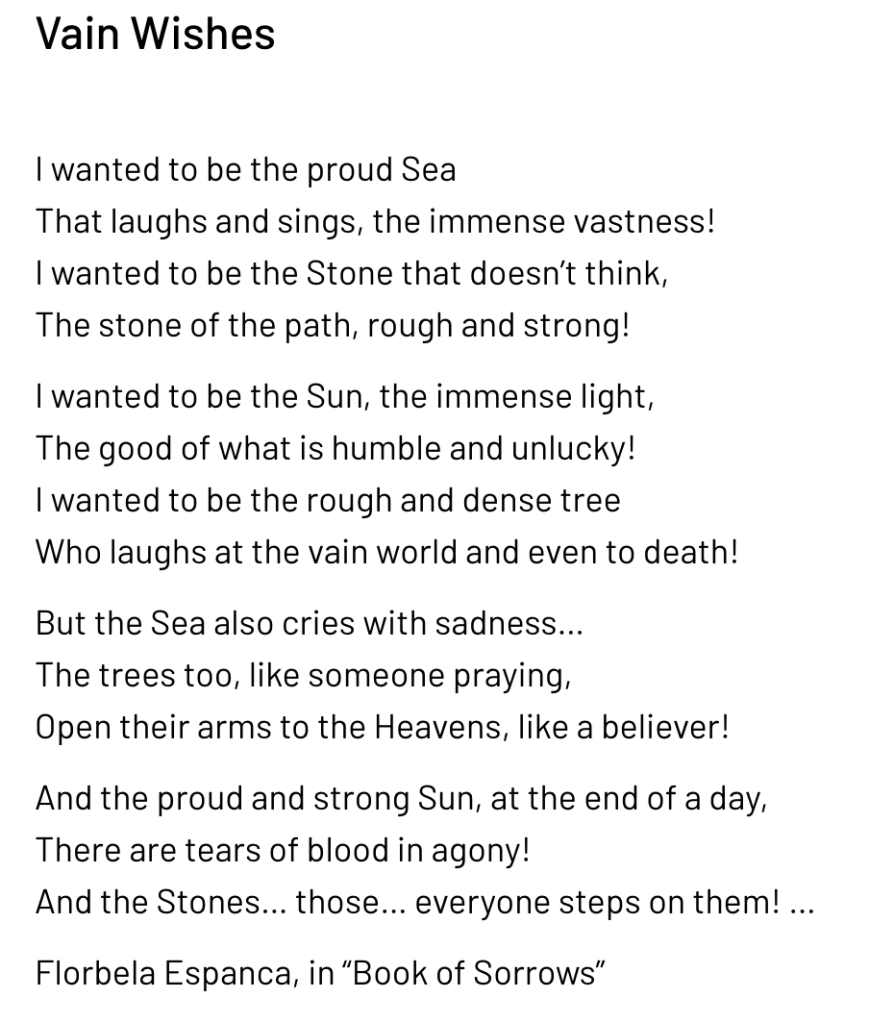
One of her poems:
 Filamentos (artes e letras)