

About one-third of the distance, going directly west from Lisbon to New York, are the Islands of the Azorean Archipelago, first officially discovered by one Gasçalo [sic] Velho Cabral in the year 1432, who acted under the instructions of Prince Henry of Portugal, surnamed the Navigator. Mohammed al Edris, who discovered the Cape Verde Islands in the twelfth century, is cited as having indicated a group of islands in the Atlantic somewhere to the west of Europe. Even in far-back Greek mythology, their existence seems to have been based on something more than mere supposition.
These beautiful islands are teeming with fable and romance, as well as with splendour of natural beauty—the passionate human interest of beautiful people in beautiful environments. Situated in a semi-tropical climate, full of rich, blazing colour and a great variety of atmospheric effects, in the words of Mr. Sandham, they form a near approach to the “Painter’s Paradise.”

Of volcanic origin, the landscape features are most strikingly effective in natural lines and contours. St. Michael, the largest and most important of the islands, is, perhaps, the most picturesque of the group, containing as it does the town of Ponta Delgada, which abounds in picturesque architecture and costumes almost oriental in splendour of colouring. The town approached from the sea is like a fairyland. Dazzling groups of white-walled buildings, iridescent with pearl-like tints of pink, green, and greys; broken lines of roof covered with tiles of various colours; here and there masses of brilliant green foliage, the whole thrown into strong relief by the background of dark, dome-shaped hills, it seems an enchanted city of the sea.
Of the kindness of the Azorean people for the stranger and their solicitude for his comfort and pleasure, one cannot say enough. The village life is religious, whole-souled, passionate, and withal intensely picturesque. Children of the soil, with little knowledge and few of the vices of the outside world, their primitive, simple life is of the kind that Millet would have loved, understood, and painted with as tender sympathy as he did the lives of his own French peasants. These people, self-centred children of nature, so simple and devout, have yet the racial qualities of power that only the primitive possess. Here the mystery of tradition and fervent religious faith is perfectly mingled with the other great mystery of romantic nature in all its tragic intensity and beauty. Of racial types there is a curious blending of West and East.
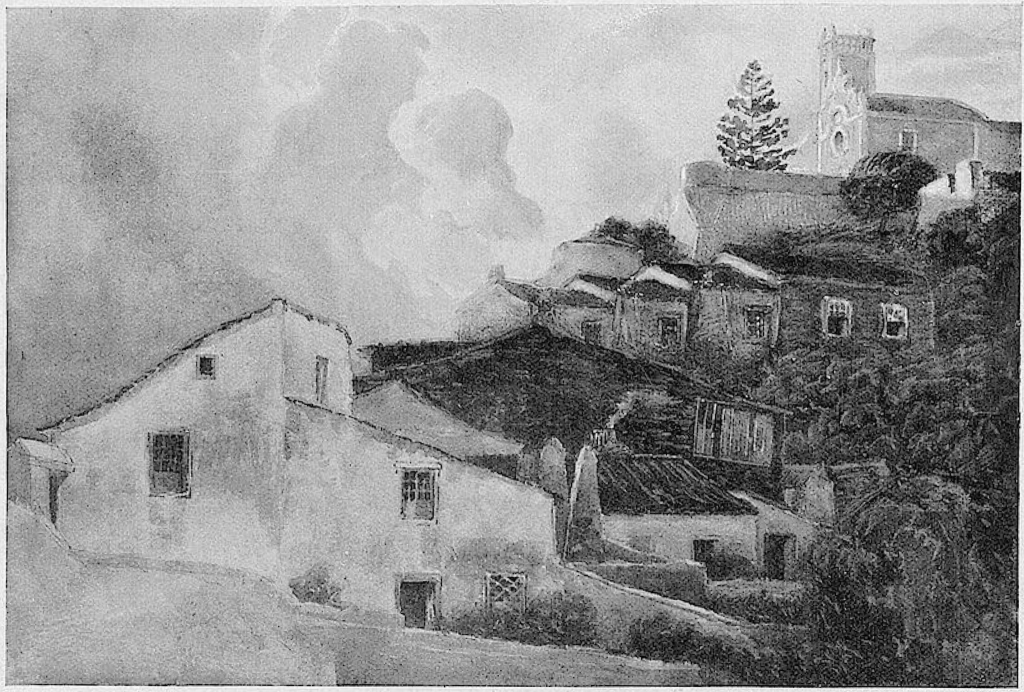
There is no end of charming variety of landscape: lakes, mountains, caves, waterfalls, dome-shaped hills covered with luxuriant verdure to their very tops, and fields of flowers running riot with the whole gamut of sensuous colour. The remarkable variety of trees and shrubbery suggest that every growth to be found in tropics or temperate zones finds fertile ground in this equable atmosphere.
Around the dark rock bed of the coast the precipitous cliffs sometimes drop sheer to depths of water going down thousands of feet. Some of these towering black volcanic groups cutting the tropical sea into myriads of sparkling, multi-hued gems, in their towering sombre outlines, seem brooding a spirit of deepest melancholy.
The agricultural parts of the island are dotted with white-walled cottages, thatched or tiled in brilliant colours, while here and there a stone windmill adds interest to the already paintable subjects.
The town of Ponta Delgada is of particular artistic interest in both architecture and people. Mr. Sandham shows the charming variety of their costumes in the typical group on the steps of the Matriz Tabernacle. With quaint garments blazing with rich colours, these people seem to dress in perfect artistic accord with the splendour of their tropical surroundings.
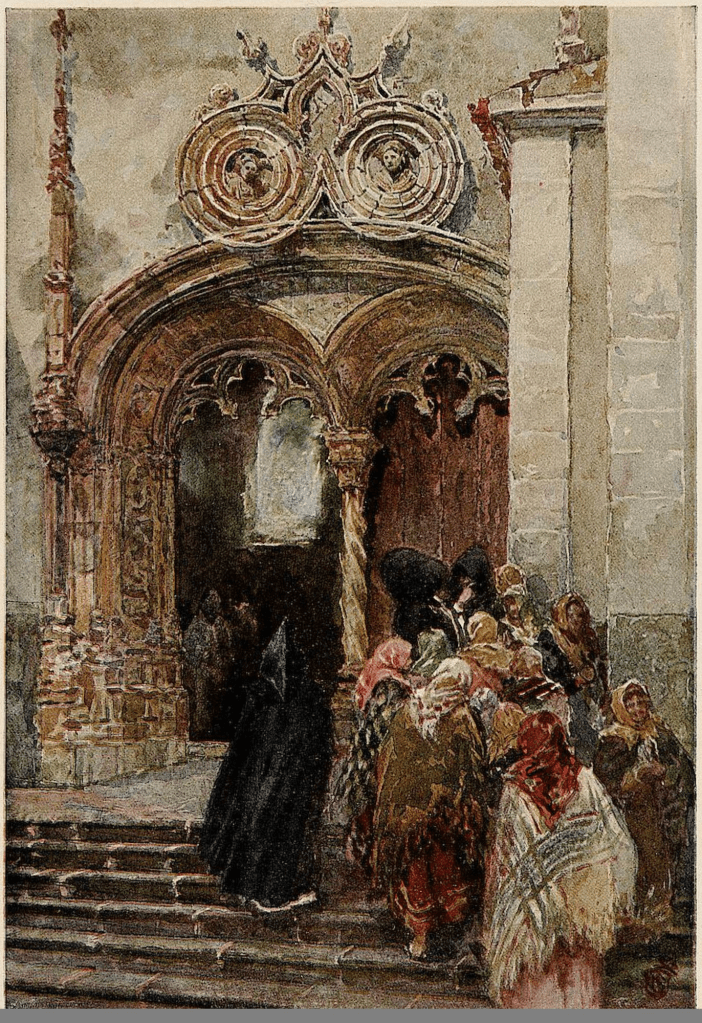
The Matriz is the largest church in the island. The south door was presented by King John of Portugal, skilled artificers being sent to construct it, together with the beautiful blocks of coloured marble from the Continent. Here the Mass is celebrated to the accompaniment of an excellent military band, and the somewhat unique feature may be witnessed of the troops attending, kneeling at the word of command from their officers.
The celebration of the many church festivals, such as the yearly procession of the “Santo Cristo,” are most imposing spectacles of colour and costume. Survivals of the pageantry of the middle ages, such occasions are full of interest to the artist.
The “Santo Cristo” is a carved figure of wood, richly dressed in robes studded with jewels of great value. The figure holds a sceptre studded with brilliants, and is surrounded in the procession by ecclesiastical dignitaries in rich vestments and civil and military officers in gorgeous uniforms. Further heightened by the wealth of colours of the people’s costumes and the soldiery, with embroidered banners flying, the whole set off by the picturesque architecture and tropical sunlight, the spectacle is one of gorgeous splendour.
At Ponta Delgada there is a good library, excellent museum, hospital, a clean, well-paved public square, an interesting market, many picturesque churches, and the crumbling ruins of a castle. Of these paintable features of the Fortunate Islands, Mr. Sandham has for many months been engaged in making a sympathetic series of pictures, and has again shown his masterly insight into the romance and beauty of picturesque places.
These subjects have appealed to him perhaps more strongly, and his feelings have, I believe, been recorded with more convincing power in these drawings than in those of the many picturesque, out-of-the-way places he has heretofore painted. The furrowed lands, the straining figures of ploughmen or rowers, the beauty of primitive agricultural occupations, the flapping boat-sails, or vistas of homely cottages, have touched his sympathies and have been transferred to his drawings with more vital force and keen appreciation of their poetic beauty than he has before shown. He has secured extremes of tropical light without hardness, brilliant, pulsating colour, vigorous, and yet full of purity and tenderness.
Of the man himself, no word of introduction is necessary to Americans, nor in his native Canada, where he has done his part in the noble fight of the past quarter of a century to establish a living existence of art in a young and growing country, where success is measured by material rather than by æsthetic standards.

At the beginning of his career a painter of marine subjects along the St. Lawrence River, he afterwards took up landscape, and finally figure and portrait painting. On the formation of the Royal Canadian Academy of Arts, under the patronage of H.R.H. the Princess Louise and the able direction of the then Marquis of Lorne, he was one of the first group of Canadian artists called to the organisation; and further honours fell to him by the purchase of several of his more important works for the National Gallery at Ottawa, and later the commission to paint the portrait of the late Sir John A. MacDonald for the Senate Chamber. He has also executed many prominent Canadian official portraits, as well as private commissions, and there is practically no private collection of importance or public gallery in Canada that does not contain one or more of his works. After some years of work in Canada he came to England and painted much both there and on the Continent, during which time he made many lasting and happy friendships in the Motherland. Returning home, he was called to Boston, United States, to execute some private portrait commissions, intending to remain but a few weeks. The warmth of welcome from the Bostonians to the young Canadian painter, and their generous appreciation of his work, led to a residence there of nearly twenty years, during which time he has been a conspicuous figure in the social and artistic life of that city. Unanimously chosen as the head of their principal organisation of artists, he has received several important commissions from the State, while his portraits and historical pictures have been acquired for the Massachusetts State House, Lexington Town Hall, the Washington and Baltimore Galleries, as well as many private collections. His black-and-white work has also been an important feature of his career. He has illustrated in this medium many important books, as well as special articles, on such out-of-the-way places as Peru, Mexico, Southern California, and Hayti. The series of drawings for the works on ranch life and the West by President Roosevelt, so pleased the distinguished author as to call forth his direct personal praise. Notwithstanding the largeness of his output, there has invariably been a spirit of conscientious conviction in all his efforts, as well as good workmanship, and a distinction of clear, logical thought. The expression is characteristic of the man — the kind, studious gentleman who lives with good reading, good breeding, and earnest minds, loving purity of thought and an outdoor life.
Will Jenkins.
This article was published on pages 173 to 177 of “The Studio” magazine, London, vol. 27, no. 117, December 1902 (and on the same pages of “The International Studio” magazine, New York, vol. 18, no. 71, January 1903), Will Jenkins (illustrator and painter from Boston) wrote an interesting article, “A Canadian Artist in the Azores.” 71, January 1903), Will Jenkins (an illustrator and painter from Boston) writes an interesting article, “A Canadian Artist in the Azores,” with a critique of the watercolors by the painter Henry Sandham (Monreal, May 24, 1842 – London, June 21, 1910) resulting from his stay of a few months in the Azores (Ponta Delgada) in 1901.
Manuel Menezes de Sequeira, a Professor Emeritus and translator now living in Flores Island, Azores, furnished this information. We thank him for his research.
 Filamentos (artes e letras)