

a Weekly segment from Bruma Publications-PBBI-Fresno State.
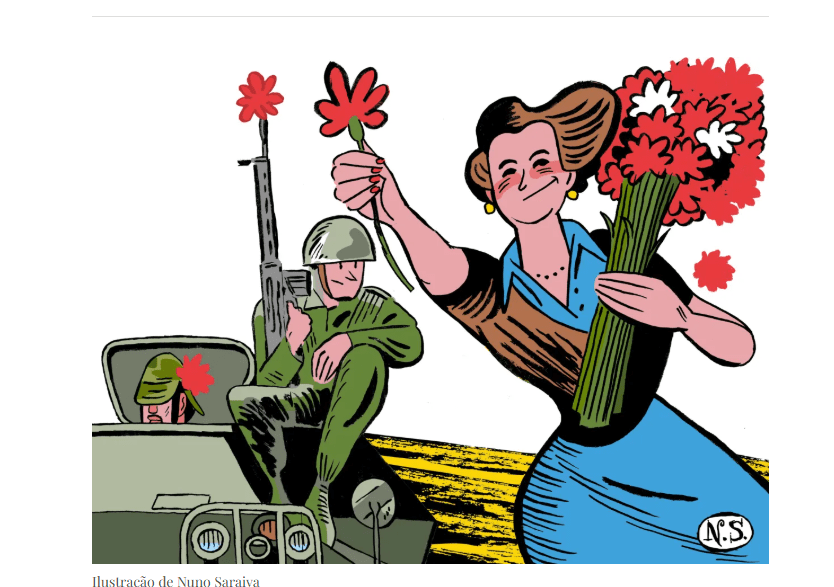
Celeste Caeiro, the woman who exchanged the bullets of a shotgun for carnations and marked the revolution, has died.
On April 25, 1974, Celeste Caeiro, without knowing it, defined the Portuguese revolution that freed the country from dictatorship. On November 15, the woman who replaced the bullets in a rifle with carnations died at the age of 91, making history once again.
Celeste Martins Caeiro had already made history on April 25, 1974, when she made the gesture that would become the image and name of a revolution. On November 15, the pensioner, former waitress, and seamstress who replaced the bullets in a shotgun with carnations died at the age of 91, making history once again.
In 2022, illustrator Nuno Saraiva painted the woman who painted Lisbon carnation red in words in a section in Mensagem where he paid homage to the Great Alfacinhas. This is the text below:
All the great historical moments are sung in odes that are sometimes too lyrical or unbalancedly romanticized. One of the most significant urban myths surrounding April 25, 1974, is the origin of the carnations on the barrels of the soldiers’ rifles – the brand image that will always remain of the revolution – an episode that for some years was attributed to the flower girls of Rossio, personified in tags that acclaim and inspire our warriors. But the real story is less epic, simpler but richer.
It all began in a modern-looking restaurant in the Franjinhas building on Rua Braamcamp, Sir. The restaurant adopted the self-service method and was already using marketing techniques.
The owner had ordered “tons” of carnations to give away to customers on the 25th to celebrate the establishment’s 1st anniversary and was caught between having to close because of a coup d’état and having to let the flowers spoil in storage.
As a fastidious man, he offered a large bunch to each employee, including Celeste, so they wouldn’t die in vain.
Celeste Caeiro walked back to her home in Chiado, hugging the carnations. She walked along Avenida da Liberdade, crossed Rossio, and went up Rua do Carmo among a crowd. There, she came across Chiado on the corner of Rua Garrett. Celeste stopped in front of a G3 soldier with an amiable face and asked him:
– “Where are you going? What’s going to happen?”
– “We’re going to Carmo Square to arrest Marcelo (Caetano). By the way, haven’t you got a cigarette?”
– “Not a cigarette, I don’t smoke. But I can offer you a carnation; I have plenty!”
The rest of the story is well-known. The soldier sticks the flower’s stem into the barrel of his rifle. The comrade next to him wants one, too, and Celeste offers him another. More soldiers pass by, each with a carnation: a photographer (Eduardo Gageiro) and another photographer (Alfredo Cunha). When she ran out of carnations, Celeste’s gesture was imitated by people on the street who rushed to buy them from the florists, who then offered them in solidarity.
Thus was born a picture painted in bright red (and some white) that will last forever in the imagery of the April Revolution.
And all because of a failed marketing ploy in a trendy café… and a cigarette that wasn’t there!
Nuno Saraiva
A hardened Lisboner, he collaborated with practically the entire national press. A political cartoonist, his line is Lisbon’s line. He is the author of the images for the Lisbon Festivities from 2014 to 2017 and the creator of the trophies for the marches. Ten of his murals are on the city walls. His book Tudo isto é Fado! won the prize at the Amadora International Comics Festival. He teaches at the Lisbon School of Design and at Ar.Co. All his drawings are on the Mensagem homepage.
 Filamentos (artes e letras)