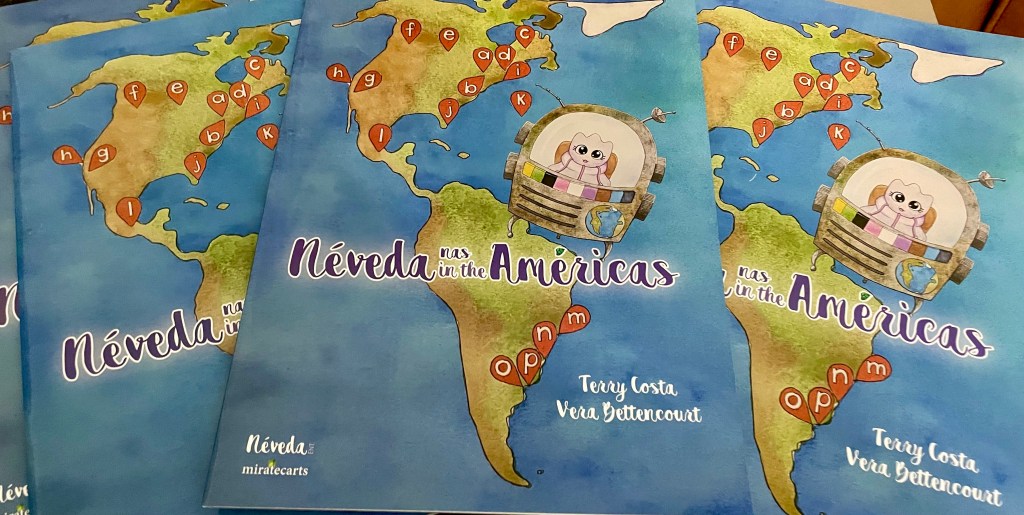
After the first book, “Néveda in the Azores,” it’s time for the character’s second adventure, created by Terry Costa and illustrated by Vera Bettencourt, “Néveda in the Americas,” to be included in the list of works recommended by the Regional Reading Plan, LER Açores.
The character Néveda, inspired by the plant Calamintha nepeta, better known as nêveda, has been around the world twice. The first time in a paper airplane, which takes us to see the nine islands of the Azores, and the second time in a teleport called Catatram-Lalaland, which ventures from the archipelago in the middle of the Atlantic Ocean to various countries in the Americas, focusing on themes of emigration, history, human rights, the environment, and the world of the arts.
The book “Néveda in the Americas” toured Canada, the USA, and Uruguay last year and was distributed to libraries and schools in Uruguay with the support of the Director of Culture of the Intendencia de Colonia, Dr. Eduardo Bonansea. Last spring, it toured Europe and is available in Brussels at the Petite Portugaise bookshop, a stone’s throw from the European Parliament. In the Azores, the bilingual version of the book is part of 4th-grade English classes and vocational schools for tourism courses. This fall, the Regional Reading Plan committee added the book to the recommended list for preschool education, reading aloud, and guided reading.
The book is available in bookstores, including Letras Lavadas in Ponta Delgada, Loja do Adriano in Angra do Heroísmo, Telegrapho in Horta, Adega das Artes in Madalena, and also at Baobá, a space in the Portuguese capital dedicated to the world of children and illustration.
To follow the adventures of the flower girl, Néveda, join us on Facebook: nevedapico and visit nevedapico.com for future presentations. The third book-length adventure is scheduled for publication in spring 2025.
From Press Release
Translated to English as a community outreach program from the Portuguese Beyond Borders Institute (PBBI) and the Modern and Classical Languages and Literatures Department (MCLL) as part of Bruma Publication and ADMA (Azores-Diaspora Media Alliance) at California State University, Fresno, PBBI thanks the Luso-American Education Foundation for sponsoring FILAMENTOS.
 Filamentos (artes e letras)