
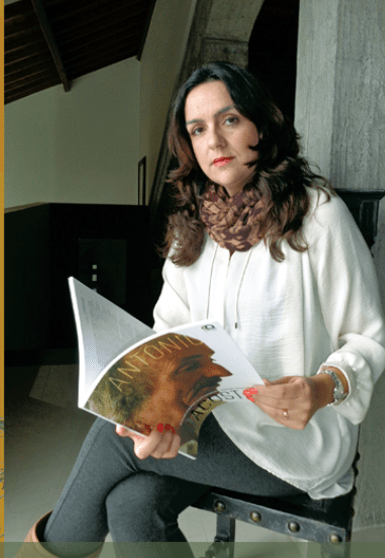
Assunção Melo is the winner of this year’s EMEL Prize – History of Paths, Routes and Mobility, awarded by the Portuguese Academy of History, with her work “Altares da Memória: o advento das micro-histórias na periferia das periferias” (“Altares of Memory: the advent of micro-histories on the periphery of peripheries”).
“I competed with my two books, the one related to Dacosta (“António Dacosta e o Sentido de Pertença na Pintura. Motivações, Resistências e Inovações”) and this one on the Altares,” says the researcher, who was surprised to win the prize for her book on the parish.
“A prize from the Portuguese Academy of History is a huge honor for me, because we’re talking about my peers at the highest level,” she says.
The parish council invited me to write the book Altares da Memória about a decade ago.
“What led me to write it, apart from that invitation, was also wanting to know a bit about my parish and because I knew that there was still no historical research based on the archives and the little bibliography, on the chroniclers,” he says.
What’s surprising about the book, he says, is how “a rural parish, in the northwest of Terceira island, on this periphery of peripheries, has a story to tell.”
“It has a rich history, not just a positive one. I wanted to portray all the facets of that people, without any strings attached, the good and the bad. What may surprise you is also the resilience of a population that went to that place with a very specific objective, which was to grow pastry and wheat, and then stayed there and made a living, in a subsistence way. He didn’t abandon that place, just as many other rural places on our islands haven’t been abandoned,” she says.

In an interview with DI, published in May, Assunção Melo also stressed this authenticity. “The informants revealed facts and events from their lives that we can transpose to community life. Many of these unpublished revelations give us a more realistic view of events. In this sense, I didn’t shy away from reporting the good and the not-so-good. This is not just a story of heroic deeds. It’s a story of facts. It has painful descriptions. Some of them disturbing. The choice to use vernacular language, nicknames and slang is also entirely my responsibility,” she said.

The historian points out that in places like the Altares, you can sometimes find your own culture. “We also have our own culture and identity, our own particularities. We have stories, language, proverbs, adages, anecdotes, tales, superstitions. These are identities,” explains Assunção Melo.
The award ceremony is scheduled for December 4, at 3 p.m., at the Portuguese Academy of History in Lisbon.
The Portuguese Beyond Borders Institute (PBBI) at Fresno State congratulates Dr. Assunção Melo on this award. We are honored to have her as a PBBI-Fresno Collaborator and look forward to having her as one of our regular presenters for our conference and lecture series starting in the spring semester of 2025. Parabéns!
 Filamentos (artes e letras)