

“Santo Cristo dos Milagres” FROM THE AZORES TO BRAZIL
The Senhor Santo Cristo dos Milagres Festival is the largest religious gathering in the Azores, held in one city and the second largest in Portugal, after Fátima. Its procession is said to be the longest and densest in Europe.
For more than three centuries, it has taken place in the middle of the Atlantic, halfway between the Old Continent and the New World, on the island of São Miguel, in the city of Ponta Delgada, in Campo de São Francisco, on the occasion of the fifth Sunday after Easter.
The story goes that the origin of the local cult dates back almost to the beginning of the archipelago’s settlement.
The Renaissance image of Ecce Homo, in the form of a tabernacle, was offered by Pope Paul III to the nuns who went to Rome in search of the apostolic bull to build the island’s first convent, in Vale de Cabaços or Caloura.
As this convent was too exposed to corsair attacks, the sisters moved to the Monastery of Nossa Senhora da Esperança —the first convent of nuns in Ponta Delgada. It had just been built by D. Filipa Coutinho, widow of its founder, the donatory captain Rui Gonçalves da Câmara, on land donated by Fernando Quental.
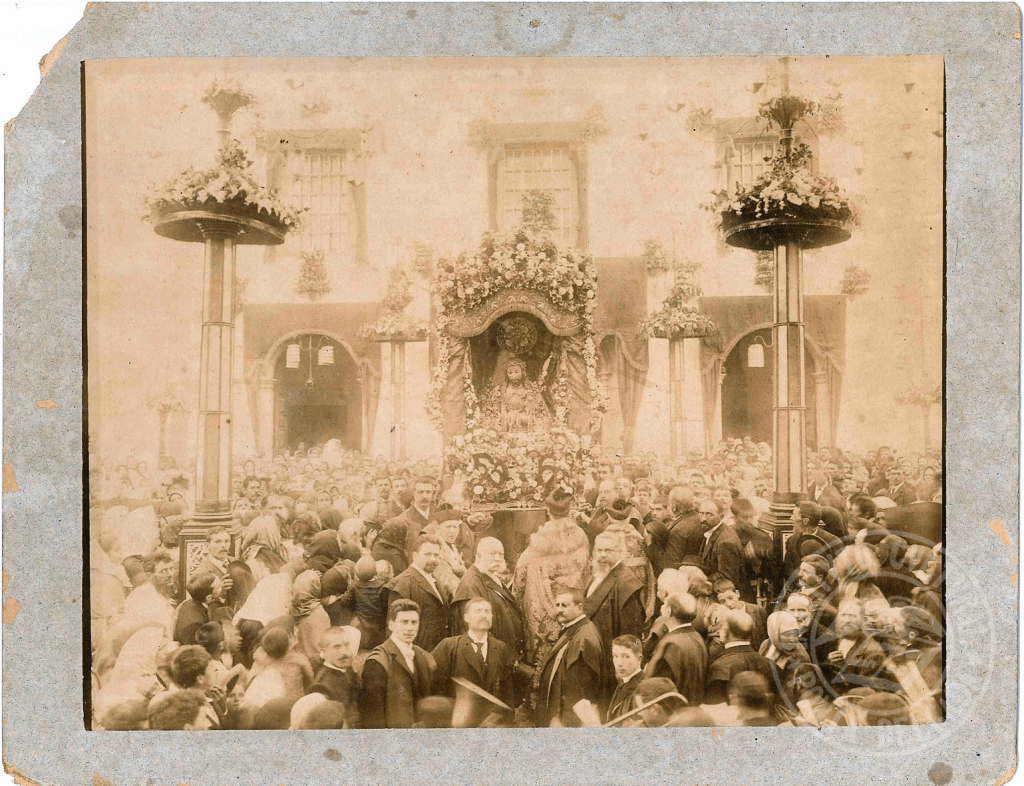
(Photo from the Instituto Histórico de Ponta Delgada)
The move took place on April 23, 1540, with the image being transferred on the initiative of the Galician nun Madre Inês de Santa Iria.
Our venerable image was housed in this new home for 160 years.
Mother Teresa da Anunciada, born on November 25, 1658, in Ribeira Seca da Ribeira Grande, joined the convent in 1681 and died here, with a reputation for holiness, on May 16, 1738.
It was on his initiative, with the permission of the diocesan prelate, D. Frei António de Pádua, that the statue first took to the streets on April 11, 1700, according to the Micaelense researcher Urbano de Mendonça Dias.
The inaugural procession was intended to intercede for divine clemency to stop the strong and repeated earthquakes shaking the island. Documents from the time tell us that the earthquake crisis was over once the Image appeared to the believing crowd.
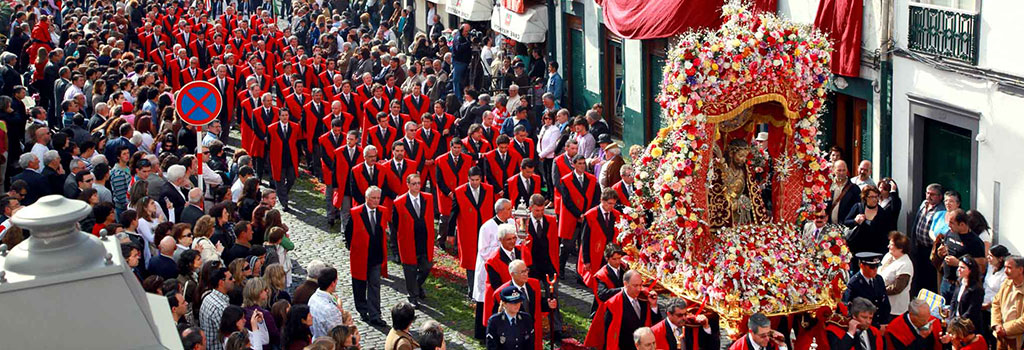
With the local nobility and countless people, she then made her way through the churches and convents of Ponta Delgada, following a route that she continued to follow more than 300 times every year until today and tomorrow.
An immense procession with a single Image—a unique image—powerful and captivating—without equal. When it passes, we are alone in the crowd, our hearts surrendered to the hymn composed in the 1960s of the 19th century by the musician Candeias of the military band.
Before this venerable image of transcendent spiritual value, the only Pope in Azorean lands for five centuries, Saint John Paul II, prostrated himself for the Celebration of the Word in Campo de São Francisco on May 11, 1991.
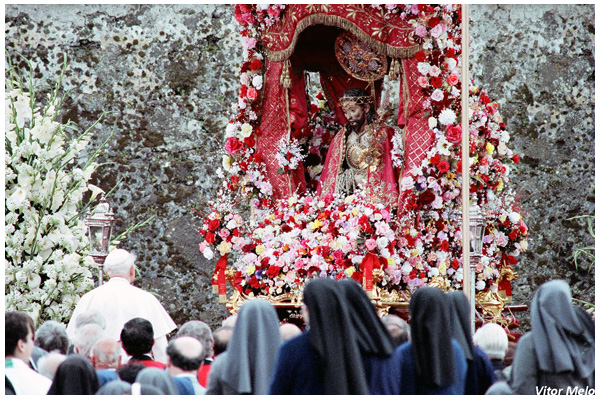
More than a quarter of a millennium ago, when the procession was already 65 years old, the diligent nuns of the convent entrusted the external celebration of the image to the Brotherhood of the Lord Santo Cristo dos Milagres.
This Brotherhood was officially founded on April 21, 1765, with the approval of its first statutes, on the initiative of the Commandant General of the island of São Miguel, Sergeant Major António Borges Bettencourt.
Formally, it is a non-profit association of the faithful, constituted in the canonical legal order, based in the Convent of Esperança, recognized as a private institution of social solidarity. It currently has around 900 brothers, many of whom are immigrants from the United States of America and Canada.

The first and greatest feast of Senhor Santo Cristo dos Milagres, a regional and transatlantic reference, has been celebrated in Ponta Delgada since 1700. Still, its devotion is widespread and intense in the Azorean communities of both Americas, first and foremost in Brazil.
In Brazil, the first stop of Azorean emigration, Santo Cristo gave its name to a church that gave its name to an entire neighborhood in the “wonderful city.”
Bairro do Santo Cristo, in the port area of Rio de Janeiro, is a middle-class port neighborhood named for the church built in front of the pier.
It all began with the image of Ecce Homo, taken from the Azores to Brazil, supposedly by men from the island of Terceira, in 1850, according to information from the current parish.
A small chapel was built by the sea, the Brotherhood of Santo Cristo dos Milagres was formed, and the foundation stone was laid for a larger chapel, which, on August 15, 1911, was elevated to the category of parish church.
In 2011, the centenary of this Brazilian parish of Santo Cristo dos Milagres was solemnly marked.
But the famous festival in honor of Senhor Santo Cristo dos Milagres, which was born in the Azores and crossed the Atlantic to Brazil, later gained a vital dimension in North America, remaining very much alive in the United States, Canada, and Bermuda, as we’ll see in the next chronicle.
_____
José Andrade is the Regional Director for Communities of the Government of the Autonomous Region of the Azores. From his book Transatlântico – As Migrações nos Açores (2023)
Translated by Diniz Borges.
 Filamentos (artes e letras)