
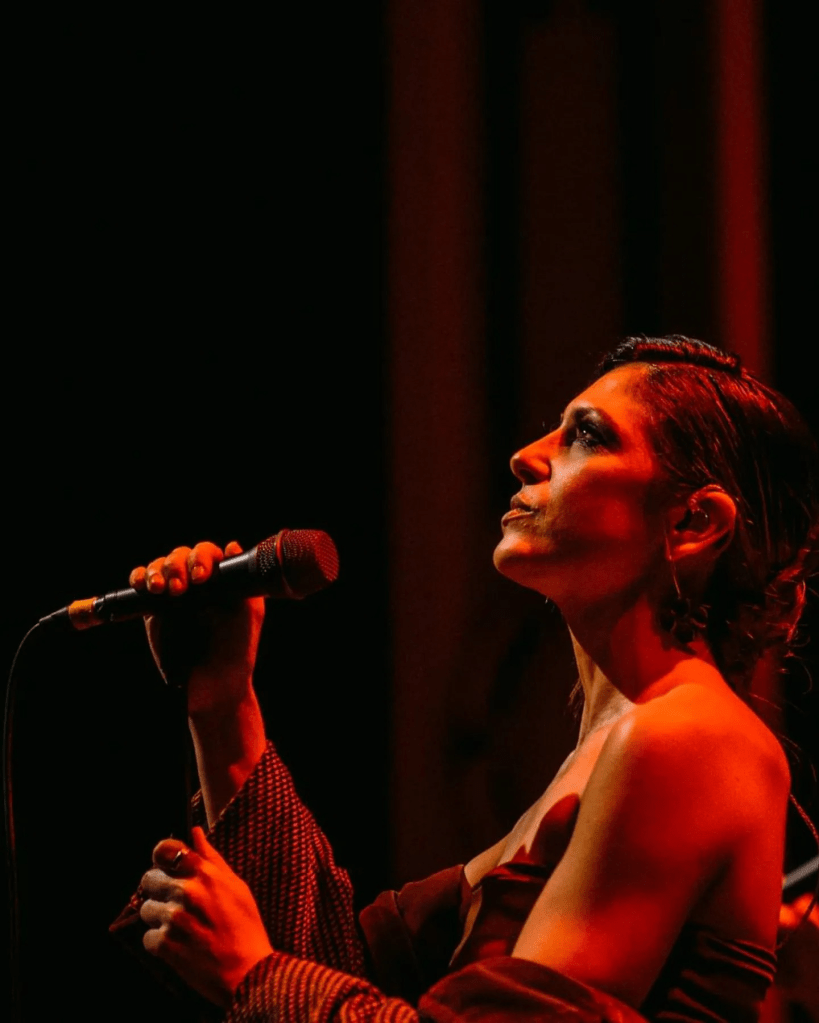
She’s known as Marisa from The Code, and her voice is her calling card. Marisa Oliveira has been singing since she was a little girl—first, at primary school parties, and then in the church choir at Ajuda da Bretanha, the parish on the north coast of São Miguel island where she grew up.
“I always remember liking to sing,” says Marisa, ‘they put me in the ’second voice’ because of my deep voice. I was so excited by the rehearsals and, on the parish feast days, we would put all the work from months of rehearsals into practice,” she recalls.
The lead singer of the band, who announced a few days ago that she was putting an end to the project, recalls: “When I was still a kid, and even though I didn’t understand English, I would write down the lyrics to the songs of my idols at the time and repeat them until I had all the songs down! At the time, I dreamed of singing on stage”.
“I spent my entire childhood in Brittany and the surrounding area. I rarely left,” she says. “I grew up with my sister and brother, whom we adopted when I was three. I was 8 and my sister was 13,” she explains, stressing that she comes from ”a very hard-working, honest and humble family. My father spent his life farming and my mother looked after our home. We often accompanied my father to the cows. My mother would bring a cake and we would sit and watch my father tend the cows while we enjoyed a nice slice of cake,” she recalls.

She spent her childhood surrounded by her maternal family. “On Sundays, we’d walk to visit my grandparents, and we’d all meet there: my cousins, uncles, and aunts.
We spent Sunday playing and eating. It was impossible not to eat our grandmother’s delicacies,” she confesses.
Later, she started participating in karaoke competitions, where he won prizes.
But it was in the band “Anjos Negros”, her first original band, that he began to “sing seriously.” I only sang in English, and we were a heavy rock band.
Curiously, almost all the members of this band were in The Code, Which appeared in 2012.
She completed elementary school in Brittany and elementary school in Capelas. “I then studied at Domingos Rebelo and decided in 2006 to study Tourism at the University of the Azores, graduating in 2009.”
But, as Marisa points out: “Inevitably, music is not my only means of livelihood.” Her day is filled with accounting, and she plans to turn her hobby of making desserts into a business.
She confesses, however, that it was “thanks to music” that he experienced “incredible and unforgettable moments” and had “the opportunity to meet wonderful people.”

On the other hand, she says that music has made her “grow and experience things that only this art has the power to offer. Singing and composing, I am who I can’t be in everyday life. Music transports me in an inexplicable way,” she confesses.
Of the experiences she’s had, she reveals that “above all, it’s the people who mark us for who they are and what they make us feel! I cried and smiled with people who were strangers to me. We cried and smiled together,” she recalls. “Music connects us and makes us feel the inexplicable! I’ll never forget the concerts and the feelings and energy that the audience has given me over the years,” she says.
One of the most critical moments was The Code’s trip to the United States. “We took the name ‘Azores’ to the American continent”. “We won several awards at the IPMA – International Portuguese Music Awards for three consecutive years.”
The Code was born in 2012. They already knew each other from the band Anjos Negros and decided to work in the studio to promote their work. However, it wasn’t until 2016/2017 that they made themselves known to the public. “We started playing live with piano, guitar, and vocals.” Still, at that time, in our concerts, we mostly played songs by other artists,’ but ‘we started including originals of our own,’ until they were approached by Brito Ventura, who was attending a concert at Mitolândia, asking them to play more originals. Brito Ventura sent some songs to Farol Música, and “weeks later, we were signing a digital promotion contract,” and “Farol Música ended up taking us to Portuguese soap operas,” she says.

When asked what explains The Code’s success, Marisa says, “Above all, a lot of work. A lot of affection and passion for the music and the message we’ve created”. But also “a style that is very much our own and that, in some way, has set us apart.” On the one hand, “there was a lot of professional and personal investment on the part of each of us,” and on the other, “I believe that things also happened the way they did because we were in the right place at the right time,” and “we always seized the opportunities that came our way.”
As for why the band broke up, Marisa reveals: “We had different goals and visions. We got together and decided it would be best to end the project.”
As for the future, Marisa Oliveira says she has “a few challenges in hand” that she will “take up when the time is right when I feel it’s time.”
She is sure about one thing: “I don’t intend to stop singing or composing. I’m not going to. It’s part of me. It’s part of my essence. I’d be unhappy if I didn’t continue with the music that’s in me”. Not least because she says: “Music reminds me of that little girl who just wanted to sing and be happy.”
In Açoriano Oriental, Paula Gouveia-director
Translated to English as a community outreach program from the Portuguese Beyond Borders Institute (PBBI) and the Modern and Classical Languages and Literatures Department (MCLL) as part of Bruma Publication and ADMA (Azores-Diaspora Media Alliance) at California State University, Fresno, PBBI thanks the Luso-American Education Foundation for sponsoring FILAMENTOS.
 Filamentos (artes e letras)