
THE AZOREANS OF SAN CARLOS
It is admirable that emigrants born in the Azores passionately preserve their cultural identity in Ontario, Quebec, California, New England, Rio de Janeiro, or São Paulo.
And it’s impressive to realize that the distant descendants of the Azorean settlers proudly recover their cultural heritage in Santa Catarina or Rio Grande do Sul.
But it’s (almost) unbelievable to feel that a new generation of Uruguayans, remotely originated from the descendants of Azoreans who crossed the border from former Brazil to present-day Uruguay, are committedly assuming their identity heritage as “Los Azorenos” of the Casa dos Açores in San Carlos.
Located south of Brazil and sharing the River Plate with Argentina, Uruguay was discovered by the Spanish, disputed by the Portuguese, and occupied by the Brazilians until its independence in 1828. With 3.5 million inhabitants (half in the capital Montevideo) in 176,000 square kilometers, it is the second smallest country – but one of the most economically developed – in South America.
Territorially, Uruguay is divided into 19 government departments. One of the six departments created in 1816 is Maldonado, on the country’s southern coast, with 140,000 inhabitants. In addition to the capital of the same name, the Department of Maldonado has seven other municipalities, most notably, the city of Punta del Este, one of South America’s most famous seaside resorts, and the city of San Carlos.
San Carlos was founded in 1763 by the Spanish general Pedro de Cevallos, with around 300 Azorean families brought from Rio Grande, in the south of Brazil, ironically to stop the Portuguese advance on Uruguayan lands. The Azoreans shaped and dominated this town until the arrival of the Spanish from Asturias and Galicia in 1780. Eight kilometers from the departmental capital and 14 from the tourist center of Punta del Este, San Carlos today has 30,000 inhabitants in an area of 1.4 square kilometers.
Although constantly prevalent in the subconscious of architecture or culture, the public affirmation of its Azorean origins occurred most prominently when commemorating its bicentenary.

When the 200th anniversary of the founding of San Carlos by Azorean couples from Brazil was celebrated in 1963, the Uruguayan Folk Dance Group “Los Azorenos” was created, mainly made up of teaching students. One of its main driving forces, Professor Ariel Edison Guadalupe Cabrera (1942-2010), worked so hard to energize the growing group and to research the inherent culture that in 2002 he managed to set up a civic association also called “Los Azorenos”.
Half a century after the dance group was formed and a decade after it became an association, “Los Azorenos” gave way to the House of the Azores of Uruguay, officially recognized by the Uruguayan government in 2013, which has been a member of the World Council of Houses of the Azores since 2011.
Its president in recent years and current Councillor for the Azorean Diaspora in Uruguay is Gladys Alícia Quintana Díaz. She is a ninth-degree descendant of the first Azoreans who populated the city and has this proven in the book “Los Islenos – Genealogia de famílias de San Carlos de origen azoriano,” which she co-authored and which was published by Casa dos Açores itself.
Watching a rehearsal of the Casa dos Açores folklore group in Uruguay is exciting, with children, teenagers, and young people singing and dancing the Balho Furado or the Mané Chiné in Spanish accents in Azorean costumes. “The most popular dance is the Chamarrita, a mixture of Azorean dance and the Criollo dances of Uruguayan folklore,” symbolizing, after all, the very cultural crossroads of these young people from San Carlos who descend – far away in time and close at heart – from the first Azorean settlers.
Two hours by road from the Uruguayan capital and three from the Brazilian border, San Carlos is a resilient symbol of the Azorean settlement in South America, along with the coasts of Santa Catarina and Rio Grande do Sul. More than two and a half centuries later, the material marks of this cultural heritage are visible or deducible.
Several former Uruguayan presidents have assumed Azorean ancestry, such as Julio Maria Sanguinetti (1985/90), the first post-dictatorship president; Luis Alberto Lacalle (1990/95); and José Mujica (2010/15), the latter a descendant of the Azorean Terra family. These three current senators are joined by interim president Manuel Bustamante Piris (1855/56), a descendant of the Pires family from the island of Pico.
All doubts vanish when you arrive at the “Plaza Islas Azores” – a large public square specially designed for local youth sports – which was inaugurated in 2008, during the 7th Azorean-Carolina festival, by the Municipality of San Carlos and the Casa dos Açores. Its toponymic plaque, in handmade blue and white tiles, shows the iconographic representation of the nine Azorean islands. Another summarizes the municipal recognition: “Azorean Founders, 1763 – Here I end the journey and begin the story”.
_____
José Andrade is the Regional Director for Communities of the Government of the Autonomous Region of the Azores
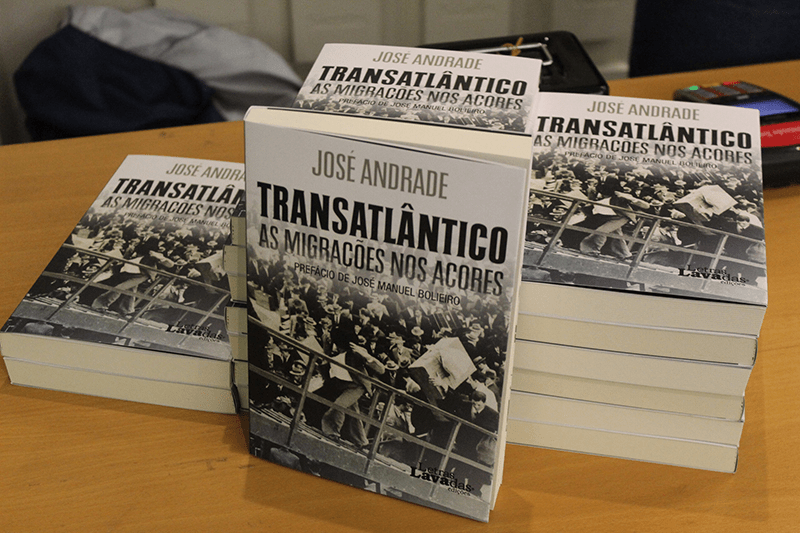
From his book Transatlântico – As Migrações nos Açores (2023)
Translated by Diniz Borges for Filamentos (arts and letters in the Azorean diaspora) by Bruma Publications–PBBI-Fresno State.
 Filamentos (artes e letras)