

OUR FLAG IN ESPÍRITO SANTO
July 25, 2022, was a historic day—historic for the Municipality of Apiacá and the State of Espírito Santo and for the historic relationship between Brazil and the Azores.
Every time a House of the Azores is born, our cultural identity goes further and becomes stronger.
Brazil already had six Houses of the Azores: Rio de Janeiro (1952), São Paulo and Bahia (1980), Santa Catarina (1999), Rio Grande do Sul (2003) and Maranhão (2019).
The seventh House of the Azores in Brazil and the 17th in the world has been born: the House of the Azores of the State of Espírito Santo.
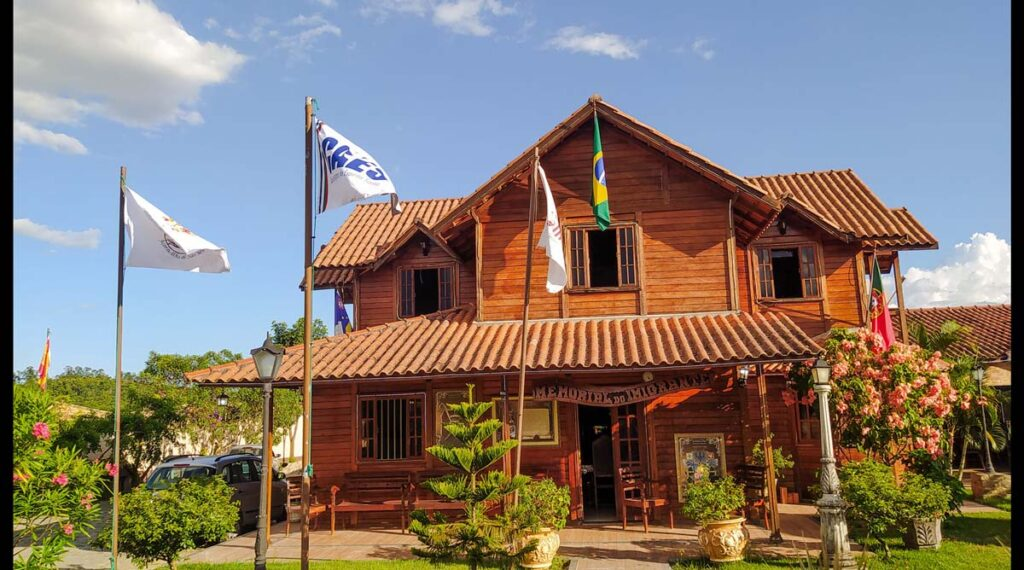
It was born in a state that bears the name of the most representative Azorean devotion.
It was born at a time commemorating the 180th anniversary of the settlement, also Azorean, of the Itabapoana Valley, which serves as its cradle.
It was born out of the genuine will of a committed group of Azorean descendants and friends of the Azores, thanks to the entrepreneurial spirit and ability to make things happen of its main founder and first president, Dr. Nino Moreira Seródio.
He introduced himself as the grandson of Azoreans from the Vieira Seródio family, who lived in the town of Povoação on the island of São Miguel.
His great-grandfather, Joaquim Vieira Seródio, left for Brazil in 1886. He landed in the port of Rio de Janeiro with three children. One of them, his grandfather Jacinto, was only two years old.
Like so many people of Azorean descent in Brazil, Nino reconstructed his family tree through personal research at the Ponta Delgada Regional Archives, when he set foot on Azorean soil 126 years after his great-grandfather’s departure.
To honor his roots, he started the Immigrant Memorial project in the Vale do Itabapoana, where he lives, in 2013. This project rescues the area’s history of populating with an Azorean solid influence.
Everyone knows for sure that the great historical reference linking the Itabapoana Valley to the Azores Archipelago is Father António Francisco de Mello, a native of the municipality of Nordeste, on the island of São Miguel, who arrived in Bom Jesus in 1899 and remained here as a spiritual guide for almost 50 years, developing our common cult of the Divine Holy Spirit.
Honoring Father Mello’s memory, the new House of the Azores was born on its own 5,000 square meter plot of land, six kilometers from the border with the state of Rio de Janeiro, to institutionally cover the entire state of Espírito Santo, including especially, the historic municipality of Viana, which has a deep Azorean connection.
There would be no better way to commemorate the 210th anniversary of the arrival of Azorean immigrants in Santo Agostinho, today the municipality of Viana.
The Brazilian municipality of Viana officially inaugurated the cycle of European immigration to Espírito Santo in 1813. More than 200 years ago. German and Italian immigrants came.
Azoreans were also called to reduce the shortage of agricultural labor and help populate the banks of the first road linking Vitória and Minas.
Paulo Fernandes Viana, the pioneer who gave the town its name, brought 53 families from the Azores who contributed to the settlement of this municipality.
The Azoreans received land, houses, tools, ox carts, and horses, settled near the Jucu River, and began growing wheat and rice while improving the corn and manioc crops already known by the natives.
Thus was born the Municipality of Viana, officially created more than 160 years ago on July 23, 1862, by detachment from Vitória.
After all, all this represents and symbolizes the Azorean monument inaugurated in 2022 in Viana’s central square.
It rescues from the past and projects into the future the cultural contribution left by the Azoreans, which is still felt in the city today, from the old houses to the persistent celebration of the Festa do Divino.
Its inauguration was a historic, emotional moment that filled and warmed Azorean hearts on both sides of the Atlantic.
The Jerónimo Leite Expeditionary Square now bears this public and everlasting mark that records and celebrates the bicentennial relationship between the city of Viana and the nine Azores islands.
Viana – yesterday, today, and forever – is also Azorean!

José Andrade is the Regional Director for Communities in the Government of the Autonomous Region of the Azores
Based on a text from his book Transatlântico – As Migrações nos Açores (2023)
 Filamentos (artes e letras)