

THE HOUSES OF THE AZORES IN BRAZIL
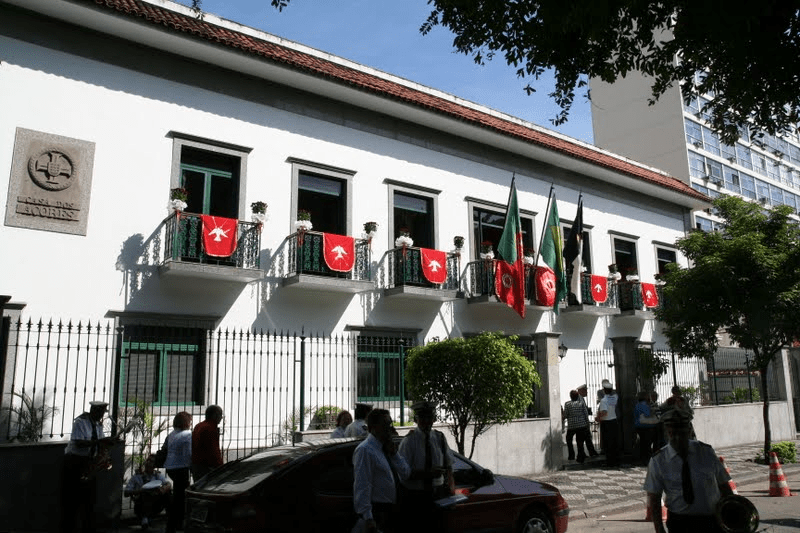
The first in Brazil and the second in the world is the Casa dos Açores in Rio de Janeiro, founded in 1952. Curiously, 25 years after the first, in Portugal, and 25 years before the third, in the United States. Its creation was driven by the important Portuguese writer Vitorino Nemésio, a native of Praia da Vitória, and its first Board of Directors was chaired by the Commander of the Portuguese Republic João Soares de Medeiros, who was born in the city Angra do Heroísmo. Its current president is João Leonardo Soares, a young son of emigrants from Terceira.
Twenty-eight years after Rio de Janeiro, in 1980, the Casa dos Açores de São Paulo was created, the second in Brazil, in Vila Carrão. In the new association, as in the state in general, the majority of Azoreans come from the island of São Miguel. This House was born by the grace of the Holy Spirit since it was organized after a festival held in praise of the Divine, and its first president was an emigrant from São Miguel, Comendador Manuel de Medeiros. Five decades later, the Feast of the Divine is still the highlight of its annual calendar, along with Cultural Week, but CASP also has a folklore group, founded in 1981, as well as the more recent choral group “Cantares do Basalto”. Its board is chaired by Marcelo Guerra, a lawyer from São Paulo.
Contemporary to São Paulo is the Casa dos Açores da Bahia. It was also founded in 1980, in the city of Salvador, and is mostly made up of Azoreans from the small island of Graciosa. Rather than bringing together people from the Azores, this House was created so that the descendants of Azoreans could get to know each other and socialize around their identity references. That’s why it holds regular get-togethers in its garden villa, on the pretext of a rump steak, codfish, or octopus, and why it organizes an annual festival in praise of the Divine Holy Spirit. Its co-founder and current president is the Graciosa businessman Orlando Souza da Silva.
But the worldwide network of Casas dos Açores has also reached southern Brazil. In 1999, the Casa dos Açores de Santa Catarina was founded, first chaired by Francisco do Vale Pereira and now headed by Sérgio Luiz Ferreira.
It works closely with the Center for Azorean Studies at the Federal University of Santa Catarina. It has temporary headquarters in a room provided by the state government in Florianópolis but is preparing to set up permanently in the Azorean environment of Santo António de Lisboa. It has been running the Raízes Açorianas Folkloric Group since 2010 and takes part in the annual organization of “Açor – Festa da Cultura Açoriana de Santa Catarina”, which has been touring the Azorean towns on the coast of Santa Catarina for three decades.
Four years after Santa Catarina, in 2003, the Casa dos Açores of the state of Rio Grande do Sul was born. Régis Albino Marques Gomes was its first and longest-serving president, until 2015. He was succeeded by Célia Silva Jachemet, Carla Marques Gomes, and now Viviane Peixoto Hunter. But the house of the Casa also has its history. Casarão dos Fonseca is a building with unique characteristics – probably the most Azorean of the Houses of the Azores – which was built by Manuel Fonseca, the son of Azoreans, in 1877. The group behind the future Casa dos Açores, led by Régis Gomes, restored the ruined building in the 1990s and turned it into a listed building by municipal law, now recognized as the architectural and cultural heritage of the Municipality of Gravataí. It is in this “Azorean cultural embassy” that the most representative institution of the Azores in the far south of Brazil promotes its intense activity, namely by promoting a group of gaucho dances and a folkloric ranch with Azorean roots.
At the other end of the country, we’ll find the second most recent House of the Azores in Brazil, but historically it should have been the first. The House of the Azores of Maranhão was founded in 2019, on the occasion of the congress commemorating the fourth centenary of the first Azorean emigration to Brazilian lands. It is formally based in the state capital of São Luís do Maranhão and is preparing to move in with its own headquarters. Its co-founder and first president was Paulo Matos, the current honorary president, who in the meantime has taken on responsibilities as Secretary of Tourism for the State Government.
The “youngest” of these Brazilian associations is the Casa dos Açores do Espírito Santo, based in the municipality of Apiacá, in the heart of the Itabapoana Valley, close to the border with the state of Rio de Janeiro. It was founded and is chaired by Azorean descendant Nino Moreira Seródio. Its official inauguration took place on July 25, 2022, curiously enough, immediately after the official commemoration of the 70th anniversary of the pioneering and neighboring Casa dos Açores do Rio de Janeiro.
_____
José Andrade is the Regional Director for Communities in the Government of the Autonomous Region of the Azores
This writing is based on a segment from his book Transatlântico – As Migrações nos Açores (2023 )
Translated by Diniz Borges, for Filamentos (arts and letters in the Azorean Diaspora)

 Filamentos (artes e letras)